Advertisements
Advertisements
Question
Read the following passage and do the activities:
A1. Fill in the blanks: (2)
- ______ percent of our daily communication is non-verbal.
- Eye contact is another type of ______ communication.
- Frequent blinking is a sign of the person feeling ______.
- One can readily detect _______.
|
According to some experts, a staggering 93 percent of our daily communication is non-verbal. Facial expressions are easy to decipher. One can readily detect happiness, sadness, anger. Physicians can tell a patient is doing well (or not) by looking at his/her face. Eye contact is another type of non-verbal communication, which can tell a lot about the other person. The eyes convey a range of emotions-happiness, sadness, boredom, surprise, confidence .......... even emotional interest. Staring at someone's forehead may intimidate the recipient, staring at the mouth is sometimes interpretated as a sign of emotional interest. In fact, staring into someone's eyes is a sign of lying, and so is looking away. In certain cultures, lack of eye contact is taken as a sign of respect. If body language is to be defined, it is a combination of facial expression, gestures, eye contact, body movements and posture and voice. Frequent blinking is a sign of the person feeling distressed or uncomfortable. If the pupils are dilated, it ofter indicates interest, even emotional interest. The lips also reflect our body language, and lip biting indicates worry and/or anxiety; tightening of the lips may be an indication of disapproval. Slightly turned-up lips indicate happiness and slightly turned-down lips indicate sadness. |
A2.

A3. Find the antonyms of: (2)
- verbal × ______
- entertaining × ______
- sender × ______
- comfortable × ______
A4. Do as Directed: (2)
- The eyes convey a range of emotions. (Frame a 'Wh' question in order to get the underlined part as answer).
- Physicians can tell about a patient's wellness. (Rewrite using 'able to')
A5. Personal Response: (2)
Non-verbal communication plays an important role in our daily life. Comment.
Advertisements
Solution
A1.
- 93 percent of our daily communication is non-verbal.
- Eye contact is another type of non-verbal communication.
- Frequent blinking is a sign of the person feeling distressed or uncomfortable.
- One can readily detect happiness, sadness, anger.
A2.
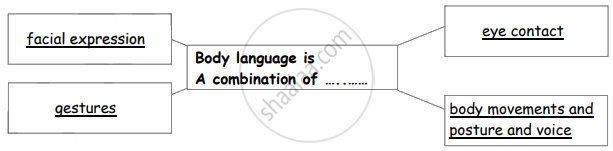
A3.
- verbal × non-verbal
- entertaining × boredom
- sender × recipient
- comfortable × uncomfortable
A4.
- What do the eyes convey?
- Physicians are able to tell about a patient’s wellness.
A5. In our daily interactions, using body language, gestures, eye contact, and facial expressions to communicate a message enhances verbal communication. When we encounter people from other cultures, it helps us communicate. One may comprehend and create stronger connections at home and at business by understanding non-verbal cues and picking up on them.
APPEARS IN
RELATED QUESTIONS
B1. Find reasons
(i) The effect of receding forest …………………………………. .
(ii) The number of animals is reduced because ………………………. .
(iii) Elephants entered the city because…………………… .
(iv) Elephants lived a wary life …………………….. .
On the left bank of the Ganga, where it emerges from the Himalayan foothills, there is a long stretch of heavy forest. There are villages on the fringe of the forest, inhabited by bamboo cutters and farmers, but there are few signs of commerce or pilgrimage. Hunters, however, have found the area an ideal hunting ground during the last seventy years, and as a result, the animals are not as numerous as they used to be. The trees, too, have been disappearing slowly; and, as the forest recedes, the animals lose their food and shelter and move further on into the foothills. Slowly, they are being denied the right to live
Only the elephants can cross the river. And two years ago, when a large area of the forest was cleared to make way for a refugee resettlement camp, a herd of elephants - finding their favourite food, the green shoots of the bamboo, in short supply - waded across the river. They crashed through the suburbs of Haridwar, knocked down a factory wall, pulled down several tin roofs, held up a train, and left a trail of devastation in their wake until they found a new home in a new forest which was still untouched. Here, they settled down to a new life but an unsettled, wary life. They did not know when men would appear again, with tractors,bulldozers and dynamite.
B2. Find out
Mention four things the elephants did when they found shortage of food:
(i)………………
(ii)………
(iii) …………
(iv) ………….
B3.Phrases
Make meaningful sentences by selecting any two of the following phrases:
(i) to make way for
(ii) in short
(iii) on the fringe of.
B4. Language study
Select the proper alternative to make the correct voice:
(i) Hunters have found an ideal hunting ground.
-An ideal hunting ground ........found by hunters. (had been, has been, was)
(ii) They are being denied the right to live.
- The people ........them the right to live. (are denying, were denying, denying)
B5.Personal response
What would be your contribution to protect the natural habitat of animals?
How important was the presence of Miss Anne Sullivan in Helen’s life?
Answer any four of the following in 30 − 40 words each :
(a) What does Saheb look for in the garbage dumps?
(b) How was Gandhi treated at Rajendra Prasad's house?
(c) Why does one feel 'a sudden strangeness' on counting to twelve and keeping quiet?
(d) Mention any two things which cause pain and suffering. (A Thing of Beauty)
(e) When was the Tiger King in danger of losing his throne?
(f) What role did the American professor play in bringing Hana and Sadao together?
Read the passage and complete the activities given below
B1 Complete the table :
A few facts about the Mehendi rituals during marriage ceremonies are given below :
Write them into appropriate columns :
(i) A simple family affair.
(ii) Song and dance performances accompanied by lavish food and entertainment.
(iii) Creative family members, apply Mehendi to the bride.
(iv) Beauticians are appointed to apply Mehendi to the bride.
Fill in the table as :
| Yesteryears | Present times |
| (i) | (i) |
| (ii) | (ii) |
Mehendi enjoys special attention during the wedding. In India, the day before the wedding is devoted exclusively to the elaborate ritual of applying Mehendi on the hands and feet of the bride. This practice is followed in Arab countries as well, except that it is held a few days prior to the wedding day. Songs are woven around the healing properties and lucky omens associated with mehndi are sung by the bride’s family and friends. An age-old belief handed down to generations lays great emphasis on the color of the bride’s Mehendi – a darker color suggests bountiful love and affection from the future in-laws and husband, and for this reason, brides take the pain to ensure that only the best quality henna is used for her wedding day.
The ritual of adorning the bride with henna is a sacred one and in some communities requires the initiation by the mother-in-law. A popular game during marriage function is the search for their names, by the bride and groom hidden within the elaborate pattern on the bride’s hands.
In certain parts of India, the bridegroom has his hands decorated with henna. The Mehendi function during marriages has evolved from simple family affairs of yesteryears to elaborate events of today. A lavish spread of food and entertainment in the form of song and dance performances have transformed it from a small function to a gala prelude. In earlier days, the task of applying Mehendi on the bride was the sole prerogative of creative family members. The demand for intricate and different style now, sees this job outsourced to beauticians skilled in this art. Beauty salons charge according to the style and complexity of pattern desired by the clients.
B2 What is the age-old belief related to the bride’s Mehendi color and its significance?
B3 Find the words :
Find the words from the passage :
| Noun | Verd | Adjectives |
| (i) attention | attend | _______________ |
| (ii) creation | _________________ | creative |
A lot of money is spent nowadays on marriage ceremonies. What is your opinion about it?
Notice these expressions in the text. Infer their meaning from the context.
-
honing our seafaring skills
-
ominous silence
-
Mayday calls
-
pinpricks in the vast ocean
-
a tousled head
Tick the item that is closest in meaning to the following phrase.
to meet one's match
Locate expressions in the text reflect the Indian idiom, for example, the pride of the generations of his ancestors.
What were the voices that Paul heard? Did they lead him to success in the real sense?
How does the poet bring out the immortality of the bird?
The poem has a literal level and a figurative level. Why has the poet chosen 'tigers' and 'sheep' to convey his message?
What facet of political life does the behaviour of Ajamil illustrate?
Divide the class into 5 groups. Each group can prepare a decorative chart/poster using an epigrammatic line from the poem. You may use calligraphy/painting/or Paint program on a computer. (With permission, put up these charts in your school.)
Make groups and discuss the following:
Name a few scientists/explorers/social reformers/inventors/discoverers, who spent most of their lives to find solutions to some major problems/setbacks, that mankind faced.
Correct the following statement.
The real ivy leaf did not fall off at all.
The ______ bees make honey from nectar.
Fill in the gap, choosing a word from the bracket to make an appropriate comparison.
(tall / quiet / humble / merry / busy / slippery / fast / sly / slow / big)
as ______ as a deer
Shylock was not at all generous.
An activity:
Speak fast, think faster! Form groups of 4-6. Discuss each of the following topics. Then each person in the group should choose a topic and speak about it for one minute. Try to say as many sentences as you can in that time
What is not likely to happen or will never happen...
‘It won’t rain in the classroom... I won’t ever see a live dinosaur... The sun will never set in the east...’ etc.
Read aloud a paragraph of your choice from the passage.
What characteristics of Mr. Nobody do we learn about from this poem?
Gather information about your favourite great historical personality. You may use the internet. You may also gather photographs, pictures, etc. Prepare a collage using the pictures, inspirational quotes, and a brief description of the person’s importance. Hold an exhibition of your collages in the classroom.
Name the following.
Pounced on Dhyan Chand and hurt him.
Tell any one of the stories orally imagining you are Gulliver.
What does the poet want to know from the lark?
Make a collection of Rangoli motifs and patterns.
Write about each motif or pattern in your own words -
it could just be a label or a description or some information or comment.
Complete the following table with information from the anecdote about Mr. Scotti’s short trip.
| Name | Nicholas Scotti |
| Occupation | |
| Reason for his trip | |
| Means of transport | |
| Destination |
Find out the rhyme scheme employed in the fourth stanza.
What qualities of Mr. Phileas Fogg are highlighted in this extract? Support your answer with suitable examples.
When should we have courage?
How does the coconut tree grow?
Read the lines and answer the question given below.
Each a glimpse and gone forever;
a. What is ‘each’ over here? Why is it gone forever?
How should one react to adversity?
It ploughs soil before _________.
Vicky decided to ______ the robot at the end.
Match the words with the pictures.
| Robinson | ![]() |
| cannibals | ![]() |
| Friday | ![]() |
| footprint | ![]() |
Why did he grow crops?
Who guessed the location of the real necklace?
Read the advertisement and answer the question given below.

What is the advertisement about?
Muthu collected ______ from every house.
What was his dream ?


