Advertisements
Advertisements
प्रश्न
Read the following passage and do the activities:
A1. Fill in the blanks: (2)
- ______ percent of our daily communication is non-verbal.
- Eye contact is another type of ______ communication.
- Frequent blinking is a sign of the person feeling ______.
- One can readily detect _______.
|
According to some experts, a staggering 93 percent of our daily communication is non-verbal. Facial expressions are easy to decipher. One can readily detect happiness, sadness, anger. Physicians can tell a patient is doing well (or not) by looking at his/her face. Eye contact is another type of non-verbal communication, which can tell a lot about the other person. The eyes convey a range of emotions-happiness, sadness, boredom, surprise, confidence .......... even emotional interest. Staring at someone's forehead may intimidate the recipient, staring at the mouth is sometimes interpretated as a sign of emotional interest. In fact, staring into someone's eyes is a sign of lying, and so is looking away. In certain cultures, lack of eye contact is taken as a sign of respect. If body language is to be defined, it is a combination of facial expression, gestures, eye contact, body movements and posture and voice. Frequent blinking is a sign of the person feeling distressed or uncomfortable. If the pupils are dilated, it ofter indicates interest, even emotional interest. The lips also reflect our body language, and lip biting indicates worry and/or anxiety; tightening of the lips may be an indication of disapproval. Slightly turned-up lips indicate happiness and slightly turned-down lips indicate sadness. |
A2.

A3. Find the antonyms of: (2)
- verbal × ______
- entertaining × ______
- sender × ______
- comfortable × ______
A4. Do as Directed: (2)
- The eyes convey a range of emotions. (Frame a 'Wh' question in order to get the underlined part as answer).
- Physicians can tell about a patient's wellness. (Rewrite using 'able to')
A5. Personal Response: (2)
Non-verbal communication plays an important role in our daily life. Comment.
Advertisements
उत्तर
A1.
- 93 percent of our daily communication is non-verbal.
- Eye contact is another type of non-verbal communication.
- Frequent blinking is a sign of the person feeling distressed or uncomfortable.
- One can readily detect happiness, sadness, anger.
A2.
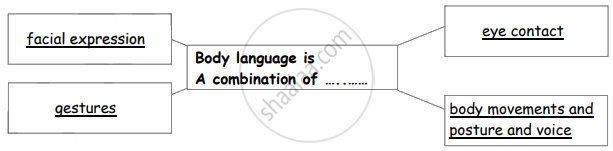
A3.
- verbal × non-verbal
- entertaining × boredom
- sender × recipient
- comfortable × uncomfortable
A4.
- What do the eyes convey?
- Physicians are able to tell about a patient’s wellness.
A5. In our daily interactions, using body language, gestures, eye contact, and facial expressions to communicate a message enhances verbal communication. When we encounter people from other cultures, it helps us communicate. One may comprehend and create stronger connections at home and at business by understanding non-verbal cues and picking up on them.
APPEARS IN
संबंधित प्रश्न
Complete the flow-chart :

Discuss the following in pairs
Empathy and understanding are going out of modern society. The individual experiences intense alienation from the society around him or her.
Look at the following set of words and mention what is common to them both in form and meaning.
|
Snuffle |
snort |
sniffle |
snore |
Why is the quality of pity earth-bound while the other two passions are elevating?
Correct the following statement.
The real ivy leaf did not fall off at all.
Read the lesson and name the following.
The Father of modern neurosurgery ______
Read the lesson and name the following.
The world’s most advanced surgical robot ______
The ______ bees make honey from nectar.
Write about how your family supports you to go to school.
Form groups and discuss the following question:
Why are the clothes compared to living things?
Explain the following statement with reference to the context.
And it's by no means the small sacrifice the town will have to make.
Present the information in the box ‘My Teacher says’. Translate the box ‘My Teacher says’ into your mother tongue.
Form pairs. Complete the following table through discussions.
| Occupation | Necessary Qualities | Reasons |
| Student | ||
| Teacher | ||
| Housewife | ||
| Sportsman | ||
| Artist | ||
| Singer | ||
| Author | ||
| Umpire | ||
| Actor | ||
| Scientist |
Find two examples of the word made by using the following suffix.
-ness
Use the following expressions in your own sentences:
- We all agree that
- It is he/she who
- Don’t you see
- None of us
Read the passage and name the following.
He led the defense of Troy for nine years.
Think and answer:
Why are the sights said to ‘fly’?
Present these points in the form of a review, and give it a suitable title.
What is direct and indirect.
Describe the following with the help of the (The Twelve Months) story.
Summer
What are the complaints of the animals?
How did Helen Keller help other blind people?
Find a word that has a similar meaning.
Whole
Who were on the ship? How were they related to Prospero?
Read the story again and write how these character reacted in these situation:
Zigzag hardly never sleeps.
Somu………………………
Dr.Krishnan……………………….
How did Hamid’s friends show that they enjoyed eating the sweets?
What do the people do when the festival of Music is celebrated?
Why does Alice drink from the bottle that says ‘DRINK ME’ and why does she eat from the cake that says ‘EAT ME’?
Fill in the table
| Problems Faced By Mr. Fogg And His Team | Solution |
| The train stopped in the middle of the forest. | |
| They couldn’t hire the elephant. | |
| They were in need of an elephant driver. |
What are the characteristics of a courageous man?
Identify the speaker/character.
Wake up, child.
What does the peepul do?
The girl admitted to her brother that she was badly frightened.
The villagers, built a _______ on his memory.
Where is the key?
Why did Kani run to the kitchen?
Why did Jana have a nightmare?
Did the girl buy a picture book?
Write the compound words from the picture.
![]() |
![]() |
| ______ | |
Being a bachelor, the stranger had no patience with children.


