Advertisements
Advertisements
Question
What would you say are 'the finer growths' that the story supports in a novel?
Advertisements
Solution
The finer growths that a story supports in a novel are the art of characterisation, the narrative techniques and thematic and plot structures. The story is the backbone, the basic structure without which the rest of the technicalities and structures are meaningless. It is the story line that determines the other features in a novel. The story contains the DNA of the novel.
APPEARS IN
RELATED QUESTIONS
A1. True or False
State whether the following statements are true or false:
(i) A new research suggests that eating healthy food and getting proper sleep helps children to succeed in school.
(ii) Kids in the age group of 6-12 years should get an average sleep of little less than 7 hours.
(iii) Kids should start their day with yogurt, fruits and veggies.
(iv) Children should have consistent sleeping habit.
A new research suggests that eating healthy food and getting proper sleep can help children succeed in school. According to research, when kids go to school without eating breakfast, their cognitive function can be affected.
According to study, kids should start the day with fruits, proteins and whole grains and they should avoid sugary cereals because they cause a sugar high. If the kids do need to eat something prior to dinner, parents should offer healthy choices like yogurt, fruits and veggies or baked chips. Children have also been advised to drink water instead of soda as-it lacks nutritional value. Moreover, research suggests that children need a good night's sleep for theiroverall school performance. It is said that. lack of sleep can lead to problems with attention and memory in the classroom, affect impulse control and mood regulation lead to.
anxiety and even depression.
While kids aged 6-12 years should get nine hours sleep nightly, adolescents from the age of 13 to 18 years should get an average sleep of little more than seven hours per night. However, the research suggests that catching up on lost sleep on the weekend can make matters worse and recommended a consistent bedtime seven days a week.
A2. Find
Fill in the blocks with the following given in the passage:
(i) Two things to be avoided by children:
(ii) Lack of sleep due to mood regulation leads to:
A3. Select
Select the correct word from the brackets and complete the statements given below:
(anxiety, consistent, impulse, attention)
(i) Last minutes study causes......... to the students.
(ii) Stress affects the.............. for a quick action.
(iii) Saina has shown ........... improvement in her performance.
(iv) Students should pay ..............in class.
A4. Language study
(i) Pick out anyone sentence from the passage where a modal auxiliary indicating advice is used.
(ii) Pick out the correct conjunctions from the given sentences:
(a) Kids should avoid sugary cereals because they cause a sugar high.
(b) It is said that lack of sleep can lead to problems.
A5. Personal response
We should eat healthy food. Explain..
Write a character sketch of Mr. Barrymore in about 125 words
The black kite may start a fire because
Dolly Winthrop has a very noble nature. Comment.
Give reasons for the following statement.
The author thought that his positive thinking strategy worked well after all.
This short story revolves around a single important event. Discuss how the narrative is woven around this central fact.
What does the phrase ‘as if he were on needles’ mean? Can you think of another phrase with a similar meaning substituting the word ‘needles’?
Examine the communication channels in the story between Basset and Paul's uncle.
Read the following statement and mark those that apply to you.
I make friends easily.
Read the story and complete the following.
When Revathi played her favourite raga, the plants began to move because, ____________.
There are different types of short stories. Use a dictionary/internet and find out what each of the following types refers to.
- fable:
- anecdote:
- fairy tale:
- parable:
- tragedy:
- humorous story:
- detective story:
- myth:
The writer of the story is William Blake.
Fibreglass kites led to creating power - driven aeroplanes.
The drone is given a death sentence because he ______.
Apart from the children, no other human beings are mentioned in the poem. However, many natural elements are shown to act like persons. Name them and also write what they do.
Fill in the gap, choosing a word from the bracket to make an appropriate comparison.
(tall / quiet / humble / merry / busy / slippery / fast / sly / slow / big)
as ______ as a bee
Draw a character sketch of Oberon as an enemy of his wife but a friend of the lovers.
Draw a diagram to show a volcanic eruption from its description given in this passage. Label the diagram. Show the following in it :
Volcano; earth’s crust; crack in the earth’s crust; hot molten rock; red, hot lava; smoke; ash; burning chunks of rock.
Explain the following statement with reference to the context.
You ought to be ashamed of yourself.
Discuss the following question after you have seen a presentation of the ‘ad’.
What would happen if you never ate fruits and vegetables?
Form groups and hold debates on the following topic. Make bulleted lists of points in favour of the topic (pros) and those against it (cons). (3-6 points each).
Boys cannot cook or do any housework.
Complete the following sentence using your idea:
I can ______.
What does the poet pray for? Why?
If you saw someone abusing an animal, what would you do? Write about it in 5 lines.
Find four words ending with ‘-ous’ from the story.
Can you add three more words ending with ‘-ous’ to this list?
Write about what you would like to do if ‘Time’ was your friend.
Read the following sentence aloud. Write who said it and to whom.
“I would rather not go to the party.”
Form groups. Discuss the first two paragraphs. Try to present their content in the form of a series of conversations among the volunteers and the villagers.
There were no human settlements on the moon.
Write the rhyme scheme of the poem (Autumn).
List the names of body parts used in the passage.
Read the lines of the following poem. Guess and fill in suitable words to make the lines rhyme -
Golden Glow
Soon after dawn, rises the _________________.
It wakes and enlivens every _________________.
It scares away the long, dark _________________.
The shining stars go out of _________________.
From tree to tree birds flit and, _________________.
Searching for food, with a sharp _________________.
The buds that open now show their, _________________
As flowers, they dance with beauty and _________________.
The hill slope wears a grassy green,_________________
The curved sparkling river, it's gold _________________.
The cock then crows to give a loud, _________________
Come on! wake up, folks! One and _________________.
I, then wake up, ‘Good Morning’ to,_________________
Let’s all look forward to a golden _________________.
Write out a few things that you would really miss about your home if you were to stay away from it for long.
What message does the poet wish to convey through this narrative poem, ‘Tansen’?
Why is Great January annoyed with Holena and her mother? Does he help them?
Write what the poet is doing.
Does the poet like the experience?
Write the line which tells us about it.
How did Helen Keller help other blind people?
What were Chulongs plans for the bird?
With their treasure, the boys would buy ______ in Eidgah.
What values did the child learn?
Two scary events from this section are listed here. Write the events that take place in between in the correct order.
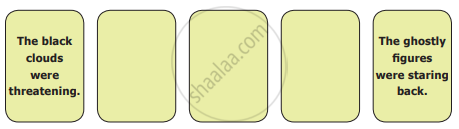
He always had lunch with his family.
Read the line and answer the question.
And all I ask is a merry yarn from a laughing fellow rover.
What kind of human company does the poet want?
The terrorists asked Neerja to collect the passports of the passengers because ______.
Amuthan locked the door behind him.
Be humble like a _____.
What is our core?
The bird-catcher let the pigeon jump into the fire.
Why did she pick up her pace?
Answer the following yes or no question.
Did all visit the waterfall?
Robinson sailed England after ______ years.
Find and write the clues.
Clue for the load on the camel ______
Who brought us to this world?
Ani valued honesty.
Choose the correct one.
Elephant

Keep moving though your progress is ______.
What was the truth finally learned by Chris?
Write about the places where the poet wants us to run.
Who said – “Oh, my ears and whiskers? How late it’s getting!”
Read the poem.
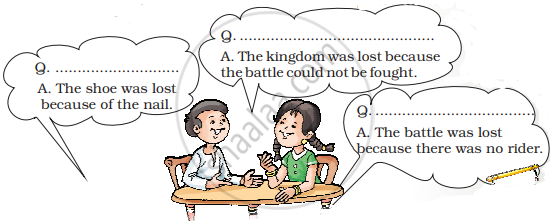
For Want of a Nail
For want of a nail, the shoe was lost,
For want of a shoe the horse was lost,
For want of a horse, the rider was lost,
For want of a rider, the battle was lost,
For want of a battle, the kingdom was lost,
And all for the want of a horseshoe nail!
[traditional rhyme]
Now form questions for the answers given in the speech bubbles.