Advertisements
Advertisements
Question
Although Paul's mother liked to be rich she did not approve of betting on horses.
Advertisements
Solution
Paul's mother foolishly wished to be rich and yet was not able to achieve or materialise her desire. She blamed it on her husband for being unlucky. However, she was one of those humans who do not tread as per their cloth. She was used to a lavish lifestyle and blamed her husband and misfortune for low income. Yet there was one thing appreciable about her that she was against gambling. She did remark in her conversation with her brother that she had seen her family members pursuing it and how it led to their fall. She advised her son to not indulge in it and made him promise that he will not think about racing horses anymore.
APPEARS IN
RELATED QUESTIONS
He asked. Boy, did he ask! First he asked me for a chance, then he asked nearly all the people he came across if they wanted to buy a telephone system from him. And his asking paid off. As he likes to put it, “Even a blind hog finds an acorn every once in a while.” That simply means that if you ask enough, eventually someone will say ‘yes’.
He cared. He cared about me and his customers. He discovered that when he cared more about taking care of his customers than he cared about taking care of himself, it wasn’t long before he didn’t have to worry about taking care of himself.
Most of all, Cowboy started every day as a winner! He hit the front door expecting something good to happen. He believed that things were going to go his way regardless of what happened. He had no expectation of failure, only an expectation of success. And I’ve found that when you expect success and take action on that expectation, you almost always get success.
Cowboy has made millions of dollars. He has also lost it all, only to get it all back again. In his life as in mine, it has been that once you know and practice the principles of success, they will work for you again and again.
He can also be an inspiration to you. He is proof that it’s not environment or education or technical skills and ability that make you success. He proves that it takes more: it takes the principles we so often overlook or take for granted. These are the principles of that Ya Gotta’s for success.
Question:
(1) What was the cowboy’s motto?
(2) What did the cowboy learn after he lost millions of dollars?
(3) Why did the cowboy firmly believe that asking would pay off?
(4) When you expect success and take action on that expectation you almost always succeed. [Name the part of speech of the underlined words]
(5)
(a) He cared about me and his customers. [Rewrite using ‘not only ……………….but also’’]
(b) Cowboy has made millions of dollars [Add a question tag]
(6) In what way is the cowboy a source of inspiration for you?
Answer any two of the following questions in about 30‒40 words:
(a) How does Kamala Das try to put away the thoughts of her ageing mother?
(b) Which is the exotic moment that the poet refers to in 'Keeping Quiet'?
(c) What are the difficulties that aunt Jennifer faced in her life?
Attempt the following in 150-200 words.
Write a character sketch of Bishop Brooks as he appears in Helen Keller's − The Story of My Life.
Read the extract given below and answer the questions that follow:
Wear skins peeped through by bones and spectacles of steel
With mended glass, life bottle bits on stones.
(b) Explain: 'slag heap'.
(c) What future awaits these children?
(d) Name the figure of speech used in the third line.
After the convocation, Mrs. Mini, Rahul’s mother and Rahul have a conversation. Write the conversation and present it to the class in groups of three.
Read the following passage and do the activities:
B1 Match:
Match the areas given in Column ‘A’ with the description of Mehendi design given in Column ‘B’:
| 'A' | 'B" | ||
| (i) | North African | (a) | A mix of Indo-Pakistani and Arabic design |
| (ii) | Indian | (b) | Delicate loops and curves, paisleys, teardrops |
| (iii) | Arabic | (c) | Geometrical images |
| (iv) | South Asian | (d) | Local textiles, paintings, and architecture |
Henna comes from the leaves of the plant Lawsonia inertias. The plant grows in hot and dry climes and is native to North Africa, the Indian subcontinent and the Middle East. The leaves of the plant are dried and crushed to powder. Various additives such as coffee decoction, tea, lime juice, Mehendi and eucalyptus oil are mixed with the henna powder to increase the potency of the dry, this also helps to bind the powder to a paste-like consistency. The mixture is applied through cones in intricate patterns depending on the region of use.
Album of Patterns
Four major styles can be found in the vast dictionary of Mehendi designs. Earlier the application was restricted to hand and feet, but the adoption of Mehendi by different cultures throughout the world has seen experimentation on different body parts including the neck naval and back.
North African patterns rely on geometrical images to trace the shape of hands and feet, Arabic designs borrow heavily from local textiles, paintings, and architecture. These are more spaced out, to allow the design to stand out boldly from the skin parts left untouched by henna. The Indian style comprises of delicate loops and curves, paisleys, teardrops and flowers that give a dainty filigreed glow-like effect. Though intricate patterning is the name of the game today, this trend took off in India only during the 20th century. The patterns preferred by the South Asian countries are mixed with Indo-Pakistani and Arabic design schemes. Chinese and Celtic symbols now find a place in the vast repertoire of Mehendi designs as well.
B2 Complete:
Complete the following and write:
(i) The procedure before applying henna _______
(ii) The reasons for using additives _______
(iii) The suitable climatic conditions for the henna plant _______
(iv) Mehendi is used on _______
B3 Find words:
Look at the following description and find out proper words from the passage and write:
(i) Existing naturally in the place : - n _______
(ii) Consist of something: - c _______
(iii) Delicate decoration made from gold, silver and copper wire: - f _______
(iv) Substance that is added in small quantity : - a _______
B4 Language study:
Fill in the blanks with suitable subordinators given in the box:
| as well as, so that, however, which |
(i) The mixture is applied through cones in intricate patterns _______ depend on the region of use.
(ii) The intricate pattern is the name of the game of today _______, this trend took off in India, recently.
(iii) North African pattern relies on geometrical images ______ they can trace the shape of hands and feet.
(iv) The patterns preferred by the South Asian countries are mixed with Indo-Pakistani _______ Arabic design schemes.
B5 Personal Response:
Which Mehendi design do you like? Why?
Answer the following question in 200-250 words:
What is the main theme of 'The Diary of a Young Girl'?
What has not changed over the years? Does this suggest something to you?
The poet’s mother laughed at the snapshot. What did this laugh indicate?
What kind of a person do you think the narrator is?
How does 'A Munda song' show that the perspective of the tribal mind towards the girl child is different from that of [other ] mainstream communities?
How does the nightingale's song plunge the poet into a state of ecstasy?
The poem is a satire against the present political class. How effectively does it convey the anger and anguish of the common man trapped in the system?
Answer in your own words.
What are the provisions in the Declaration of the United Nations, to ensure the equality of men and women?
Sue and Johnsy were very close friends.
Discuss in groups and share with one another.
When you go for a picnic, what and how do you enjoy?
Answer the following question in short.
Explain the significance of the title.
List all the words specially used in the game of Kabaddi.
Explain the term plot.
Complete the following using your own idea:
His head was too big to ______.
Guess the meaning of the following from the context.
Dawn wakes the starling.
Visit a library:
Find and read stories and poems written by Edith Nesbit.
Write one line about the following with the help of the poem.
wind in the autumn evening
Write about the sights you may see from a bus or an airplane. You may write it in the form of a short poem.
Gather more information about the following from your Science textbook, the internet, and other sources.
Gravitational force
Think of a play/skit which you have seen enacted on the stage and which has impressed you. Write the following details about it.
| Name of the play/skit: | ______________ |
| Important characters: | ______________ |
| Any famous actors/actresses: | ______________ |
| Theme: | ______________ |
| Climax: | ______________ |
| Ending: | ______________ |
| Use of lights and special effects if any: | ______________ |
| Use of background music and sound effects if any: | ______________ |
| Use of sets: | ______________ |
| The costumes, make up, etc. of the characters: | ______________ |
| How well the actors present the play and behave on the stage: | ______________ |
| Your own opinion about the play: | ______________ |
Read the poem again. Does it have a uniform rhyme scheme throughout?
Write down the rhyme scheme of every stanza separately.
- 1st stanza ______
- 2nd stanza ______
- 3rd stanza ______
- 4th stanza ______.
Write in your own words.
What makes the poet remember his mother?
Read the word. Write the words that combine to make it.
snowwhite
List and say whether the following statement agrees with the passage or not.
You should try to talk most of the time whenever there is a discussion.
Find out the difference between the fingerspelling method, sign language and Braille.
Read the following passage and answer the questions that follow.
BUNGEE-JUMPING
Bungee jumping is an activity that involves jumping from a tall structure while connected to a long elastic cord. The tall structure is usually a fixed object, such as a building, bridge or crane; but it is also possible to jump from a movable object, such as a hot-air-balloon or helicopter, that has the ability to hover above the ground. The thrill comes from the freefalling and the rebound. When the person jumps, the cord stretches, and the jumper flies upwards again as the cord recoils and continues to oscillate up and down until all the kinetic energy is dissipated.
Jumping Heights, located in Mohan Chatti village, in Rishikesh has been rated as one of the most preferred bungee jumping destinations in India at a height of 83 meters. It is the only place in India where bungee jumping can be done from a fixed platform. This is also India’s only fixed platform Bungee- performed from a professional cantilever, to separate it from entertainment parks, and create instead, an extreme adventure zone. The Bungee has been designed by David Allardice of New Zealand.
The Cantilever platform is built over a rocky cliff over-looking the river Hall, a tributary of River Ganges. Bungee-ing amidst the vastness of nature lends the experience an absolutely breathtaking quality. Jumping heights is well known for its safety measures and experienced staff. It costs around Rs 2500 per jump, a bit expensive, but totally worth the experience. The Bungee jumping experience has been set amidst the astoundingly stunning landscape of Rishikesh. To Bungee jump, one must be at least 12 years and should weigh between 40-110 kg.
Questions
- What is Bungee Jumping?
- Can Bungee be performed from a movable object? How?
- When do you think Bungee becomes thrilling?
- What is the experience when one falls off the platform?
- Where is the Bungee jumping point located in India?
- What is the minimum age to Bungee jump?
____________ raised a dreadful storm.
The second human being that Miranda saw on the island was __________________.
Identify the character or speaker.
Now pray tell me, sir, your reason for raising this sea-storm?
From the poem ‘The Grumble Family’ what kind of behavior does the poet want the readers to possess?
What did Aravind confess?
An Anagram is a word or a phrase formed by rearranging the letters of a different word or phrase, typically using all the original letters exactly once.
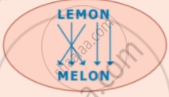
Now try to solve these anagrams
| 1. | ELBOW | |
| 2. | SECTION | |
| 3. | VIEWER | |
| 4. | RIPPLES | |
| 5. | NEEDLESS |
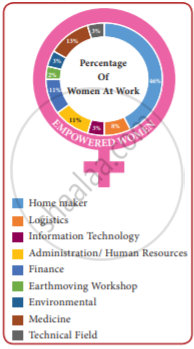
Read the data below and answer the following question.
Choose the correct answer.
What is the difference between the percentage of women working in logistics and Medicine?
‘ If only her son were there, it would have been a different kind of Eid’! What had happened to her son?
What do you think is going to happen next?
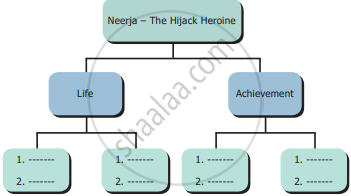
Write a summary based on the flow chart.
A tiny bird looked for a place to lay her eggs.
Did Santhosh enjoy his morning walk? How do you know?
Vicky’s father decided to change his son’s character.
Kaliyan worked in a ______.
The bird-catcher let the pigeon jump into the fire.
Choose what the elephant did.
Read the advertisement and answer the question given below.

What is the size of the screen?
Jana saw a _______ behind her.
We shouldn't ______ ever.
Why did the greedy merchant get angry?
Read the passage carefully and answer the following question.
What is the main idea of the story?
Why did Bala go to Chennai with his father?
What is the one thing you will try and improve after reading the story? How?
Which creatures wake up in the morning before the child does?
How did the boy enjoy the company of the tree?
How did the jackal become blue?
Read the passage and write a summary of it. Suggest a suitable title for the summary.
|
A sparrow is a small bird which is found throughout the world. There are many different species of sparrows. Sparrows are only about four to six inches in length. Many people appreciate their beautiful songs. Sparrows prefer to build their nests in low places-usually on the ground clumps of grass low trees and low bushes. In cities, they build their nests in building nooks or holes. They rarely build their nests in high places. They build their nests out of twigs grasses and plant fibers. Their nests are usually small and well-built structures. Female sparrows lay four to six eggs at a time. The eggs are white with reddish-brown spots. They hatch within eleven to fourteen days. Both the male and female parents care for the young. Insects are fed to the young after hatching. The large feet of the sparrows are used for scratching seeds. Adult sparrows mainly eat seeds. Sparrows can be found almost everywhere where there are humans. Many people throughout the world enjoy these delightful birds. The sparrows are some of the few birds that engage in dust bathing. Sparrows will first scratch a hole in the ground with their feet then lie in it and fling dirt or sand over their bodies with flicks of their wings. They will also bathe in water or in dry or melting snow. Water bathing is similar to dust bathing with the sparrow standing in shallow water and flicking water over its back with its wings also ducking its head under the water. Both activities are social with up to a hundred birds participating at once and are followed by preening and sometimes group singing. |
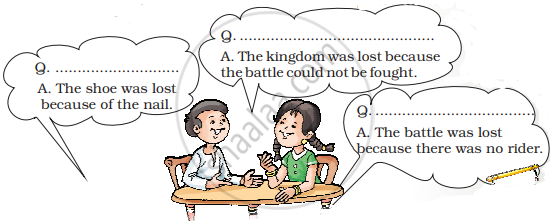
Read the poem.
For Want of a Nail
For want of a nail, the shoe was lost,
For want of a shoe the horse was lost,
For want of a horse, the rider was lost,
For want of a rider, the battle was lost,
For want of a battle, the kingdom was lost,
And all for the want of a horseshoe nail!
[traditional rhyme]
Now form questions for the answers given in the speech bubbles.