Advertisements
Advertisements
Question
How does Forster use the analogy of Scheherazade to establish his point ?
Advertisements
Solution
Forster uses the analogy of Scheherazade to establish his point that story telling with an element of surprise is the most important aspect in a novel. He refers to the story of Scheherazade to bring home the point that her survival depended on her ability to tell stories one after another to her husband king. Similarly, the art of novel is dependent on the story line and the surprise and suspense that a story creates. Without this element a novel cannot come into existence nor it can survive.
APPEARS IN
RELATED QUESTIONS
B1. What does the poet want us to do in the following situation?
(a) While struggling ………..
(b) While making money ………
(c) While dreaming ………………
(d) While losing …………..
It's doing your job the best you can,
And being just to your fellow man;
It's making money-but holding friends,
And being true to your aims and ends.
It's figuring how and learning why,
And looking forward and thinking high;
And dreaming a little and doing much,
It's keeping always in closest touch.
With what is finest in word and deed,
It's being through, yet making speed;
It's daring blithely the field of chance,
While making labour a brave romance.
It’s going onward despite defeat
And fighting staunchly, but keeping sweet;
It's struggling on with the will to win,
But taking loss with a cheerful grin.
B2. Achieving Success
Hints given by the poet to become successful are
(a) Doing your job the best
(b)
(c)
(d)
(e)
B3. Poetic Device
Select the appropriate rhyme scheme for the 3rd stanza.
(1) abab
(2) aabb
(3) aaba
How did Helen Keller enjoy her visit to the World fair? (120‒150 words)
Answer any four of the following questions in 30-40 words each:
(a) How could the peddler enter the forge without being noticed by the blacksmith?
(b) At Champaran what did the British landlords want from the sharecroppers?
(c) How does the poet show the futility of Aunt Jennifer's efforts?
(d) Stephen Spender in his poem, 'An elementary School Classroom in a Slum' paints a dismal picture of poverty. Comment.
(e) How did Evans have the last laugh at the Governor?
(f) How did the General plan to get rid of the American POW?
Answer the following in 120-150 words :
Within a few days of his arrival in Iping, people became suspicious of Griffin. Why?
To what end have humans used their superior intelligence ?
'The Address' is a story of human predicament that follows war. Comment
“One day back there in the good old days when I was nine and the world was full of every imaginable kind of magnificence, and life was still a delightful and mysterious dream. ” The story begins in a mood of nostalgia. Can you narrate some incident from your childhood that might make an interesting story?
Identify the common characteristics shared by tribal communities all over the world.
Explain the significance of the lines ‘I tie this Ridin creeper To fasten your soul to your body.’
The poem is a satire against the present political class. How effectively does it convey the anger and anguish of the common man trapped in the system?
complete the following sentence.
Ajoy reported about ________________.
Using a dictionary/internet note down the main difference between self-reliant and self-assured.
For preparing questions based on the poem, an overall understanding of the poem is a must. Discuss with your partner and prepare a set of five questions.
For example:
- What is the name of the bridge?
- ________________________________
- ________________________________
- ________________________________
- ________________________________
- ________________________________
Think and answer in your own words.
Which line proves that in our busy lives we do not even have a fraction of a second to enjoy nature’s beauty?
Visit a library: Find the stories of
- Mulla Nasiruddin
- Gopal Bhand and
- Tenali Raman. Share them in the class.
Find at least two things from the poem that show the following:
It is the early morning.
Form pairs. Make a list of as many games as you can. (At least 25) Then classify the games using the following criteria:
- Indoor and outdoor games.
- Games played with and without any equipment.
- Games which have one-to-one matches and those in which teams play against each other (Single-player or team)
- Games played mostly by children and games played by adult players.
- Shape and size of the court or field.
Use the following figures to show your classification.
Read aloud the account of how Flying Officer Nirmal Jit Singh Sekhon sacrificed his life to defend our country.
What two basic rules were followed in the Science Fair?
Write a short note on the following:
The ‘four signs’ that Prince Siddharth beheld.
How do you behave with your classmates? Write about your attitude and behaviour in the appropriate column.
Some actions:
- Ask others for help
- Refuse help
- Judge others by their appearance
- Judge others by their accent
| Always | Sometimes | Never |
| ____________ | ____________ | ____________ |
| ____________ | ____________ | ____________ |
| ____________ | ____________ | ____________ |
Using the information given in the passage, write a short note on the following in your mother tongue.
Gond art
Mention the various places that the brook flows past.
How does the following character in the story live up to their name? Provide points from the story.
Taffimai Metallumai
There are many popular lines like:-
- ‘Life is a game - play it well’.
- ‘Life is a journey - keep going ahead’.
Discuss and write down a few such metaphorical lines about ‘life’. You can make them up yourselves.
- ____________________________
- ____________________________
- ____________________________
- ____________________________
- ____________________________
Name the following.
Not comfortable with the wet ground.
Name the following.
Pounced on Dhyan Chand and hurt him.
How was Gulliver tied down on the seashore?
Find a word that has a similar meaning.
unfair
Read the following line from the poem and answer the question that follow.
Let me but live my life from year to year, With forward face and unreluctant soul; Not hurrying to, nor turning from the goal; Not mourning for the things that disappear.
Identify the rhyme scheme of the given lines.
What did Hamid buy at the fair? And for whom?
Look at the number pattern. Fill the blank in the middle of the series or end of the series.
QPO, NML, KJI, ______, EDC
Which mode of transport did Fogg choose?
Read the lines and answer the question given below.
Faster than fairies, faster than witches,
Bridges and houses, hedges and ditches;
- What is faster than fairies and witches?
- Why does the poet mention ‘bridges and houses, hedges and ditches’? Where are the
There is a connection between the rhyming words and rhythms of the train. Present your views about it.
Jaswant Singh Rawat was awarded ______.
Choose the odd one out.
The hut was very ______.
The bird-catcher had a pigeon in his _______.
The hen-pigeon got dry _______ for the bird catcher.
How did he win the match?
Look at the picture and tick choose the correct word.

Why did Uthaman become angry with the old man?
Write the rhyming word.
goat
Why do we ask questions?
What was the reason behind Nandhini’s dullness?
In early days, Amir left the tap opened.
What did the leader see on the river?
Read the passage three times and colour a dustbin each time.
|
I am Mani. I had to take a bus to nearby city. I crossed the road to reach the bus stand. I got the bus, sat down, and read a book. Before I started to read, I just looked at the people around me. The two men sitting next to me were talking loudly. Some were listening to music on their phone. I was unable to focus on reading. The men were talking about cleaning the city. As they were talking, they opened a pack of biscuits to eat. After some time I dozed off. When I opened my eyes, the bus had reached the city. The two men were not there but pieces of the biscuits and wrappers were there. I cleaned the wrappers and put them in the dustbin.
|

- What did Mani take out?
- What did Mani find on the seat when he woke up?
- If you were Mani, what would you do?
Read the passage three times on your own. Colour a Piggy bank each time you read.
Piggy bank is a coin box used by children. The real use of a piggy bank is to store coins. Piggy banks look like pigs. They come in many shapes and sizes. In Tamil, they are known as Hundial. It is a red, mud pot. We can drop the coins into the pot. Once the pot is full, we must break the pot and use the coins. Start saving with your hundial today!

The kingdom was situated in the foothills of______.
Write the word with same meaning.

tap- ______
Write the word with same meaning.

Sink
Match the rhyming words.
| strokes | floor |
| shore | rush |
| brush | chokes |
How was the stump of the tree useful?
Where did the naughty boy go?
Read the following passage and do the activities.
A1. State whether the following sentences are True or false. [2]
- The king’s temperament also changed.
- The king was happy with prediction of the astrologer.
- The courtiers sought an audience with Tenali Raman.
- Courtiers advised the king to regulate his diet.
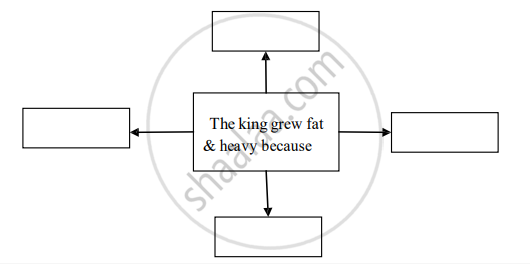
A2. Complete the web. [2]
|
King Krishnadeva Raya would perform heavy exercises every morning. He regularly applied oil on his body and thereafter worked out till all the oil came out with the sweat. This was followed by a long ride on his horse. Once the king started leading a sedentary lifestyle, and he stopped exercising. He no longer went horse-riding either. The king overate and as a result grew fat and heavy. The king‟s temperament also underwent a sea change. Noticing this, the royal physicians cautioned the king against the ill effects of overeating and explained to him the risks posed by obesity. They advised the king to regulate his diet, exercise, and take care of his health. The repeated advice he got from the physicians to eat less made him so angry that one day he announced a reward for anyone who could find him an easy cure. But there was one condition: those who failed would have their heads off. None dared to advise the king in this regard. The situation became precarious and as usual Tenali Raman was approached by the courtiers for a remedy. Tenali heard the problem and assured the courtiers of a viable solution. The next day, an astrologer predicted that the king had only a month left to live. When the king came to know of this, he was furious. The astrologer was ordered by the king to be imprisoned for a month so that his prediction could be put to test and so the hapless forecaster was sent to prison. |
A3. Find out describing words from the passage for the words given below. [2]
- exercise - ...........
- lifestyle - ...........
- ride - ...........
- physician - ...........
A4. Do as directed. [2]
- King Krishnadeva Raya would perform heavy exercises every morning.
(Use ‘used to’) - They advised the king to regulate his diet. (Pick out the infinitive)
A5. What are the benefits of daily exercise? [2]
What should parents do to ensure the safety of children in cyber space?
Which of the following should one avoid while using social media? Tick against the correct options.
Pick out word which mean the same as
place or fix (para 2)
