Advertisements
Advertisements
Question
Answer the following question in about 80 – 100 word.
Describe the journey of life as depicted in the poem by Henry Van Dyke.
Advertisements
Solution
Introduction:
Henry Van Dyke was an American author and poet. His poem describes about the Life. Life taking on life in its truest form is an adventure. This poem is beautiful and inspiring but also idealistic.
The poet’s wish:
Life is described not as an entity, but an experience. It must be lived with no hurry but courage, dedication, and goal. It should be lived without hurry. He does not want to mourn for the things that he had lost. He should not worry about past and future.
The poet’s journey:
He must embrace the presence with happiness. We should face all problems with a smile in our face. Life will have various situations. But we must be happy as it teaches us to grow and live.
The poet’s hope:
Our imagination should have the innocence of childhood. It seeks new friendships, adventure and experiences. It will enrich us. We should have faith in our hearts. Be bold and you will lead a happy life.
Conclusion:
The poet says that life’s is journey becomes joyful in all situations.
APPEARS IN
RELATED QUESTIONS
Read the extract and do the following activities:
A1 Complete :
| Night |
Morning |
| (i) | (i) |
| (ii) | (ii) |
There was a roaring in the wind all night;
The rain came heavily and fell in floods;
But now the sun is rising calm and bright,
The birds are singing in the distant woods;
Over his own sweet voice the Stock-dove broods;
The Jay makes answer as the Magpie chatters;
And all the air is filled with pleasant noise of waters
All things that love the sun are out of doors;
The sky rejoices in the morning’s birth;
The grass is bright with raindrops-on the moors
The hare is running races in her mirth;
And with her feet she from the plashy earth
Raises a mist; that, glittering in the sun,
Runs with her all the way, wherever she doth run.
A2 What do the different birds do? Discuss.
A3 The sky rejoices in the morning’s birth. (Name and explain the figure of speech)
Describe the changing relationship between the author and his grandmother. Did their feelings for each other change?
Explain the phrase.
Time's fool
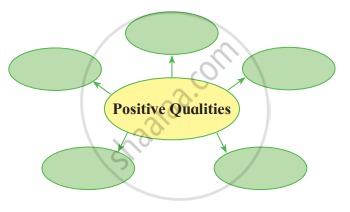
Find from the poem, positive qualities to fill up the web.
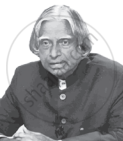
Name the world-famous personality who reached great heights despite of humble circumstances.
State whether the following statement is True or False. Correct the false statement by finding evidence from the poem to support your remark.
The poet repents planting the cherry tree.
Write a short note on the following:
Care of animals in the regime of Emperor Ashoka
Based on your understanding of the poem, complete the following passage by the using the phrases given in the box.
| youth to old age | up or down the hill | to hurry nor move away | |
| high adventure | joyful | mourn | looking ahead |
The poet wants to live his life __________, willing to do something. He neither wants __________from his goal. He does not want to _______ the things he has lost, not hold back for fear of the future. He instead prefers to live his life with a whole and happy heart which cheerfully travels from __________. Therefore, it does not matter to him whether the path goes __________, rough or smooth, the journey will be __________. He will continue to seek what he wanted as a boy - new friendship, __________ and a crown (prize). His heart will remain courageous and pursue his desires. He hopes that every turn in his life's journey will be the best.
The hut was very ______.
How did the girl seem?
