Advertisements
Advertisements
प्रश्न
Look at the following set of words and mention what is common to them both in form and meaning.
|
Snuffle |
snort |
sniffle |
snore |
Advertisements
उत्तर
All the words given are different ways of breathing
Snuffle: To breathe noisily due to cold or because of crying
Snort: To breathe air out noisily through the nose to show anger
Sniffle: To breathe air from the nose in a way that makes a sound, especially while crying or on having cold
Snore: To breathe noisily through nose and mouth while sleeping
APPEARS IN
संबंधित प्रश्न
It was her determination that helped Helen Keller get admission to Radcliffe College. Comment.
Read the following extract and answer the questions given below:
How do you know
Peace is a woman?
I know, for
I met her yesterday
on my winding way
to the world's fare.
She had such a wonderful face
just like a golden flower faded
before her prime.
(1) How does the poet describe the face of peace?
(2) Do you think there is a way out of the war-ridden world? What is it?.
(3) Name and explain the figure of speech in the following line:
"I met her yesterday
on my winding way."
(4) The poet asks the question and herself answers it. What effect does it create in the extract?
On the basis of your understanding of the above passage, make notes on it using headings and subheadings. Use recognizable abbreviations (wherever necessary – minimum four) and a format you consider suitable. Also supply an appropriate title to it.
Attempt a character sketch of Mrs. Hall.
A1 Web :
Complete the following web with the help of the passage :
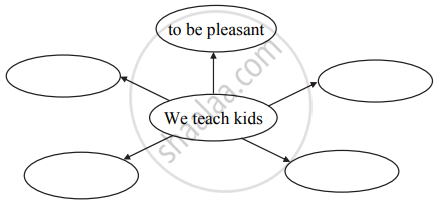
My dictionary tells me that personality is the “Personal or individual quality that makes one person be different and act differently from another.” Personality is, “the total physical, intellectual and emotional structure of an individual, including abilities, interests, and attitudes.”
There are many benefits to having a pleasant personality. There is only one opportunity to make a first impression, and all of us instinctively make decisions or judgments about an individual within the first few seconds of crossing paths. With that in mind, I believe when we teach our kids to smile, to be pleasant and cheerful, to be courteous and respectful of others, to pleasantly respond to requests or questions, we are helping them develop a personality that will open many doors for them. Once the doors are opened, the character will keep them open; but personality, not character, is on display in the first few seconds. Therefore, it’s important to develop a pleasant personality and use it for life.
A2 Personality :
Personality of an individual is recognized by :
(i) _______ (ii) _______
(iii) _______ (iv) _______
A3 Vocabulary :
Find out words for the following from the passage and write:
(i) polite =
(ii) relating to feelings =
(iii) to do anything naturally without thinking =
(iv) a chance to do something =
A4 Complete the following table :
| Noun | Adjective | Adverb |
| – | different | differently |
| Instinct | – | instinctively |
Select any word from the table and use it meaningfully in a sentence of your own.
A5 Personal Response :
Why do you thing, personality development is necessary?
Can you think of a song or a poem in your language that talks of homecoming?
Briefly comment on:
The purpose of the author’s journey to Mount Kailash.
Comment on the symbols used in ‘A Munda Song’. What aspect of the tribal worldview do they reflect?
'Now I hold Creation in my foot' – explain the centrality of this assertion in the poem. What makes the hawk's assertion of its invincibility so categorical?
Discuss the following in pairs or in small groups.
“Discipline and a questioning spirit can coexist in an individual.”
Read the extract 'Being Neighborly' and complete the following statement:
To Jo, the fine house seemed like ______.
Think and answer in your own words in your notebook.
Why do you think God created worms? What is their ecological importance?
In our country engineering, teaching, and medical fields are much sought after. Other professions, occupations though they make a significant contribution to society, do not get their due.
| (a) | Farmer | highly unpredictable economic gains |
| (b) | Conservancy workers | ________________ |
| (c) | ________________ | ________________ |
| (d) | ________________ | ________________ |
| (e) | ________________ | ________________ |
‘But the peasant bowed and prayed to God ...........’ What could he have prayed for?
Discuss with your partner and complete the web, highlighting the sad and gloomy aspects of life mentioned in the first part of the poem.

Choose the proper alternatives from the statements given below which would explain why town planning is essential - _______________.
- To develop the city according to the guidelines.
- To get the ‘Best City Award’.
- To attract tourists.
- To use and develop the land available in the city for the interest of the citizens.
Answer the following question in short.
On what condition did Tenali Raman agree to take up the challenge?
Write a short note on Emperor Akbar.
Read and prepare a small presentation in about 100 to 150 words on the ideas of any two philosophers given below.
- Sant Dnyaneshwar
- Gautam Buddha
- Aurobindo Ghosh
- Kahlil Gibran
- Socrates.
Complete the following sentence using your own ideas.
The princess was as ______ as ______. (Positive)
What could have happened to the one who flew away? Who was she?
Can you name different types of fabrics? Which is the most expensive fabric you know? Talk to your parents or to a textile shop assistant. Collect samples of as many types as you can and paste them into your scrapbook. Name each type.
Name the type of fabric closely associated with Mahatma Gandhi, the Father of the Nation. Why did Gandhiji want all of us to use this fabric?
Read the passage and find the verbs used with the following nouns and phrases:
- volcano
- molten rock
- volcanic mountain
- dust
- 165 village and towns
- the wind and the sea
- seeds
- bird
Who erected the first known veterinary hospitals in the world?
Portia saved Antonio in the court of law.
List the various people and places mentioned in the passage. The places Milo visits and the people he meets have unusual names. Write the meanings of those names.
What do the following event/action tell us about the characters? Discuss.
The Archbishop announced that everyone was free to try his hand at the sword and called all the Lords to a Tournament.
What do the following event/action tell us about the characters? Discuss.
Arthur agreed to bring Sir Kay a sword at once.
What do the following events/actions tell us about the characters? Discuss.
Sir Ector kneeled before Arthur.
‘Unke, Munke, Timpetoo,
I wish, my wish is coming true.’
Try to compose two other funny magical chants that have rhyming lines.
What did Gopal Bhand say he was doing?
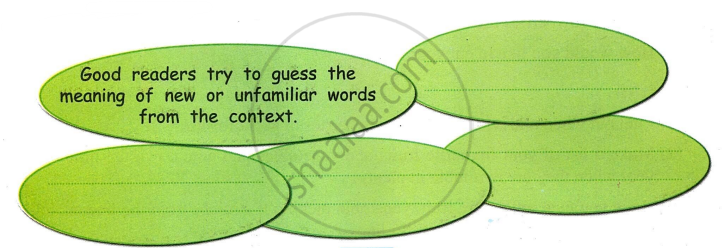
Form groups. Discuss how one can be a 'good reader'. Use the points in the above passage in your discussion. Write down the points that show what makes a 'good reader'.
Imagine that you are in a land of tiny people like Lilliput. Write about some of the interesting things you might see there, including animals, houses, plants, vehicles, etc. Find an interesting name for this land.
The poem has rhyming words at the end of the lines. Find and write the pairs of rhyming words in each stanza.
Read the following.
- Skipper: captain of a ship or boat.
- Dipper: This word has two meanings. Dipper means a container for taking out water. Also, there are two constellations called Little Dipper (Little Bear) and Big Dipper (Big Bear) in the sky.
- Milky Way: The band of light consisting of stars that spreads across the sky at night.
The taxi driver took away the narrator’s suitcase.
Read the following line from the poem and answer the question given below.
Let us learn to walk with a smile and a song,
No matter if things do sometimes go wrong;
- What does the poet expect everyone to learn?
- What should we do when things go wrong sometimes?
‘They’ descended on the sweet and toy-vendors’ stores like an army moving to attack.
Who does they refer to? Did they move one by one in a line or in a big group?
Pick out the rhyming words from the first stanza of the poem.
Activity
It’s fun to help out in the kitchen. You can even practice reading aloud when reading the recipe. And you can learn a little math by figuring out how to measure. Here are a few fun items to make that are “Alice” themed.
Vasantha made a lot of noise because ______
The hatchlings use a tiny egg-tooth to come out of the eggs.
Identify the sports and the sports personalities from the lesson and fill in the table.
| Sports | Name of the player & Field of sports | Awards |
 |
||
 |
||
 |
How should one react to adversity?
They all stood around the little jewel of blue means______.
Imagine you are the girl and give a different ending to the story.
Answer using Yes or No and pick sentence from the story to support your answer.
Was Robinson alone in the island?
What does the man have?
Divide the following word.
butter
Fill in the blank
Do you like apple______ orange?
If we didn’t have boundaries, we don’t need _______.
Join the word with the correct prefix.
| paid | un |
| send | dis |
| able | re |
| continue | pre |
Do you think Ani will be a good leader? Why?
Write the word with same meaning.

queue- ______
Mugund did not cut the raw wood.
What did the books in the library look like ?
Where did they go to buy books?
Read the following information given in the table below and answer the questions.
| A nice choice from Chennai to the National capital | |||
| RAJADHANI EXPRESS TIMETABLE | |||
| Shortest Route between Chennai and Hazrat Nizamuddin 8 Halts & 324 intermediate stations in between | |||
| Station Name | Departs | Day | Speed |
| Chennai Central | 06.05 | 1 | 75 |
| Vijayawada | 11.55 | 1 | 76 |
| Warangal | 14.40 | 1 | 77 |
| Balharshah | 18.00 | 1 | 78 |
| Nagpur | 20.45 | 1 | 74 |
| Bhopal | 02.10 | 2 | 89 |
| Jhansi | 05.31 | 2 | 99 |
| Gwalior | 06.32 | 2 | 85 |
| Agra Cantt | 07.57 | 2 | 76 |
| Hazrat Nizamudin | 10.25 | 2 | - |
a) The number of stations between Chennai Central and Hazrat Nizamudin is______.
- five
- ten
- eight
- eleven
b) The train is expected to reach ______ around 8.45 PM
- Warangal
- Vijayawada
- Bhopal
- Nagpur
c) Between ______ the train runs at its maximum speed.
- Bhopal and Gwalior
- Bhopal and Jhansi
- Bhopal and Hazarat Nizamudin
- Bhopal and Agra
d) Almost ______ the train reaches Vijayawada.
- the day after
- around early morning
- late night
- around noon
e) People prefer the Rajadhani Express to travel from Chennai to reach the capital because ______.
- it reaches the destination on the same day
- the charge is reasonable.
- the train halts at ten stations.
- it is the shortest route from Chennai to New Delhi.
f) The destination of Rajadhani express is______.
- Hazarat Nizamudin.
- New Delhi junction.
- Old Delhi.
- Rajkot.
Why is it not advisable to play online games?
