Advertisements
Advertisements
प्रश्न
What was the reason for the anxiety of Paul's mother as he grew older?
Advertisements
उत्तर
As can be implied from the story, The Rocking-horse Winner, Paul was an autistic child who also suffered Oedipus-complex. The story pictures a very young Paul who is at the threshold of teenage and is very eager to fight the sounds that keep whispering in his house that “there must be more money He was desperate to bring happiness to his mother through money and desired to replace his father in her life. As Paul grew impatient and betted on racing horses to earn money by means of gambling. Hester realised that her son was indulging too much in horse racing and asked the gardener and her brother to keep him away from it. She realised how tensed Paul had grown. Yet she knew not that the worry that had been eating and consuming him up was of his mother. Eager to win, Paul lost and lost again. It was before Derby, he grew worried to earn for his mother and prove his luck to her. She was worried so much that she left the party in the middle to return to her son to see him safe and healthy. However, it was the last time she saw her son in senses.
APPEARS IN
संबंधित प्रश्न
What were Watson's observations on the stick left behind by Dr. Mortimer? How far did Sherlock Holmes prove him wrong? (in about 125 words)
With reference to ‘The Story of My Life’, describe how a teacher can positively impact a child’s life ?
How do chimps drink water from the waterholes?
Dolly Winthrop has a very noble nature. Comment.
How do Shahid and the writer react to the knowledge that Shahid is going to die?
“I have done something; oh, God! I've done something real at last.” Why does Andrew say this? What does it mean?
Discuss in small groups.
‘On reading Shelley’s A Defence of Poetry, the question insistently occurs why there is no similar A Defence of Science written by a scientist of equal endowment.’
How do you respond to these lines?
Light, chill and yellow,
Bathes the serene
Foreheads of houses
Discuss in pairs
Ruskin's insistence on looking intensely at words, and assuring oneself of meaning, syllable by syllable – nay, letter by letter.
How does the poet juxtapose the human condition with the behaviour of the political class?
Using a dictionary/internet note down the main difference between our strengths and our achievements.
Discuss in groups and share with one another.
How your family relaxes on weekends.
Say where . . . . . . .
______ does Beauty’s smile begin?
The term 'Anaesthesia' in the poem means - 'The planner gives beautiful pictures of the new modern city'. Now find out what is Amnesia and Hypnosis in the given context.
Use the letters in the word MATHEMATICIAN to make 4 letters/5 letter and 6 or more letter words, within a time limit fixed by your teacher.
Answer the following question in short.
Why was Tenali Raman summoned to the court?
Fill in the gap, choosing a word from the bracket to make an appropriate comparison.
(tall / quiet / humble / merry / busy / slippery / fast / sly / slow / big)
as ______ as an eel
Are there any stories/legends about the moon or special names for the moon in your language? Talk to your friends and family members and collect this information.
Answer the following question in one sentence.
What examples of man’s progress have been given in the poem?
Present any one of the speeches given above.
Rewrite the poem in the form of a prose passage.
Write a few lines about each character.
In the novel, the Lethargarians give a whole day’s time table of their activities. Can you guess what it would be like?
Use your own ideas and prepare their time table.
Read the following sentence aloud. Write who said it and to whom.
“What! ... how ! ... That’s impossible! ”
List the lines that begin with 'Here' or 'And here'.
Also, list the sentences or phrases that begin with ‘And there’.
These phrases and sentences tell us about things that appear one after the other as the carriage moves. Can we tell which ones are closer to the train and which ones are at a distance? How?
Write the meaning of doth.
Describe a crocodile in your own words.
The items in the programme below have got mixed up. Rearrange them in the proper order. Just add the number in the left-hand column.
| Balanand Vidyalaya Art Festival Programme | |
| ( ) | → Koli Dance |
| ( ) | → igniting the Lamp |
| ( ) | → Chief Guest Speaks |
| ( ) | → Appraisal of the Art Festival |
| ( ) | → Dignitaries Arrive |
| ( ) | → Recital of ‘Taal kacheri’ |
| ( ) | → Welcome and Introduction of Guests |
| ( ) | → Prize Distribution |
| ( ) | → The Boy Comes Home - A skit by Std IX |
| ( ) | → Vote of Thanks |
Using your imagination, write how the other pets in the house could have objected to Caesar living in their house.
Form groups. Discuss how one can be a 'good reader'. Use the points in the above passage in your discussion. Write down the points that show what makes a 'good reader'.

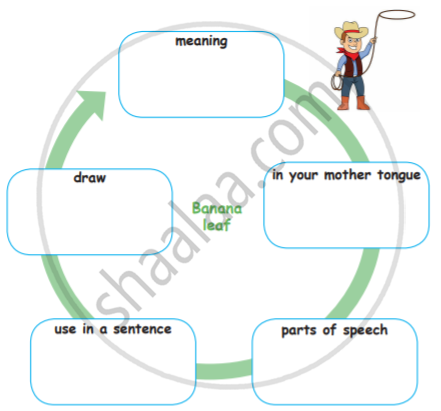
Find the meaning of the following word.
starlets
Find out how the following game is played.
Badminton
Write what the goldfish does.
List all the pairs of antonyms you find in the passage.
How was the young seagull’s first attempt to fly?
Describe the struggles underwent by the young seagull to overcome its fear of flying.
Few articles are missing in the given passage. Edit the passage given below by adding suitable articles where ever necessary.
My neighbourhood is very interesting place. My house is located in apartment building downtown near many stores and offices. There is small supermarket across street, where my family likes to go shopping. There is also post office and bank near our home. In our neighbourhood there is small, Green Park where my friends and I like to play on weekends and holidays. There is small pond near park and there are many ducks in park. We always have great time. In addition there is elementary school close to our home where my little brother studies in third grade. There are so many things to see and do in my neighbourhood that’s why I like it. It’s really great place.
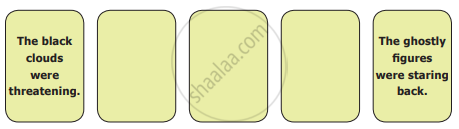
Two scary events from this section are listed here. Write the events that take place in between in the correct order.
Why was it a struggle for the children to dry their clothes?
Write the names of the characters in this story.
1. ______ 2. ______ 3. ______
Vasantha’s imagination run wild because ______.
In India’s coastal waters we can see a species of ______.
What made the trip a memorable one?
Identify the speaker/character.
He felt something moving along his body almost up to his chin.
How is water produced in Mars?
Where were the boys taken to?
Look at the picture and Choose the correct word.

Try your own.
The brown sparrow laid ________eggs.
Parents help us to overcome our______.
Name the character or speaker.
"Do you have a fever?"
Read the advertisement and answer the question given below.

What is the name of the dealer?
The king looked for a______.
Why did the king want a leader who knows to grow a plant?
Read the passage 3 times and colour the trees for each time.
Trees help us in many ways. The colour green is calming and heals your worries. By planting and caring for trees, we help improve our surroundings, as they give fresh air. When air is dirty the people of Delhi suffered a lot. But people of Madhubani district in Bihar have shown how art can be used to make our air clean. So that people made paintings on trees to stop people from cutting the trees.

What did the boy wonder about?
Why did the dogs feel scared when they saw the jackal?
Read the following passage and answer the questions that follow:
The Stationmaster’s Supreme Sacrifice by Sanchari Pal (Adapted)
- Thirty-three years ago, on the night of December 2, 1984, Bhopal was hit by a catastrophe that had no parallel in the world’s industrial history. An accident at the Union Carbide pesticide plant in Bhopal had released almost 30 tons of a highly toxic gas called methyl isocyanate, turning the city into a vast gas chamber. The result was a nightmare; more than 600,000 people were exposed to the deadly gas cloud that left thousands dead and many more breathless, blind and in agonizing pain. Few people know that during the Bhopal gas tragedy a heroic stationmaster risked his own life to save others.
- On the evening of December 3, 1984, Ghulam Dastagir was settling down in his office to complete some pending paperwork. This work kept him in his office till 1am in the night, when he emerged to check the arrival of the Gorakhpur Mumbai Express. As he stepped on to the platform, the deputy stationmaster felt his eyes burn and a queer itching sensation in his throat. He did not know that poisonous fumes leaking from Union Carbide’s pesticide factory were stealthily enveloping the railway station.
- Beginning to choke, Dastagir did not know then that twenty-three of his railway colleagues, including his boss, station superintendent Harish Dhurve, had already died. It was later reported that Dhurve had heard about the deadly gas and had immediately tried stopping the movement of trains passing through Bhopal before collapsing in his office chamber. His suddenly worsening health and years of experience told Dastagir that something was very wrong. Though he did not fully comprehend what was happening, he decided to act immediately when he did not get any response from the station master. He alerted the senior staff at nearby stations, like Vidisha and Itarsi, to suspend all train traffic to Bhopal.
- However, the jam-packed GorakhpurKanpur Express was already standing at the platform and its departure time was 20 minutes away. Listening to his gut instinct, Dastagir summoned his staff and told them to immediately clear the train for departure. When they asked if they should wait until the order to do so came from the head office, Dastagir replied that he would take complete responsibility for the train’s early departure. He wanted to ensure that the train left immediately, without any delay. His colleagues later recalled that Dastagir could barely stand and breathe as he spoke to them. Breaking all rules and without taking permission from anyone, he and his brave staff personally flagged off the train.
- But Dastagir’s work was not done. The railway station was filling up with people, desperate to flee the fumes. Some were gasping, others were vomiting, and most were weeping. Dastagir chose to remain on duty, running from one platform to another, attending, helping and consoling victims. He also sent an SOS to all the nearby railway offices, asking for immediate medical help. As a result, four ambulances with paramedics and railway doctors arrived at the station. It was winter and the gas was staying low to the ground, a thick haze poisoning everything in its path. Besieged by hordes of suffering people, the station soon resembled the emergency room of a large hospital. Dastagir stayed at the station, steadfastly doing his duty, knowing that his family was out there in the ill-fated city. That day all he had for his protection was a wet handkerchief on his mouth.
- Ghulam Dastagir’s devotion to duty saved the lives of hundreds of people. However, the catastrophe didn’t leave him unscathed. One of his sons died on the night of the tragedy and another developed a lifelong skin infection. Dastagir himself spent his last 19 years shuttling in and out of hospitals; he developed a painful growth in the throat due to prolonged exposure to toxic fumes. When he passed away in 2003, his death certificate mentioned that he was suffering from diseases caused as a direct result of exposure to MIC (Methyl Isocyanate) gas. A memorial has been built at platform No.1 to pay tribute to those who sacrificed their lives in the line of duty on the fateful night of December 3, 1984. However, Ghulam Dastagir, who died later, is not one of them. A forgotten hero whose sense of duty and commitment saved countless lives, Dastagir’s story deserves to be recognized and remembered by our fellow countrymen.
- Why was the accident at Union Carbide unparalleled in the world’s industrial history?
- How was Dastagir affected by the poisonous gas?
- What was the action taken by the station superintendent?
- How did Dastagir and his staff break rules?
- What was the cause of Dastagir’s death?
- Find words from the passage which mean the opposite of the following.
- safeguard (para 1)
- common or familiar (para 2)
- prompt (para 4)
- cause (para 6)
Complete the dialogue.
| Anil: | Which is your favourite book? |
| Sunil: | ________________________ |
| Anil: | What type of book is it? |
| Sunil: | ________________________ |
Make groups of 10-15. In this game, each person writes three sentences about himself/herself, two of which are true and the third one is a lie. Read aloud your sentences, while others guess which two are true and which is a lie.
Examples: Hello, everyone! I am Sonali. I have a brother and a sister. I live in Amalner. We have a pet dog at home.
In the game ‘Two Truths, One Lie!’, it is necessary to use details which can be verified to see whether they are true or false. For example, you cannot use sentences like ‘I once had a blue sweater.’
