Advertisements
Advertisements
Question
What was the reason for the anxiety of Paul's mother as he grew older?
Advertisements
Solution
As can be implied from the story, The Rocking-horse Winner, Paul was an autistic child who also suffered Oedipus-complex. The story pictures a very young Paul who is at the threshold of teenage and is very eager to fight the sounds that keep whispering in his house that “there must be more money He was desperate to bring happiness to his mother through money and desired to replace his father in her life. As Paul grew impatient and betted on racing horses to earn money by means of gambling. Hester realised that her son was indulging too much in horse racing and asked the gardener and her brother to keep him away from it. She realised how tensed Paul had grown. Yet she knew not that the worry that had been eating and consuming him up was of his mother. Eager to win, Paul lost and lost again. It was before Derby, he grew worried to earn for his mother and prove his luck to her. She was worried so much that she left the party in the middle to return to her son to see him safe and healthy. However, it was the last time she saw her son in senses.
APPEARS IN
RELATED QUESTIONS
Read the follow ing extract and answer the questions given below:
Not gold but only men can make
A people great and strong;
Men who for truth and honor's sake
Stand fast and suffer long.
Brave men who work while others sleep,
Who dare while others fly...
They build a nation's pillars deep
And lift them to the sky.
(1) What makes a nation strong?
(2) According to you, what makes India a strong and powerful nation?.
(3) Write down the rhyme scheme used in the extract.
(4) What does the phrase 'others fly ... ' mean?
Does the poem talk of an exclusively personal experience or is it fairly universal?
Describe the mental condition of the voyagers on 4 and 5 January.
Discuss in groups of four.
The sensitive behaviour of hill-folk.
Briefly explain the following statement from the text.
“You need some interaction to cause a transition.”
Both Ramanand and Azam Khan seem to have very fixed views. How does Ramanand score over Azam Khan towards the end of the story?
Considering that this is an excerpt from a lecture, how does the commentary provided by the speaker string the arguments together?
Notice these expressions in the poem and guess their meaning from the context:
| rancid breath | squelching tar |
| spectroscopic flight of fancy | |
| rearing on the thunderclap | brunette |
| peroxide blonde | clinical assent |
| raven black |
Read the following statement and mark those that apply to you.
I have a small group of close friends and have no wish to interact with anyone else.
Find evidence from the lesson and write in your own words.
India has many amazing success stories.
The kite - Bazar in Ahmedabad, is open day and night for a week.
Given below are some words from legal terminology used in court affairs. Discuss and complete the table accordingly.
| Sr. No | Legal Terminology | Description |
| 1. | Affidavit | A written statement confirmed by oath or affirmation for use as evidence in court. |
| 2. | Argument | |
| 3. | Consent | |
| 4. | Counsel | |
| 5. | Judgement | |
| 6. | Trial | |
| 7. | Verdict | |
| 8. | Contempt of Court | |
| 9. | Notice | |
| 10. | Stay order |
Read the text and enlist the achievements and honours of Ramanujan, received in England.
Answer the following question in short.
What was Pundit Shahane’s claim as a scholar?
Make a list of functions/events/programs/activities organized in your junior college. Choose three events and plan a program schedule of your own. Prepare a script as well to show the associating role of the compere for a particular event. Make your own sequence and design a template for the same.
Explain the following statement with reference to the context.
And then, once the ring's broken, we'll get to work and show the public every day just how incompetent the Mayor is!
Write a useful ‘ad’ for the importance of games, drinking enough water, your own school.
Apart from the stone, how many things go into the soup?
Read the following words. Write the words that are combined to make these words.
- faraway
- nobleman
- whoever
- moneylender
- sometimes
Add ten more words to the list on your own. Each of the component words must be meaningful.
What characteristics of Mr. Nobody do we learn about from this poem?
Read the following sentence aloud. Write who said it and to whom.
“Why, the dress you go to the theatre in !”
Prepare similar word chains using the following ideas.
size - big _______________.
Identify one example of a main clause and one example of a dependent clause from the content below:
Troy was filled with the sight of leaping flames and the sound of shouting and the noise of weapons and the cries of weeping women. The sleeping Trojans sprang out of their beds, but they were taken by surprise. Their enemies were right inside their walls, and many of the Trojans were killed before they could put on their armour and seize their weapons.
A bright light lit up the night sky as palaces and houses, temples and towers, went up in flames. The Trojans fought as well as they could, but it was all in vain. Old King Priam was killed with all his brave sons. Hector’s wife and his old mother and sister were carried off as slaves by the conquerors. Their fate was in contrast to Helen’s when King Menelaus rushed through the city, looking for her, and found her in her palace. She hung her head in shame and sorrow as she faced her former husband. Her voice was choked with emotion and she could not speak. But Menelaus forgave her and she went back with him, for it was only Aphrodite who had turned her heart away from her home and her husband and her child.
When morning came, nothing was left of the proud, rich city that had resisted attack for ten years.
The Emperor says he had realised earlier that Abdul has great talent. Does this tally with his actions? Give your opinion.
Fill in the blank choosing the appropriate word/idiom from the lesson.
While arguing with his elders he had ______.
Summarise this poem in your own words in 8 to 10 lines, highlighting only the main points.
Find out when and where we get strawberries in Maharashtra.
Write some more expressions like ‘hundreds of’. Expand each expression.
Example, ‘Hundreds of children in the school.’
Find a word that has a similar meaning.
Sorry
Find out the difference between the fingerspelling method, sign language and Braille.
Prospero ordered Ariel to bring ____________ to his place.
How did the Bodwells react, when a shoe was thrown into their house?
Read the story again and write how these character reacted in these situation:
You are an absolute treasure…………. Dr.Krishnan………………..
Zigzag………………………..
Hamid’s granny scolded him for buying iron tongs. Then she understood that Hamid had bought it ______.
Read the comic strip and answer the following question.
Can we read and access the information free of cost?
Sea turtles come to rest on land.
Sea turtles come to the shore to ______.
Why did the author leave town?
Merlin was thrilled when the school arranged the trip because ______.
The eggs hatched and the babies flew away.
Our planet is called the _____.
How did the third daughter use the grain?
Jaswant managed to kill _________ Chinese soldiers.
Try your own.
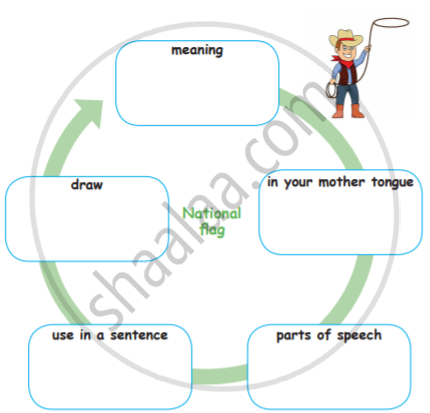
Name the character or speaker.
"Why don't you do that yourself?"
Identify the character or the speaker.
“Do not feel sad dear.”
Why did everyone ridicule the boy?
Answer using Yes or No and pick sentence from the story to support your answer.
Did Robinson kill Friday?
Why did he grow crops?
What did the archer want to show to the crowd?
The brown sparrow laid ________eggs.
The sparrow solved the problem with her _____.
Parents never let us get ______.
Why did Bala go to Chennai with his father?
Why did he go there?
Read the poem.
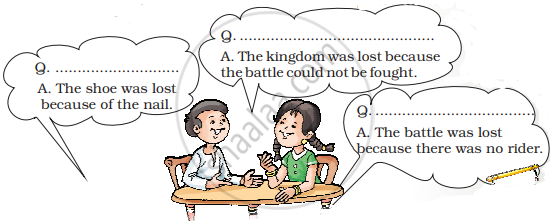
For Want of a Nail
For want of a nail, the shoe was lost,
For want of a shoe the horse was lost,
For want of a horse, the rider was lost,
For want of a rider, the battle was lost,
For want of a battle, the kingdom was lost,
And all for the want of a horseshoe nail!
[traditional rhyme]
Now form questions for the answers given in the speech bubbles.
What should we do to ensure Safe Surfing?
What are the details not to be revealed in public domain?
