Advertisements
Advertisements
Question
Make a list of the expressions that imbue the watch with human attributes.
Advertisements
Solution
The following is the list of some expressions that have brought about human attributes in the watch (personification):
i). "infallible in its judgment"
ii). "she is four minutes slow"
iii). "it sickened to a raging fever and its pulse went up to a hundred and fifty in the shade"
iv). "It was away into November enjoying the snow, while the October leaves were still turning"
v). " it would go like the very mischief, and keep up such a barking and wheezing and whooping and sneezing and snorting"
vi). " She makes too much steam you want to hang the monkey-wrench on the safety-valve!"
APPEARS IN
RELATED QUESTIONS
Answer any four of the following questions in 30-40 words each:
(a) Why did Franz not want to go to school that day?
(b) What was Sophie's ambition in life? How did she hope to achieve that?
(c) What kind of pain does Kamala Das feel in 'My Mother at Sixty-six'?
(d) How can 'mighty dead' be things of beauty?
(e) Why was the Maharaja once in danger of losing his kingdom?
(f) What was the basic plot of each story told by Jack?
Read the passage given below :
(ii) he added a lot of grandeur to Mewar.
(iii) of his valour, sacrifice and patriotism.
(iv) both (ii) and (iii)
(b) Difficulties in the way of Mewar were :
(ii) ancient traditions of the kingdom.
(iii) its small area and small population.
(iv) the poverty of the subjects.
(ii) the flag of Mewar was hoisted high.
(iii) the people of Mewar showed gallantry.
(iv) most of the rulers heaved a sigh of relief.
(d) Mewar was lucky because :
(ii) most of its people were competent.
(iii) most of its rulers were competent.
(iv) only a few of its people were incompetent.
Answer the following questions briefly:
(h) How could art and literature flourish in Mewar?
(i) How did the rulers show that they cared for their subjects?
(j) What does the erection of Vijaya Stambha and Kirti Stambha in the same fort signify?
(k) Find words from the passage which mean the same as each of the following:
(ii) evidence (para 4)
On the basis of your understanding of the above passage, make notes on it using headings and subheadings. Use recognizable abbreviations (wherever necessary – minimum four) and a format you consider suitable. Also supply an appropriate title to it.
|
The energy stored in coal and petroleum originally came to the earth from the sun. The bulk of the present-day supplies was laid down some 200 to 600 million years ago, when tropical conditions were widespread. Lush, swampy forests produced huge trees; warm coastal seas swarmed with microscopic forms of life. When these organisms died, much of their tissue was recycled as it is today — through scavenging and decay. But a significant amount of dead plant and animal material was covered with mud, which prevented complete decomposition. With the passage of time, layer upon layer of the fine sediment was deposited over the once-living material; the sheer weight turned the sediments to rock. Sandwiched between the layers, both coal and petroleum were produced and preserved under pressure. Coal was formed mostly of giant fern-like plants that have only small counterparts today. Coal may still be forming here and there on earth, but conditions are not right for the production of significant quantities. |
Combine related points.
Why does Ruskin feel that reading the work of a good author is a painstaking task?
Taking off from Forster’s references to Emily Bronte, Sterne and Proust, discuss the treatment of time in some of the novels you have read.
Read the story and complete the following.
Revathi won the prize for the ‘Best plant’ because, ____________.
Write down any two Slogans on 'Gender Equality'.
Read the Preamble of the Constitution of India given in your textbook. Pick out a word that refers to the following.
Brotherhood
Discuss in groups and share with one another.
When you go for a picnic, what and how do you enjoy?
Think and answer in your own words.
'Beauty' in stanza 5 to 6 can refer to a beautiful maiden as well as nature itself. Explain when and how nature ‘dances’ and also 'smiles'.
Visit a library: Find the stories of
- Mulla Nasiruddin
- Gopal Bhand and
- Tenali Raman. Share them in the class.
Read the description of the Kabaddi match and do the following:
Note down the names of the players and say whether each one belongs to 9 A or 9 B.
Read the description of the Kabaddi match and do the following:
Describe, in your own words, the important events in the first half.
Choose the odd one out :
Bottom, Moth, Mustardseed, Cobweb.
Explain the use of the following property in the development of the play.
Hat
Write a short note on the following:
Veterinary Science in Ancient India.
Guess the meaning of the following from the context.
The meadow is wrapped in shadow.
Draw word webs for the following. Begin with the given word and go on writing as many other words associated with it, as you can. Use these words to write other related words to form a word web.

Apart from class/school, where else are you likely to find a time table useful?
Recite the poem with proper rhythm and intonation.
Imagine you are Malti. Write about any one event in the story from Malti’s point of view.
Write the following:
The sights seen through a railway carriage mentioned in the first stanza.
Choose the appropriate phrase to insert in the gap, to make the sentence meaningful. Use the appropriate form of the verb.
Before we ______ let us stand in attention for the National Anthem.
Write in your own words.
What does the poet miss?
List 5 of the sounds that you like.
Write other meaningful words that begin/end with stepmother.
In what way can we help to reduce or minimize waste generation?
Discuss the issue in groups of 4 or 5 and note down all good suggestions.
Resolve to follow them yourself. Some have been given below for your reference.
- Don’t waste food.
- Take as much as you want but finish everything that’s on your plate.
- Don’t throw away broken or half-used things. Repair them and use them.
- Avoid things which can be used only once.
For example: thermocol (polysterene) cups, plastic glasses, etc. - Reuse!
- Recycle!
Read the following lines from the poem and answer the question that follow.
Let me but live my life from year to year,
With forward face and unreluctant soul;
- Whom does the word ‘me’ refer to?
- What kind of life does the poet want to lead?
____________ raised a dreadful storm.
Identify the character or speaker.
He imprisoned the spirits in the bodies of large trees.
Who were the narrator neighbours?
What was the e-mail message sent to Somu by Dr.Krishnan?
How were offerings carried during the ancient period?
Why can’t Alice get through the little door into the garden?
Read the line and answer the question.
And the wheel’s kick and the winds song and the white sail’s shaking
What according to the poet are the pleasures of sailing?
Identify the speaker/character.
Don't worry, Madam, it's only a warning.
Identify the speaker/character.
Stop ship. Drop anchor. Quick!
Why did the girls snigger?
Geetha madam couldn’t stop the children running out of the train because they ______.
The little bird found a shallow hollow in the ground.
The blue lights seen through the window were aliens.
Find the rhyming word from the poem.
Crowd - ______.
What did Anitha eat in the expo?
Fortune knocks with its best who _______ for their guest.
Read the advertisement and answer the question given below.

What is free, for LED TV?
Who were the guest to Kani’s home?
What are the difficulties they faced in India?
Who is responsible for the society?
Divya loved solving _______.
Hundial is a______ pot.
In real the plate was made of ______.
Read the passage and colour one bag each time you read.
There lived a poor but an honest farmer in a village. He supported himself, his wife and seven children using his small piece of land.
One day while he was walking in his field, he found a bag of gold.
He took it home and showed it to his wife. His wife told him to keep some of the gold. He told his wife that honesty is the best policy. He tried to find the person who lost it. At last, he found that the owner of the bag and gave it back. The rich man took the bag and thanked him.

Let us learn a few more word by joining the dots. Join the dots and fill the table below.
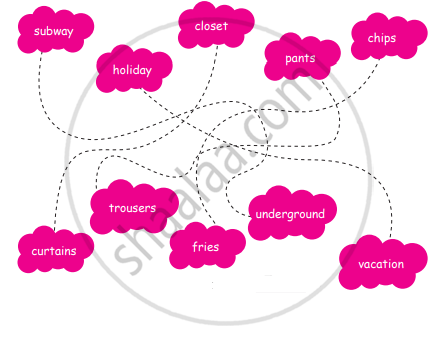
| subway | |
| holiday | |
| closet | |
| pants | |
| chips |
Who wins the world at the end?
What did Nasruddin boast about?
List three questions that the little boy asks.
- ______
- ______
- ______
Who came to Akbar’s court?
How did the tree help the boy earn money?
