Advertisements
Advertisements
प्रश्न
Discuss in groups of four.
The sensitive behaviour of hill-folk.
Advertisements
उत्तर
Hill folk are innocent and rustic people. They are very conservative and cultural. They do not have the exposure of a city life. They are simple and humble. They are habitual to country life, which is not fast. They are always ready to help. People who are from small towns are religious and humane.
APPEARS IN
संबंधित प्रश्न
Attempt the following in 150-200 words.
Bring out the importance of the diary in Anne's life.
Read the following passage and complete the activities given below:
Read the following passage and do the given activities:
A.1) True or False
State whether the following statements are true or false:
(i) The patient stirred and looked about in cheerful anticipation
(ii) The patient’s wife wanted to know the truth …………
The lady went away to the kitchen. She felt restless. She felt she must know the truth whatever it was. Why was the great man so evasive? The suspense was unbearable. Perhaps he could not speak so near the patient’s bed. She beckoned to him from the kitchen doorway.
The doctor rose and went over. She asked, “What about him now? How is he?” The doctor bit his lips and replied, looking at the floor, “Don’t get excited. Unless you must know about it, don’t ask now.” Her eyes opened wide in terror. She clasped her hands together and implored, “Tell me the truth.” The doctor replied, “I would rather not talk to you now.” He turned around and went back to his chair. terrible wailing shot through the still house; the patient stirred and looked about in bewilderment. The doctor got up again, went over to the kitchen door, drew it in securely and shut off the wail.
A.2) Give reasons for the following:
(i) Her eyes opened wide in terror.
(ii) The lady went away to the kitchen.
A.3) How, according to you, should the nature of the doctor be?
Answer the following in 200-250 words :
Describe the relationship between Anne and Margot?
Briefly explain the following statement from the text.
“The lack of determinism in quantum theory!”
Why do you think Professor Gaitonde decided never to preside over meetings again?
What was the importance of the watch to the author?
Why did the author finally give up on his watch?
Which are the lines in the poem that impressed you the most and why?
Comment on the physical features of the hawk highlighted in the poem and their significance.
Read other poems by Leigh Hunt, especially 'Abou Ben Adhem'.
Compare the messages in that poem with those in 'The Plate of Gold'. What do you observe?
The poet encourages her brother in the second part of the poem by telling him about the brighter side of life. Discuss with your partner and make a list of the expressions in the poem that mean encouragement.
- Brighter garden
- ________________
- ________________
Using points from the lesson, give the details of the following in a short paragraph.
International Kite Festival at Ahmedabad.
Sue was a rich girl.
Correct the following statement.
Johnsy was eager to recover from her illness.
Go through the poem and state whether the following statement is true or false.
Planners deliberately find drawbacks in the old city planning.
Answer the following question in short.
What do you learn about Pundits of Vijaynagar?
Answer the following question in short.
What did the bundle in silken cloth contain?
Visit a library: Find the stories of
- Mulla Nasiruddin
- Gopal Bhand and
- Tenali Raman. Share them in the class.
Go through the following web that highlights the essential qualities of a compere. Discuss with your partner the essential qualities and also the precautions that a compere should take while compering a program.

Precautions to be taken :
- __________________________
- __________________________
- __________________________
- __________________________
Comment on the given statement after reading the given dialogue -
I wouldn’t be in your shoes if he rewards me ten times as much. People generally fall victim to incentives. Some people stick to values. They _________________.
Draw a diagram to show how life returned to the island. Label the diagram.
(Use the technique of drawing diagrams when you study science, geography, etc.)
Discuss the following questions after you have seen a presentation of the ‘ad’.
Can you become fair in five days? How long will the effect of the cream last?
Discuss the following question after you have seen a presentation of the ‘ad’.
Think of the people you like. Do you like them because they have a fair (white) skin or because of some other qualities? List those qualities.
Have you seen a newborn young one of an animal?
An activity:
Speak fast, think faster! Form groups of 4-6. Discuss each of the following topics. Then each person in the group should choose a topic and speak about it for one minute. Try to say as many sentences as you can in that time.
Imagine you are watching a scene. For example, someone learning to ride a bicycle; or a cricket match. Give a running commentary on what you see.
‘Monu is sitting on the bicycle. It has side wheels. Monu tries to push the pedal down - No - he stops. His uncle holds the seat in one hand and the handle in the other hand. He says, ‘Come on, Monu’... etc.
Read the passage and answer the following:
When was the book written?
Read the passage and answer the following:
Who has written the book?
Read the passage and name the following.
He persuaded Helen to elope with him.
We find the following in the script of a skit or play. Rearrange these steps in the proper order and write them down in the form of a flow chart.

Read the poem again. Does it have a uniform rhyme scheme throughout?
Write down the rhyme scheme of every stanza separately.
- 1st stanza ______
- 2nd stanza ______
- 3rd stanza ______
- 4th stanza ______.
The story has a very heart-warming and touching end. Now try to change the end of the story to make it sound very funny.
Draw a diagram to explain the idea of Internet.
Who were the narrator neighbours?
Read the following line from the poem and answer the question given below.
| And so it were wisest to keep our feet From wandering into Complaining Street; |
- What is the wisest thing that the poet suggests?
- What does the phrase ‘to keep our feet from wandering’ refer to?
Vasantha made a lot of noise because ______
The eggs of an Olive Ridley are in the shape and size of a cricket ball.
How did Grandfather’s dream come true?
The blue lights seen through the window were aliens.
What did Nilavan see through the window?
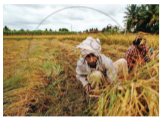
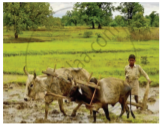
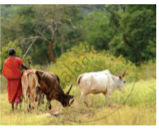
| Mr. Murugan is a farmer. He has a small piece of land and two bulls. He takes good care of his bulls as they help him in farming. Every morning, he takes the bulls for grazing. When it rains he ploughs the land with the bulls. As he has no one to help he starts sowing the seed before sunrise. He irrigates the crop till it grows. He reaps and binds the crop then takes it to thrash the paddy. Finally, with the help of the bulls, he takes the paddy to his house. |
Name the actions of Murugan.
 |
|
 |
|
 |
________ was a young talented doctor.
Find the rhyming word from the poem.
Country - ______.
What kind of a boy was Vicky?
Vicky's dad bought a ______ robot.
Look at the picture and Choose the correct word.

Write the rhyming word.
Nature - ______.
How were her strokes?
Why was the fish floating on top?
Who disguised himself as an old man?
Find and write the clues.
Clue for lame ______.
Every year the children visit the______.
What will help you say the truth?
Choose the correct one.
Rooster

Why did the headmaster give Megala a special prize?
Who came to Akbar’s court?
Where did the naughty boy go?
Read the passage given below and make notes.
To match the best cities across the world, the Government of India initiated ‘smart cities’ to drive economic growth and improve the quality of life of people. The agenda under smart city promises to resolve urban sustainability problems. Urban forests provide a range of important ecosystem services that are critical for the sustainability of cities. Urban forestry, which is defined more as ‘Management of Trees’ contributes to the physiological, sociological and economic well-being of the society. Mangroves, lakes, grasslands, and forests in and around our cities, act as sponges that absorb the air and noise pollution and they present themselves as our cultural and recreational hotspots. However, these spots are rapidly being reclaimed and replaced in the name of development. Presence of urban green has shown to increase the economic value of the place.
Urban forests contribute to reduce the cost of building storm water drain systems for municipalities and neutralizing urban heat island effect. Plants not only provide shade but also help in regulating the micro-climate. They help regulate energy budgets, improve air quality, and curtail noise pollution. Trees, herbs, shrubs, and grasses arrest sedimentation and prevent other pollutants from entering our water systems. This will give a chance for our urban lakes and rivers to recover and help improve aquatic ecosystems. Biodiversity also gets a boost through the urban forestsand helps create corridors connecting the forest areas. High biodiversity areas can also help to build resilient ecosystems. Availability of forests within our urban areas gives an opportunity for children to connect to the natural environment and learn about native species.
What should parents do to ensure cyber safety for their wards? (Any three points)
Enact any one anecdote in the classroom.
