Advertisements
Advertisements
प्रश्न
Comment on the physical features of the hawk highlighted in the poem and their significance.
Advertisements
उत्तर
Hawk Roosting signifies self-esteem or self-assertion of a Hawk that is so alienated from the human world. The poem is a dramatic monologue in a non-human voice; i.e., of the Hawk, who carries the false belief of himself being the most superior living being. The Hawk brandishes its supreme ego by boasting of its physical features. The outrageous fashion in which he brands his physiology insinuates his arrogance. The much-vaunted self-praise has criticised as an instance of fascism. The poet has brought out savagery by describing the unsophisticated physiology of the Hawk. In the first stanza of the poem, the Hawk claims to limit the whole of the world between his “hooked head” and “hooked feet”. The Hawk insinuates himself to embody the whole of creation and even while he is asleep he “rehearses perfect kills and eats” in his dream. In the third stanza, we see the Hawk challenging God. He flatters himself that “it took the whole of Creation” to design him, his foot, his each and every feather. Now the roles are reversed and he possesses and exercises his power over the whole world.
APPEARS IN
संबंधित प्रश्न
Answer any six of the following questions in 30‒40 words:
(a) Why did Gandhiji feel that taking the Champaran case to the court was useless?
(b) Why did the peddler derive pleasure from his idea of the world as a rattrap?
(c) How is Mukesh different from the other bangle makers of Firozabad?
(d) What tempted Franz to stay away from school?
(e) Why did the maharaja ban tiger hunting in the state?
(f) How was the skunk's story different from the other stories narrated by Jack?
(g) Which words of her brother made a deep impression on Bama?
Answer any four of the following questions in 30-40 words each :
(a) Why was Franz not scolded for reaching the school late that day?
(b) Sophie was dreaming of so many things in her life. What were they?
(c) Why are the youngsters described as springing? (My Mother at Sixty-six)
(d) In the hot season, how do man and beast get comfort? (A Thing of Beauty)
(e) How did the Maharaja deal with a high ranking British officer who wanted to shoot a tiger?
(f) Having got rid of his stink, what problem did Roger Skunk face?
Read the following extract and answer the questions given below:
If you do not get lowered in your own eyes
While you raise yourself in those of others,
If you do not give in to gossips and lies
Rather heed them not, saying, 'who bothers?'
You may be the person I am looking for.
If you crave not for praise when you win
And look not for sympathy while you lose,
If cheers let not your head toss or spin
And after a set-back, you offer no excuse,
You may be the person I and looking for.
(1) What should be your reaction towards gossips and lies?
(2) Who are your role models? Why?
(3) Give the rhyming pairs of words from the first stanza.
(4) Which line is repeated in this extract and what is its effect?
Read the following passage and complete the activities given below:
Read the following passage carefully and complete the activities given below:
B.1) Order :
Rearrange the following sentences in proper order:
(i) Hanmant joined engineering.
(ii) Hanmant got his Diploma and secured a job in Philips.
(iii) Hanmant migrated to Pune when he was in class VI.
(iv) Hanmant took up a painting job to earn.
Hanmant Gaikwad was born in Koregaon in Satara district.
“My native place is Rahimatpur, around 10 km from Koregaon. My father was a clerk in the court and we lived in a small, rented house.”
Hanmant was a brilliant student especially good in mathematics. When he was in class six, the family shifted to Pune. They lived in Phugewadi near Dapodi in a tiny one-room house-10 by 10 feet. At this point, Hanmant realized the difference between himself and those who had money.
Hanmant was then studying at Modern High School. He needed one rupee to buy a bus ticket to and from the everyday. Even that was hard to come by.
Despite the hardships, Hanmant secured 88% in class 10. Hanmant completed his diploma and joined Philips as a trainee. But he wasn’t happy with the work he got there.
The natural choice for a diploma engineer is to go for a B.Tech. But engineering colleges charge hefty fees. At the time, the family’s only source of income was a teacher’s salary of Rs. 2,300 a month……….
And then I decided to also do some earning. “Khud Ka Kamana Chalu Kiya”.
Hanmant took up painting jobs and quickly discovered it was excellent business.
The young engineering student paid his own fees from the third year onwards. But his lifestyle remained frugal.
Life was getting better, but Hanmant had his sights set higher. In the final year of engineering, he was attracted to the writings of Swami Vivekananda.
“I felt Ki Kuch Alag Karna hai. What should I do, I did not know but in 1993 I formed an organization-Bharat Vikas Pratisthan.”
B.2) Complete :
|
Hardships faced by Hanmant Gaikwad |
B.3) Rewrite the following sentence choosing the appropriate word/s for the underlined word/s :
(i) His lifestyle remained frugal:
(a) simple
(b) meager
(c) extravagant
(ii) Despite hardships, Hanmant secured 88% in class X:
(a) In spite of
(b) Regarding
(c) Affected
(iii) Hanmant took up painting jobs:
(a) assumed
(b) to continue
(c) accepted
(iv) Hanmant had his sights set higher:
(a) looked ahead
(b) lofty ambitions
(c) looked above
B.4) Do as Directed
(i) Hanmant secured 88% in class X. ( Begin the sentence as-88%....................)
(ii) In the final year of engineering, he was attracted towards the writings of Swami Vivekananda. (Frame a ‘Wh-question’ to get the underlined part as the answer.)
B.5) “Today’s hardships lead to tomorrow’s success”-Justify.
Briefly explain the following statement from the text.
Gangadharpant could not help comparing the country he knew with what he was witnessing around him.
We 'draw up a deed'. Complete the following phrase with an appropriate word.
________a loan
Suggest a few instances in the poem which highlight humour and irony.
Which are the lines in the poem that impressed you the most and why?
'There is no sophistry in my body' – this statement expresses the brutal frankness of the Hawk. Does the poet suggest something through this statement?
An acrostic is a poem or a write· up in which the first letter of each line forms a word. when it is read vertically.
For example,
Faithful
Reliable
Inspiring
Encouraging
Noble
Dedicated
With your benchmate / group, complete the acrostic of BELIEVE and FAITH.
(Please note that the words / phrases should be more or less related to the topic. You can use a thesaurus.)
Be certain of
E ......................
L ......................
I ......................
E ......................
V ......................
E ......................
F ......................
A ......................
I ......................
T ......................
H ......................
Find from the story one word for the following.
a very narrow passage between buildings ______
Think and answer in your own words.
What is the difference between a hawker and a shopkeeper?
Given below are some words from legal terminology used in court affairs. Discuss and complete the table accordingly.
| Sr. No | Legal Terminology | Description |
| 1. | Affidavit | A written statement confirmed by oath or affirmation for use as evidence in court. |
| 2. | Argument | |
| 3. | Consent | |
| 4. | Counsel | |
| 5. | Judgement | |
| 6. | Trial | |
| 7. | Verdict | |
| 8. | Contempt of Court | |
| 9. | Notice | |
| 10. | Stay order |
Go through the poem and state whether the following statement is true or false.
Planners are concerned about the environment of the area.
Imagine that one of your family members/friends/classmates has recently undergone surgery. You were curious and wanted to learn about his/her experience.
Match the questions you asked with their answers.
| 1. | What health problem did you suffer from? | a. | I was given a bath and I wore a surgical gown. |
| 2. | Whom did you inform about it first? | b. | I was given an injection of anesthesia. |
| 3. | What type of doctor did you consult? | c. | I consulted an orthopedic surgeon. |
| 4 | How did he/she find out that you needed a surgery? | d. | I was relieved and happy that the operation was over. |
| 5. | What preparation was done before the surgery? | e. | I had fractured my ankle while playing hockey. |
| 6. | What did you feel when you were taken to the operation theatre? | f | No, I did not feel anything. I was fast asleep. |
| 7. | What was the first step before the actual surgery? | g. | I recovered and I could walk normally after 3 weeks. |
| 8. | Did you feel any pain during the surgery? | h. | Our school hockey coach. |
| 9. | What did you feel when you opened your eyes after the operation? | i. | The doctor took an X-ray of my ankle, and he found a fracture in my ankle. |
| 10. | How soon did you recover? | j. | I was very nervous. |
Answer the following question in short.
What was Pundit Shahane’s claim as a scholar?
Visit a library:
Read the biographies of other Indian Saints. Share at least one story from their life with your friends. What message does it contain?
There are some dialogues that are short, but quite effective. They give us enjoyment and add beauty to the main story. Find some more from the text.
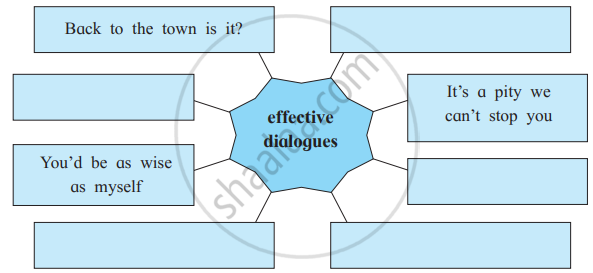
Does the traveller really have a magic stone?
Read the following chains of words:
- fortune - fortunate - fortunately - unfortunately
- know - knowing - knowingly - unknowingly
- amaze - amazing - amazingly
- possible - impossible - impossibly
Choose a 'question' through your own observation. Try to follow the scientific method to find the answer to that question. Take the help of your teacher/parents to set up the experiment.
Write five words each -
with the suffix
- -less
- -ly
- -ness
Write about Malti and Rima using the following points:
 |
 |
| Appearance... | Appearance... |
| Studies... | Studies... |
| Singing... | Singing... |
| Attitude to others... | Attitude to others... |
| Weak points... | Weak points... |
Use details from the story and your own imagination when you write the above descriptions.
Think and answer:
Are the boys and girls happy that it is raining?
Talk about the good qualities of any one person you do not like. (You need not name the person.)
There are many popular lines like:-
- ‘Life is a game - play it well’.
- ‘Life is a journey - keep going ahead’.
Discuss and write down a few such metaphorical lines about ‘life’. You can make them up yourselves.
- ____________________________
- ____________________________
- ____________________________
- ____________________________
- ____________________________
Read the poem and answer the following.
Which strawberries are plump and juicy?
What did Anshuman’s father compare bad habits to?
How do we come to know that Kasim was a generous man?
Find a word that has a similar meaning.
unfair
How was the young seagull’s first attempt to fly?
____________ raised a dreadful storm.
Use this passage to play the game. You can collect information on other famous personalities and play too.
Charlie Chaplin was born on April 16, 1889, in London England. His birth name was Charles Spencer Chaplin, though he had many nicknames growing up such as Charlie, Charlot, and The Little Tramp. His father, Charles Chaplin, and his mother, Hannah Chaplin, were inducted into the music hall of fame, leading the way to his exposure even as a young boy. His first onstage moment was when he was 5 years old; he sang a song that was intended to be sung by his own mother; she had become ill at the time of the performance, so little Charlie Chaplin stood instead and performed for his mother.
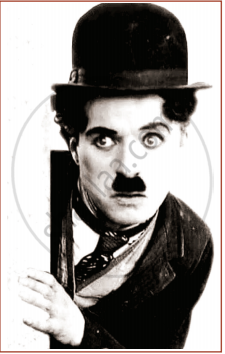
Charlie Chaplin came to the United States in 1910, at the age of 21. He was brought to New York, which was known to be a great place to start out for anyone trying to become a professional actor. Two years later, in 1913, Chaplin signed his very first contract at Keystone and it was no time before he headed to Hollywood. His first movie premiered in 1914, “Making a Living,” and went on to make over 35 movies total in that year alone. Charlie Chaplin grew to become one of the most popular and successful actors of all time. The moment that really kicked off his long career was in 1921 when he starred in, and produced, his first full-length film called “The Kid.” From then on, most people all over the world knew Charlie Chaplin and loved his movies. He had a great career and life, dying on December 25, 1977, in Vevey, Switzerland. He had apparently died of natural causes in his sleep from old age.
Few articles are missing in the given passage. Edit the passage given below by adding suitable articles where ever necessary.
My neighbourhood is very interesting place. My house is located in apartment building downtown near many stores and offices. There is small supermarket across street, where my family likes to go shopping. There is also post office and bank near our home. In our neighbourhood there is small, Green Park where my friends and I like to play on weekends and holidays. There is small pond near park and there are many ducks in park. We always have great time. In addition there is elementary school close to our home where my little brother studies in third grade. There are so many things to see and do in my neighbourhood that’s why I like it. It’s really great place.
Which gift did Anne value the most?
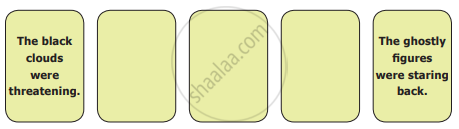
Two scary events from this section are listed here. Write the events that take place in between in the correct order.
Read the comic strip and answer the following question.
Do you think that all the information online can be used without any permission?
Imagine you are a marketing executive for a company in a specific industry (toothpaste, soup, hair care products, automobiles, etc) and are developing a product with a brand name that refers to a character from the story.
For example: You want to sell bandages that have little pictures of Don Quixote on them. Your company’s name is Kure-All and you decide to call them “Kure-All Quixote Bandages”.
The slogan might be: “Had a tough day with windmills? When you take a fall, use Kure-All.”
You can use exciting words, a catchy new slogan and a jingle among other things to promote sales of your item.
Why was Sir Francis angry?
Work in pairs and answer the following.
Pick out the alliterated words.
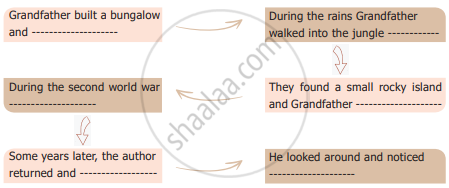
Describe what the author saw when he went back to the island.
Grandfather helped grandma out with the gardening because he______.
Read the story on your own. Discuss in a group and complete the story map below.
| A story map is the main events of the story given in a flow chart. |
Were the girl and her brother friendly with each other?
Match the following.
| cuckoo | blows |
| breeze | sings |
| river | swims |
| fish | flows |
Vicky was an active boy.
Connect and write the homophones in the box.
|
Sea |
 |
|
One |
 |
|
Flower |
 |


What was the age of Robinson Crusoe when he left for sea?
What did the oil seller perform?
Like whom did they want to do?
______helped Bujju to reach his family.
______ lies stretching in the river.
Name the character or speaker.
"Why does Nandhini look so sad?"
Kamali gave her savings to______.
Read the passage carefully and answer the following question.
What did the farmer find in the field?
How did the boy enjoy the company of the tree?
How did the animals know that the king was just a jackal?
Read the passage and write a summary of it. Suggest a suitable title for the summary.
|
A sparrow is a small bird which is found throughout the world. There are many different species of sparrows. Sparrows are only about four to six inches in length. Many people appreciate their beautiful songs. Sparrows prefer to build their nests in low places-usually on the ground clumps of grass low trees and low bushes. In cities, they build their nests in building nooks or holes. They rarely build their nests in high places. They build their nests out of twigs grasses and plant fibers. Their nests are usually small and well-built structures. Female sparrows lay four to six eggs at a time. The eggs are white with reddish-brown spots. They hatch within eleven to fourteen days. Both the male and female parents care for the young. Insects are fed to the young after hatching. The large feet of the sparrows are used for scratching seeds. Adult sparrows mainly eat seeds. Sparrows can be found almost everywhere where there are humans. Many people throughout the world enjoy these delightful birds. The sparrows are some of the few birds that engage in dust bathing. Sparrows will first scratch a hole in the ground with their feet then lie in it and fling dirt or sand over their bodies with flicks of their wings. They will also bathe in water or in dry or melting snow. Water bathing is similar to dust bathing with the sparrow standing in shallow water and flicking water over its back with its wings also ducking its head under the water. Both activities are social with up to a hundred birds participating at once and are followed by preening and sometimes group singing. |
