Advertisements
Advertisements
Question
Comment on the physical features of the hawk highlighted in the poem and their significance.
Advertisements
Solution
Hawk Roosting signifies self-esteem or self-assertion of a Hawk that is so alienated from the human world. The poem is a dramatic monologue in a non-human voice; i.e., of the Hawk, who carries the false belief of himself being the most superior living being. The Hawk brandishes its supreme ego by boasting of its physical features. The outrageous fashion in which he brands his physiology insinuates his arrogance. The much-vaunted self-praise has criticised as an instance of fascism. The poet has brought out savagery by describing the unsophisticated physiology of the Hawk. In the first stanza of the poem, the Hawk claims to limit the whole of the world between his “hooked head” and “hooked feet”. The Hawk insinuates himself to embody the whole of creation and even while he is asleep he “rehearses perfect kills and eats” in his dream. In the third stanza, we see the Hawk challenging God. He flatters himself that “it took the whole of Creation” to design him, his foot, his each and every feather. Now the roles are reversed and he possesses and exercises his power over the whole world.
APPEARS IN
RELATED QUESTIONS
How important was the presence of Miss Anne Sullivan in Helen’s life?
Answer the following question in 120-150 words :
Nancy Lammeter is a typical country girl. Comment.
Complete the following statements :
(ii) Maharashtra depends on India, because ................
Would you agree that the author’s grandmother was a person strong in character? If yes, give instances that show this.
Briefly explain the following statement from the text.
“You neither travelled to the past nor the future. You were in the present experiencing a different world.”
In which language do you think Bhausahebanchi Bakhar was written?
What impressions of Shahid do you gather from the piece?
Notice these expressions in the poem and guess their meaning from the context:
| rancid breath | squelching tar |
| spectroscopic flight of fancy | |
| rearing on the thunderclap | brunette |
| peroxide blonde | clinical assent |
| raven black |
Discuss in pairs or in small groups
What does a novel do?
'He is free to play the flute all day as well-fed tigers and fat sheep drink from the same pond
with a full stomach for a common bond.'
What do the phrases 'play the flute all day' and 'a common bond' refer to?
Rearrange the letters to make meaningful words, occurring in the poem.
- clearmis ____________
- sowmid ____________
- gearuoc ____________
- rissupser ____________
- tabyue ____________
- madres ____________
- laveu ____________
- downre ____________
Select any one of the famous personalities mentioned in ‘Warming up 1’ on page no. 5. From the library or internet find out their success story. Write it in your own words in about 20 to 30 lines of your notebook.
Give your write-up a suitable title.
Answer in your own words.
What did Revathi discover about her balsam plants?
Make a list of words related to agriculture.
Prepare an Acrostic from the word ‘Leisure’. The words should be related to what one likes to do in free time.
L______
E______
I______
S______
U______
Reading stories
E______
Go through the poem and state whether the following statement is true or false.
Planners plan to construct buildings wherever they find a place.
Discuss in your class.
What are the advantages of learning science?
Complete the following statements with the help of the text.
To learn about meditation, you have to see ____________________________________________________________ Watch your thinking. Do not ________________________ Do not ____________________________________ Begin to learn ______________________________ Just watch thought. Do not ____________________________________________________.
Read aloud the account of how Flying Officer Nirmal Jit Singh Sekhon sacrificed his life to defend our country.
Find more information about other Param Vir Chakra awardees. Prepare a collage using photographs, pictures, and text matter written in beautiful handwriting.
Explain the following statement with reference to the context.
And it's by no means the small sacrifice the town will have to make.
Find the meaning of ‘Charity begins at home’. Find other sayings which have a similar meaning.
Hold a mock trial for the following offence. There should be a complainant, a defendant, and lawyers to argue the case on behalf of them. The whole class can vote to pass the judgment. On what occasions will you plead for justice? What punishment will you suggest? When will you plead for mercy?
A very poor and honest servant has broken a vase while cleaning it. The vase was valuable and the employer liked it very much.
What did the Clean Brigade do?
What do the following events/actions tell us about the characters? Discuss.
Sir Ector kneeled before Arthur.
Talk about your strengths.
Rewrite in your own words.
One of the Caesar’s traits that makes you laugh.
Make as many 5 to 8 letter words as you can within 5 minutes, from the name.
| TESHUMAI TEWINDROW | |||
| Five-letter words | Six-letter words | Seven-letter words | Eight-letter words |
From the poem, find the old word used for each of the following :
- towards
- here
- does
Pick out the line that means:
Sing in such a manner:
Discuss what you can do to help other animals in your surroundings. Write down any three ideas you like from the discussion.
Which theory of Ramanujan helps the ATMs to dispense cash?
‘Finally the day had come’. Here the day refers to ______.
Tom lay thinking. Presently it occurred to him that he wished he was sick; then he could stay home from school. He examined himself. He found no symptoms or sickness, and he investigated again. This time he felt he had a stomach ache, but it soon grew feeble, and presently died wholly away. He reflected further.
Why did Tom wish that he were sick?
Why did the author leave town?
How did Gulliver overcome the adversity?
Complete the sentence given below with word/phrase.
The buffalo ______ in the hole.
Name the tools the farmer brought out. What did he do with them?
Work in pair, find answer for the question and share in the class.
When is it autumn in India? Why does the poet say this? Is there an autumn season in India?
The boy was rather unsympathetic to his sister.
Amuthan locked the door behind him.
Name some of the activities that the village children were doing on their vacation.
How did the third daughter use the grain?
What does it sing?
Pick out the rhyming words from the poem and write.
| Mars | |
| time | |
| be |
Fortune knocks with its best who _______ for their guest.
Why do we ask questions?
Parents help us to overcome our______.
Miss Malliga teaches _______.
Why was the tree called 'The Mother Tree'?
Read the passage carefully and answer the following question.
What did the farmer find in the field?
Choose the word with same meaning.
Foot hills- ______
Why did the headmaster give Megala a special prize?
Write the correct word.
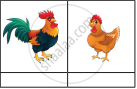
| rooster, king, hen, tiger, queen, tigress. |
Who was Nokomis?
What did he claim to know?
What did the boy make with the trunk of the tree?
What should parents do to ensure cyber safety for their wards? (Any three points)
Pick out word which mean the same as
place or fix (para 2)
Being a bachelor, the stranger had no patience with children.
