Advertisements
Advertisements
Question
The poetic effect is achieved in the poem through understatement and asides. Discuss this with examples.
Advertisements
Solution
The effect that an understatement or an aside creates is the vivid visual imagery that descends in the reader's mind while reading the poem. It brings the reader in resonance with the poet's mood while composing. The reader is overwhelmed with the setting through which the poet captivates the reader's mind. Thus, the work of these adjectives is to not just beautify but to create the image of the plot. The details of the background and other surroundings, the details about the characters that infuse the mind of the reader so that it all appears lucid to imagine and feel what the poet probably felt or is trying to convey through her/his creation.
When the poet details the environment like “on a broken window pane” and the rest, an image is imparted of the house the characters live in. The emotional effect is created when the narrator recalls “the man she loves who happened to be me” amidst the argument, it makes it clear that no matter how many debates or discussions happen the bond between a husband and wife is eternal and can not be challenged. The poet does not forget the little one around and his body language, he describes keenly. How with “his small legs well apart” he demanded his mother with dinner. The little boy is growing up, his body language reflects his attitude; “his crescent-moon-like chin uplifted eyes hard and cold” display his determination. These all draw images cascading in the mind along while one reads the poem.
APPEARS IN
RELATED QUESTIONS
It was her determination that helped Helen Keller get admission to Radcliffe College. Comment.
To what end have humans used their superior intelligence ?
Notice this expression in the text. Infer their meaning from the context.
the thought was almost revolting
Notice these expression in the text. Infer their meaning from the context.
careered down
Give reasons for the following statement.
The article has been titled ‘Silk Road.’
Examine the communication channels in the story between Paul and Bassett.
'Constancy' is the theme of the poem. Indicate the words, phrases, and images that suggest the theme.
Discuss with your partner and describe the atmosphere in the woods when Mrs. Adis didn’t hand over Peter Crouch to the keepers because -
- _________________
- _________________
- _________________
Have you heard of birds that fly from one part of the world to another in small or large flocks?
They are called Migratory birds.
Discuss and write down two reasons why they migrate and return.
The cherry tree has inspired the poet to compose the poem. Such poems, describing Nature or aspects of Nature are called ‘Nature poems’. Find out some expressions from the poem that bring out the elements of the beauty of Nature.
Answer the given question in your own words.
Why did the Swallow finally decide not to leave the Prince?
The term 'Anaesthesia' in the poem means - 'The planner gives beautiful pictures of the new modern city'. Now find out what is Amnesia and Hypnosis in the given context.
Guess the meaning of the following words and phrases:
untold wealth, closest to the Emperor’s heart, grave offence, banish.
Read the passage and answer the following question:
What is seen on the obverse and reverse of the PVC medal?
Explain the term plot.
Find sentences from the play related to the given points.
Loyalty in Irish Nationalism:
- Maybe Sergeant you’ll be on the side of the country yet.
- ____________________________
- ____________________________
- ____________________________
Put the following events in chronological order.
- The sword in the stone appeared in the churchyard.
- Lord Uther died.
- Lord Uther drove the barbarians away.
- The Lords and knights began to fight for the kingdom.
- Sir Kay left his sword behind at home.
- Merlin announced that Arthur was the son of Lord Uther.
- Arthur brought the sword from the churchyard.
- Ancient Britain was invaded by wild barbarians.
- Many knights tried to pull the sword out of the stone.
- Arthur grew up in Sir Ector’s house.
- Merlin entrusted a baby to Sir Ector.
Find out the following with the help of your teacher and the internet.
Rain in countries like the UK which experience spring-summer-autumn-winter.
Prepare similar word chains using the following ideas.
size - small _______________.
Complete the following sentence with reference to the passage.
It is believed that _________ Homer, who __________ and who ________ to all who __________________.
Answer the following question and write in short, why the parody sounds funny.
What does the crocodile stand for?
Complete the following diagram.
Observe the picture and the labels carefully. Then match the words and the meanings given in the following table.
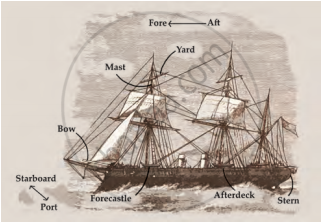
| Words | Meaning |
| 1. yard | (a) a floor, flat area built on a ship |
| 2. mast | (b) the forward part of the main body of a ship |
| 3. bow | (c) the forward part of a deck |
| 4. deck | (d) tall, upright pole on a ship |
| 5. forecastle | (e) a pole slung across a ship’s mast. A sail hangs from a yard. |
| 6. starboard | (f) the rearmost (back) part of a ship |
| 7. stern | (g) the part which is always at the front while the ship is sailing. |
| 8. afterdeck | (h) the right-hand side of a ship as one faces forward |
| 9. fore | (i) an open deck near the back |
Complete the following phrases with the help of the poem.
- ______ music
- ______ rivers
- ______ breeze
- ______ lake
- ______ citron-trees
Which of the words and phrases in the poem will you use in a realistic description?
Put a tick mark against the ones you will use.
- little
- shining tail
- golden scale
- cheerful
- grin
- claws
- gently smiling
- jaws
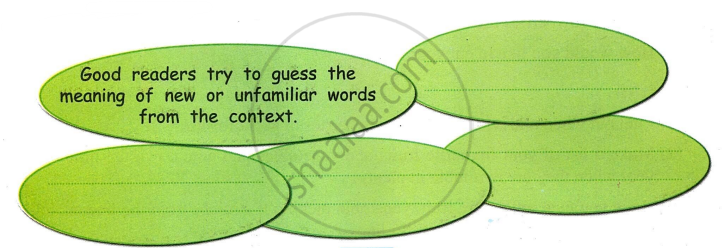
Form groups. Discuss how one can be a 'good reader'. Use the points in the above passage in your discussion. Write down the points that show what makes a 'good reader'.
Find the meaning of the following word.
delicious
Find out how the following game is played.
Football
Discuss the following in group.
Do’s and Don’ts for young children.
Find a word that has a similar meaning.
happily
Guess the meaning of the following word.
finely
The author left the ties in the taxi.
Read the following line from the poem and answer the question given below.
They growl at that and they growl at this;
Whatever comes, there is something amiss;
- What does the word ‘growl’ mean here?
- Why do they find everything amiss?
An Anagram is a word or a phrase formed by rearranging the letters of a different word or phrase, typically using all the original letters exactly once.
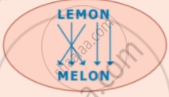
Now try to solve these anagrams
| 1. | ELBOW | |
| 2. | SECTION | |
| 3. | VIEWER | |
| 4. | RIPPLES | |
| 5. | NEEDLESS |
Hamid thought that his grandma would be pleased if he bought______
The market was ______ away from the village.
At dawn, the______ began to sing.
Look at the number pattern. Fill the blank in the middle of the series or end of the series.
QPO, NML, KJI, ______, EDC
He always had lunch with his family.
The captain presented a gift to Vasantha because ______
Identify the speaker/character.
Don't worry, Madam, it's only a warning.
When did the garden become a happy place for the author?
The land was wet and green.
Complete the sentence given below with word/phrase.
The hole became ______ and ______.
Name the planets the poet flies through.
The man didn’t want to get up because he was tired as he wcoas thrown into the ditch.
Did Santhosh enjoy his morning walk? How do you know?
They ate a bowl of __________.
A ________ dies for the nation.
Brain of a robot is the______.
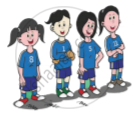
Write the events won by these players.
 |
______ |
 |
______ |
 |
______ |
Pick and write the adverbs to complete the sentence.
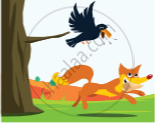
A jackal cheated the crow ______.
Find and write the clues.
Clue for lame ______.
Amir switched off the fan wheFalsen he walked out.
Leafcutter ants drink______.
What did Rani want to become?
Match the rhyming words.
| 1. | earn | day |
| 2. | fend | learn |
| 3. | glow | end |
| 4. | play | slow |
The fir tree was not happy with the gold leaves ______.
Write compound word using the pictures.
 |
+ |  |
| ____________ | ||
Form groups of four to six.
Discuss whether and how you can improve English spelling.
