Advertisements
Advertisements
प्रश्न
The poetic effect is achieved in the poem through understatement and asides. Discuss this with examples.
Advertisements
उत्तर
The effect that an understatement or an aside creates is the vivid visual imagery that descends in the reader's mind while reading the poem. It brings the reader in resonance with the poet's mood while composing. The reader is overwhelmed with the setting through which the poet captivates the reader's mind. Thus, the work of these adjectives is to not just beautify but to create the image of the plot. The details of the background and other surroundings, the details about the characters that infuse the mind of the reader so that it all appears lucid to imagine and feel what the poet probably felt or is trying to convey through her/his creation.
When the poet details the environment like “on a broken window pane” and the rest, an image is imparted of the house the characters live in. The emotional effect is created when the narrator recalls “the man she loves who happened to be me” amidst the argument, it makes it clear that no matter how many debates or discussions happen the bond between a husband and wife is eternal and can not be challenged. The poet does not forget the little one around and his body language, he describes keenly. How with “his small legs well apart” he demanded his mother with dinner. The little boy is growing up, his body language reflects his attitude; “his crescent-moon-like chin uplifted eyes hard and cold” display his determination. These all draw images cascading in the mind along while one reads the poem.
APPEARS IN
संबंधित प्रश्न
Read the extract given below and answer the questions that follow:
That for themselves a cooling covert make
"Gainst the hot season; the mid forest brake,
Rich with the sprinkling of fair musk-rose blooms;
..................
(a) Identify the poem and the poet.
(b) What is the role of the clear rills?
(c) How has the mid forest brake become rich?
(d) Name the figure of speech in 'cooling covert'.
Read the following extract and complete the activities given below :
A1 Compare the old and new house and complete the table :
| Points | Old House | New House |
| Surrounding | razzle-dazzle | – |
| Size of the house | – | big |
I was thirteen, the year we moved to the Cantonment at Allahabad. In stark contrast to the razzle-dazzle of the city’s commercial areas like Katra and Chowk, the Cantonment was a quiet, orderly place with broad tree-lined roads that still carried the names of long-dead Britishers. Our bungalow was on a sleepy by-lane called MacPherson Road. When we first saw it, my brothers and I were delighted. It was by far the biggest house we had ever lived in. The task of furnishing those huge, echoing rooms daunted mother.
“Is a slightly smaller house not available?” she asked father, “We do not have enough curtains for this place. And the furniture seems a little inadequate. Why did they have to plan the kitchen at such a distance from the dining-room? It is like doing a route march. And who is going to help me keep this place clean and dusted?”
Her misgivings and objections were undoubtedly valid. But, seeing our crestfallen faces, she sighed and gave in. We made extravagant promises to help in the household chores. Keep our rooms tidy. Put away our toys and books. She smiled with amused disbelief, her mind already working out how many meters of curtain-cloth would be needed and so on.
A2 Complete :
Complete the following list of objections that the mother had with the new house :
(i) Inadequate _______
(ii) Do not have _______
(iii) Kitchen at a distance from _______
(iv) A very big _______
A3 Personal response:
Do you agree with the objections raised by the mother? Explain.
Notice the kind of English Tsetan uses while talking to the author. How do you think he picked it up?
Briefly comment on:
The author’s physical condition in Darchen.
Tick the item that is closest in meaning to the following phrase.
to meet one's match
If you were to write about these issues today what are some of the incidents, examples and problems that you would think of as relevant?
What causes the element of surprise when the child comes on the scene of 'adult reconciling'?
'Whose roots lay deeper than our lives' – what aspect of human behaviour does this line reflect?
What are the unpleasant aspects of the human condition that the poet wants to escape from?
Pick out words from the poem to fill in the web diagram. They should be related to the theme in the web.
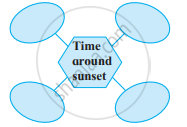
Say where . . . . . . .
______ do the cows and sheep stand?
Select any four zoo animals mentioned in the poem. Imagine they are able to talk in English. Compose a dialogue among the four animals discussing their discomfort and illnesses.
Read the lesson and name the following.
A sack around the heart ______
Read the following word and use it in a sentence of your own.
Renown
List all the words specially used in the game of Kabaddi.
Choose the odd one out :
Flute, Snug, Quince, Cobweb.
In each of the following line, spot the sound that is used repeatedly -
- There’s a silver house in the lovely sky.
- As round as a silver crown
- It takes two weeks to build it up. And two to pull it down.
Complete the following sentence with reference to the passage:
The king was determined to prevent his beloved son from ____________.
Visit a library:
Read stories about Gautama Buddha. Relate one story in the class.
List the various people and places mentioned in the passage. The places Milo visits and the people he meets have unusual names. Write the meanings of those names.
Prepare similar word chains using the following ideas.
waterbody - pool ____________.
Guess the meaning of the following word:
exorbitantly
Write the smaller and related words that you see within this word.
Pick out words from the poem that describe the following. List them in Column ‘A’. Substitute each of those describing words with another word/phrase of the same meaning.
| A (Poetic words) | B (Your own words) | |
| the ‘Autumn’ | a maiden fair | |
| stars | ||
| moonlight | ||
| cooing of birds |
Answer the following question and write in short, why the parody sounds funny.
Why does the bee work hour after hour?
What do you like better - the original poem or the parody? Why?
Present these points in the form of a review, and give it a suitable title.
Find the meaning of the following words or phrases :
- ridges
- brimming
- eddying
- babble
- fallow
- trout
- netted
Which lines are repeated in the poem? What do they mean?
The table-tennis set was gifted by ______.
Read the poem and answer the following.
What are the two different ways of eating strawberries?
Discuss how you will measure the worth of a book.
Enact the play.
Find a word that has a similar meaning.
unfair
What is used to make Rangoli designs?
| soft | vain | fear | joy | love | heard | toiled | mild | good | sand | life | harsh |
The ______, the______, which it may bring.
Identify the character/speaker.
Oh no, I'll never get back to the right size.
Why did the train stop in the middle of the forest?
Read the line and answer the question.
And the wheel’s kick and the winds song and the white sail’s shaking
What according to the poet are the pleasures of sailing?
What did Raj buy?
Mother called ______.
There is a connection between the rhyming words and rhythms of the train. Present your views about it.
The wild boar got up from its daybed because it was disturbed by another boar.
Read the lines and answer the questions given below.
Summer comes
in a blaze of heat with
sunny smiles
and dusty feet
- Does the poet welcome the summer? How do you know?
- Which line tells you that there is no rain in summer?
Why don’t we use chemicals?
When do we land on Mars?
Master trained Akilan on a ______.
Name the character or speaker.
“How did I win the competition with a single stroke?”
Read the passage three times and colour a spacesuit for each time.
A spacesuit is like a spaceship built for one. A spacesuit lets us work and live in space. It protects us from the heat and the cold. It gives us air to breathe. The suit is made of many parts and has water to drink. It even has a built-in toilet, if you need to use it.
Why did he grow crops?
Write the word under the correct group and divide it.
bullet
candle
bat
title
ball
tiffin
 |
 |
 |
Name the character or speaker.
"Are you alright?"
How did they go to school?
Where do the moles save their food?
When does the world become green?
What did Rani want to become?
Write the word with same meaning.

queue- ______
The child won’t ______ anything, if he closes his ears.
What is the best time to water the plants?
What did he call his puppet?
Read the passage below:
| 1. | Our history makes it evident that the Indian Plastics Industry made a vigorous beginning in 1957 but it took more than 30 years for it to pervade Indian lifestyles. In 1979, "the market for plastics' was just being seeded by the state-owned Indian Petro-Chemicals and it was only in 1994 that plastic soft drink bottles became a visible source of annoyance. |
| 2. | In the same year, people in other cities were concerned about the state of public sanitation and also urged regulatory bodies to ban the production, distribution and use of plastic bags. However, the challenge was greater than it appeared at first. |
| 3. |
The massive generation of plastic waste in India is due to rapid urbanisation, spread of retail chains, plastic packaging from grocery to food and vegetable products, to consumer items and cosmetics. The projected high growth rates of GDP and continuing rapid urbanisation suggest that India's trajectory of plastic consumption and plastic waste is likely to increase.
|
| 4. | According to the United Nations Environment Programme (UNEP) report of 2018, India stands among few other countries like France, Mongolia and several African countries that have initiated total or partial nationallevel bans on plastics in their jurisdictions. On World Environment Day in 2018, India vowed to phase out single-use plastics by 2022, which gave a much needed impetus to bring this change |
| 5. | In this context, thereafter ten states (Andhra Pradesh, Chhattisgarh, Gujarat, Himachal Pradesh, Karnataka, Madhya Pradesh, Meghalaya, Odisha, Rajasthan and Tamil Nadu) are currently sending their collected waste to cement plants for co-processing, twelve other states/UTs are using plastic waste for polymer bitumen road construction and still four other states are using the plastic waste for waste-to-energy plants and oil production. A world of greater possibilities has now opened up to initiate appropriate and concrete actions to build up the necessary institutions and systems before oceans turn, irreversibly into a thin soup of plastic. |
| 6. | However there is no one single masterstroke to counter the challenges witnessed by the staggering plastic waste management in the country. The time is now to formulate robust and inclusive National Action Plans and while doing so, the country will establish greater transparency to combat the plastic jeopardy in a more sustainable and holistic way. |

Based on your understanding of the passage answer any six out of the seven questions given below:
- What does the writer mean by 'visible source of annoyance'?
- Why did people demand a ban on plastics?
- What created a demand for plastics in India?
- With reference to the graph write one conclusion that can be drawn about the production of plastics in 2019 (approximately).
- What does the upward trend of the graph indicate?
- What does the line, oceans turning 'irreversibly into a thin soup of plastic', suggest?
- What step must be taken to combat the challenges of plastic waste management? What will be its impact?
