Advertisements
Advertisements
प्रश्न
Taking off from Forster’s references to Emily Bronte, Sterne and Proust, discuss the treatment of time in some of the novels you have read.
Advertisements
उत्तर
Over time, novels have creatively used the aspects of time. Most of the novels like To Kill a Mockingbird, The Alchemist, Pride and Prejudice and Famous Five etc. follow a chronological pattern, revealing truth in time. However some novels like The Girl on the Train narrates the story going back and forth in time and thereby becoming a thriller. Some genres like fantasy also narrate story of two or more realms like the realm of God and the realm of normal humans like in mythological twists like The Red Pyramid where times passes differently in each.
APPEARS IN
संबंधित प्रश्न
B1. What does the poet want us to do in the following situation?
(a) While struggling ………..
(b) While making money ………
(c) While dreaming ………………
(d) While losing …………..
It's doing your job the best you can,
And being just to your fellow man;
It's making money-but holding friends,
And being true to your aims and ends.
It's figuring how and learning why,
And looking forward and thinking high;
And dreaming a little and doing much,
It's keeping always in closest touch.
With what is finest in word and deed,
It's being through, yet making speed;
It's daring blithely the field of chance,
While making labour a brave romance.
It’s going onward despite defeat
And fighting staunchly, but keeping sweet;
It's struggling on with the will to win,
But taking loss with a cheerful grin.
B2. Achieving Success
Hints given by the poet to become successful are
(a) Doing your job the best
(b)
(c)
(d)
(e)
B3. Poetic Device
Select the appropriate rhyme scheme for the 3rd stanza.
(1) abab
(2) aabb
(3) aaba
How important was the presence of Miss Anne Sullivan in Helen’s life?
How did the air raids disrupt the Dutch public life?
Answer the following in 30-40 words each:
(a) Why do you think the booking clerk refused to accept the money? Why did the narrator get out so fast?
(b) Why could the Russian research vessel, ‘The Akademik Shokaskiy’ not move any further? What did the captain decide then?
(c) What sort of hunts did the Maharaja offer to organize for the high-ranking British officer? What trait of the officer does it reveal?
(d) What did Jo want the wizard to do when Mommy Skunk approached him?
Answer the following question in 120-150 words:
What kind of life did Silas lead at Lantern Yard?
Read the following extract carefully and complete the activities given below :
A1 Complete the following :
(i) Books were found on the _____________ and ____________.
(ii) The tales are described as ______________ and __________.
|
Have you forgotten? Don't you know?
We'll say it very loud and slow:
THEY ... USED ... TO ... READ! They'd READ and READ,
AND READ and READ, and then proceed
To READ some more. Great Scott! Gadzooks!
One-half of their lives was reading books!
The nursery shelves held books galore!
Books cluttered up the nursery floor!
And in the bedroom, by the bed,
More books were waiting to be read!
Such wondrous, fine, fantastic tales
Of dragons, gypsies, queens, and whales
And treasure isles, and distant shores
Where smugglers rowed with muffled oars,
And pirates wearing purple pants,
And sailing ships and elephants,
And cannibals crouching 'round the pot,
Stirring away at something hot.
(It smells so good, what can it be?
Good gracious, it's Penelope.)
|
Comment on the influence of English – the language and the way of life – on Indian life as reflected in the story. What is the narrator's attitude to English?
How do Shahid and the writer react to the knowledge that Shahid is going to die?
‘The Tale of Melon City’ has been narrated in a verse form. This is a unique style which lends extra charm to an ancient tale. Find similar examples in your language. Share them in the class.
What, according to Russell, is the importance of love in life?
How do the patterns of creativity displayed by scientists differ from those displayed by poets?
Explain the metaphor in the line: ‘Poets are the mirrors of gigantic shadows that futurity casts on the present’.
The lecture was delivered in 1864. What are the shifts in style and diction that make the language different from the way it is used today?
Write down in your own words the way Laurie confirmed the names of the March sisters.
Read the story and complete the following.
At first, Revathi’s plants did not look normal and healthy because, ____________.
Answer the given question in your own words.
What message do you get from this story?
State the difference between drama and novel.
Select the correct options :
A Midsummer-Night’s Dream is a ___________________.
- poetic drama
- comedy of errors
- a comedy based on fantasy
- a character play
- a revenge tragedy
- belongs to realm of dreams
Discuss and write 1-2 lines about the following,
Yonamine’s ideas about marriage.
Answer the following question in one sentence.
Who misses all the fun?
Talk to your parents and family members and write what you could do when you were a day old.
Complete the following sentence with reference to the passage:
He realised that making the body suffer was not ____________.
In the novel, the Lethargarians give a whole day’s time table of their activities. Can you guess what it would be like?
Use your own ideas and prepare their time table.
Write one or two sentences about something beautiful, using your own experience or imagination. Then rearrange the words in the sentences in a poetic form. You may write about a beautiful day, a beautiful night, a stream, a crop standing in a field, a graceful bird or animal, etc.
Prepare similar word chains using the following ideas.
waterbody - pool ____________.
Read the following and observe the use of tenses.
‘Last week I witnessed a strange accident. Let me tell you about it. The signal flashes green. Vehicles start in the opposite direction. They move fast. Suddenly a speeding motorcyclist tries to cut across, from the wrong side. He is about to collide with a loaded truck. He applies the brakes. He falls and slides out with his bike from under the truck. He comes out unscathed on the other side.’
- When an event, which has occurred in the past, is narrated in the Present Tense to create a dramatic effect its Tense is called the ‘Dramatic Present Tense’.
- Now try to relate Jayant’s sci-fi story, in brief, in the dramatic past tense.
‘Unke, Munke, Timpetoo,
I wish, my wish is coming true.’
Try to compose two other funny magical chants that have rhyming lines.
Correct the following sentence and rewrite it.
By afternoon, Papa Panov had stopped looking out for Jesus.
Guess the meaning of the following word.
postponed
Write what the following do, with the help of the poem.
ripples
Discuss the following in group.
Do people admit that they have bad habits?
Guess the meaning of dreary.
Identify the character or speaker.
I was Duke of Milan, and you were a princess.
What will happen to the bird in imprisonment?
What were the children doing beside the stone wall?
What did Usha see while walking to the bazaar?
Read the poem aloud in pairs
Identify the speaker/character.
Don't worry, Madam, it's only a warning.
Sea turtles are very small.
In India’s coastal waters we can see a species of ______.
Identify the speaker/character.
They somehow managed to put him on the platform.
Why did the farmer have to travel far?
Which planet has rings around it?
The boy and the girl were taken by the cavalry to explain their action.
Match the rhyming words.
| filth | farmer |
| cook | harm |
| charm | wealth |
| armour | look |
Fruits and shadows are free under the _______.
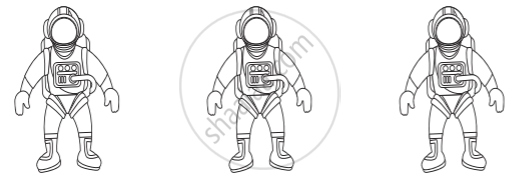
Read the passage three times and colour a spacesuit for each time.
A spacesuit is like a spaceship built for one. A spacesuit lets us work and live in space. It protects us from the heat and the cold. It gives us air to breathe. The suit is made of many parts and has water to drink. It even has a built-in toilet, if you need to use it.
How did the girl seem?
Uthaman was skilled in _____.
What does the man have?
Guess how would the sparrow pull the elephant and the crocodile.
Name the character or speaker.
"Do you have a fever?"
Amir switched off the fan wheFalsen he walked out.
Fill in the blank
Let us learn a few more word by joining the dots. Join the dots and fill the table below.
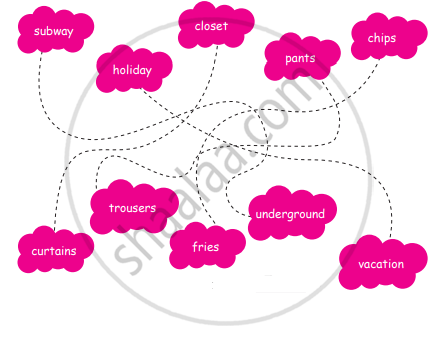
| subway | |
| holiday | |
| closet | |
| pants | |
| chips |
Recite the poem Never give up with correct intonation.
The pretty little fir tree was happy with gold leaves but______.
“Something is wrong,” said Helen’s mother. What was wrong with Helen?
According to Tagore, when will India get the opportunity to win the gift of freedom?
Being a bachelor, the stranger had no patience with children.
