Advertisements
Advertisements
प्रश्न
How do Shahid and the writer react to the knowledge that Shahid is going to die?
Advertisements
उत्तर
A model answer has been provided for students' reference.
It is strongly recommended that students prepare the answer on their own.
“Oh dear! I cant see a thing...I hope this doesn't mean that I am dying,” The fear of death was very vividly visible in Shahid's tone of voice and usage of words. He got scared when he felt for the first time that he was dying. When his occasional memory lapses became more serious with passage of time, the realisation of death drawing nearer becomes stronger. When he was in a conversation with Amitav Ghosh, he said in a clear ringing voice- “When it happens, I hope you will write something for me.” The writer could think of nothing to say on such a topic. At last, he had to promise, “I'll do the best I can.” From that day, the writer started keeping a record of all the conversations and meetings he had with Shahid. This record helped him to fulfil his promise.
संबंधित प्रश्न
He asked. Boy, did he ask! First he asked me for a chance, then he asked nearly all the people he came across if they wanted to buy a telephone system from him. And his asking paid off. As he likes to put it, “Even a blind hog finds an acorn every once in a while.” That simply means that if you ask enough, eventually someone will say ‘yes’.
He cared. He cared about me and his customers. He discovered that when he cared more about taking care of his customers than he cared about taking care of himself, it wasn’t long before he didn’t have to worry about taking care of himself.
Most of all, Cowboy started every day as a winner! He hit the front door expecting something good to happen. He believed that things were going to go his way regardless of what happened. He had no expectation of failure, only an expectation of success. And I’ve found that when you expect success and take action on that expectation, you almost always get success.
Cowboy has made millions of dollars. He has also lost it all, only to get it all back again. In his life as in mine, it has been that once you know and practice the principles of success, they will work for you again and again.
He can also be an inspiration to you. He is proof that it’s not environment or education or technical skills and ability that make you success. He proves that it takes more: it takes the principles we so often overlook or take for granted. These are the principles of that Ya Gotta’s for success.
Question:
(1) What was the cowboy’s motto?
(2) What did the cowboy learn after he lost millions of dollars?
(3) Why did the cowboy firmly believe that asking would pay off?
(4) When you expect success and take action on that expectation you almost always succeed. [Name the part of speech of the underlined words]
(5)
(a) He cared about me and his customers. [Rewrite using ‘not only ……………….but also’’]
(b) Cowboy has made millions of dollars [Add a question tag]
(6) In what way is the cowboy a source of inspiration for you?
Anne's father was close to her. What did she like about him? Why?
To what end have humans used their superior intelligence ?
Which language do you use to talk to elderly relatives in your family?
We 'draw up a deed'. Complete the following phrase with an appropriate word.
________a deaf ear to
Why does Russell call the three passions 'simple'?
The peacock is a colourful bird. How does the poem capture the various colours that its plumage displays?
Discuss the following in pairs or in small groups.
Kumudini Lakhia's life is an inspiring illustration of the emancipation of women.
The poem has a literal level and a figurative level. Why has the poet chosen 'tigers' and 'sheep' to convey his message?
Read the following statement and mark those that apply to you.
I have a small group of close friends and have no wish to interact with anyone else.
Find from the story one word for the following.
a low constant sound made by cats ______
Read the poem and write 3 qualities of the following.
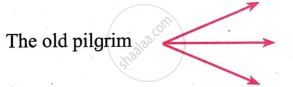
Answer in your own words.
What are the provisions in the Declaration of the United Nations, to ensure the equality of men and women?
Little creatures in nature can also be your teachers. Think and write what we can learn from the following.
Bees:
Read the Preamble of the Constitution of India given in your textbook. Pick out a word that refers to the following.
Brotherhood
Pick out a word from the poem to complete the sentence meaningfully.
Stephen Hawking was a ______ (famous) Astrophysicist.
Make a list of archaic words from the poem and give their modern equivalents.
Discuss with your partner and complete the web, highlighting the sad and gloomy aspects of life mentioned in the first part of the poem.

Behrman was a hard-hearted person.
When a poet/writer attempts to describe something in words, so that it appeals to our five senses (sight, smell, hearing, touch, taste) he/she has used a device called Imagery.
For example: ‘a host of golden daffodils’.
‘to a chasm, deep and vast and wide’.
Go through other poems in your textbook or other books and find outlines that contain Imagery. Write them down along with the name of the poem and line/stanza number.
Find out from a vet or from a website, what precaution a vet has to take when he/she is called to treat wild, dangerous animals?
Make point-wise notes of the same.
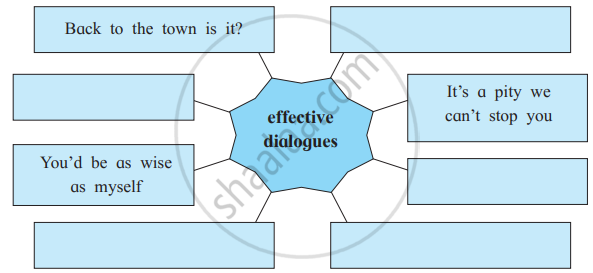
There are some dialogues that are short, but quite effective. They give us enjoyment and add beauty to the main story. Find some more from the text.
“A Midsummer-Night’s Dream” is one of the best examples of Shakespeare’s Comedy of Errors. Comment.
Talk to your parents and family members and write what you could do when you were a day old.
Shylock was not at all generous.
Write about one occasion when you have behaved like -
Mr. Nobody
What does the poet want to do?
What changes do we see in the life of human beings when the season changes? Write with reference to their clothes.
Pick out words from the poem that describe the following. List them in Column ‘A’. Substitute each of those describing words with another word/phrase of the same meaning.
| A (Poetic words) | B (Your own words) | |
| the ‘Autumn’ | a maiden fair | |
| stars | ||
| moonlight | ||
| cooing of birds |
Find the meaning of the following words or phrases :
- ridges
- brimming
- eddying
- babble
- fallow
- trout
- netted
Put the following expressions in a table of Do’s and Don'ts as expressed by the poet.
- Please listen
- give me advice
- tell me why
- solve my problem
- just hear me
- accept as a simple fact
- contribute to my fear
- wait a minute
| Do’s | Don'ts | |
| 1. | ||
| 2. | ||
| 3. |
Write in your own words.
How does the poet describe his home in the second stanza?
List and say whether the following statement agrees with the passage or not.
You should look at the person you are talking to.
Describe Gulliver’s walk around the city.
What does a farmer need most for his fields?
What is the ‘Internet’?
Hamid’s granny scolded him for buying iron tongs. Then she understood that Hamid had bought it ______.
Read the comic strip and answer the following question.
What do you mean by cyber safety?
Read the comic strip and answer the following question.
Do you think that all the information online can be used without any permission?
What do you need to learn to live a good life in this world?
Fill in the table
| Problems Faced By Mr. Fogg And His Team | Solution |
| The train stopped in the middle of the forest. | |
| They couldn’t hire the elephant. | |
| They were in need of an elephant driver. |
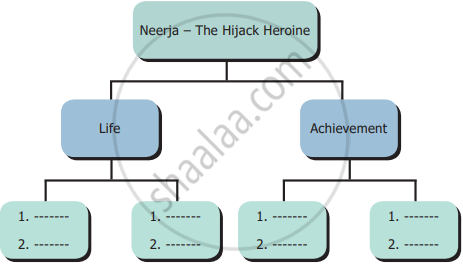
Read the “Story of Self Sacrifice and Bravery” once again and complete the flow chart.
Why do we need trees? List four reasons that Grandfather gives.
Read the lines and answer the question given below.
And ever again, in the wink of an eye,
Painted stations whistle by
- ‘In the wink of an eye’ means very quickly. Explain ‘painted stations whistle by’.
_____ is called the red planet.
Work in groups. Discuss and have a debate on life in bustling cities and life in calm towns.
_______ broke out in the near by villages.
_________ is the memorial for the soldiers.
Read scene I of the play carefully and answer the question below.
Match the following.
| Sr.No. | CHARACTER | TRAIT |
| a. | Father Wolf | with a grey nose…feeds her four cubs |
| b. | Tabaqui | the big one from Waingunga River with a lame foot |
| c. | Mother Wolf | the chief of the Wolves |
| d. | Shere Khan | begs for meat and thanks for the meal/warns the wolves about the arrival of Shere Khan |
Name the character or speaker.
"Play me a pleasant song."
Why did the old man need someone?
Match the following.
| pale |  |
| tremble |  |
| fainted |  |
Answer the following yes or no question.
Did all visit the waterfall?
Fill in the blank with rhyming word.
tunnels- ______
Choose the word with same meaning.
Foot hills- ______
Name the animal and sound it makes.
What incident made Mugund make a wooden drum?
Choose the right word.
The tamarind tree grows over Tansen’s ______.
Which of the following should one avoid while using social media? Tick against the correct options.
