Advertisements
Advertisements
प्रश्न
Discuss the following in pairs or in small groups.
Kumudini Lakhia's life is an inspiring illustration of the emancipation of women.
Advertisements
उत्तर
Kumudini Lakhia's life shows the emancipation of women. She started learning dance under the inspiration of her mother. She later on joined an Agriculture course. In the Agriculture college she could experience the behaviour of boys and the American teachers. After the completion of the course, she chose to join Ram Gopal company as a performer. Having led a successful dance career, she settled in a married life. All these show that she was free to chose her ways despite being a woman and the way she could establish her identity in her career is inspiring illustration of the emancipation of women.
APPEARS IN
संबंधित प्रश्न
How did a story book, 'Little Lord Fauntleroy' open a window of knowledge to Helen and help to shape her career?
How did Helen benefit when Dr. Graham Bell accompanied her to the World Fair?
Read the extract and do the activities that follow:
The duke senior and his follower were sitting down to a meal one day when Orlando rushed out from among the trees, his sword in his hand. ‘Stop, and cat no more!’ he cried. The Duke and his friends asked him what he wanted.
‘Food,’ said Orlando. ‘I am almost dying of hunger’. They asked him to sit down and eat, but he would not do so. He told them that his old servant was in the woods, dying of hunger. ‘I will not eat a bite until he has been fed,’ Orlando said.
So the good Duke and his followers helped him to bring Adam to their hiding-place, and Orlando and the old man were fed and taken care of. When the Duke learned that Orlando was a son of his old friend sir Rowland de Boys, he welcomed him gladly to his forest court.
Orlando lived happily with the Duke and his friends, but he had not forgotten the lovely Rosalind. She was always in his thoughts andevery day he wrote poetry about her pinning it on the trees in the forest. ‘These trees shall be my books,’ he said, ‘so that everyone who looks in the forest will be able to read how sweet and good Rosalind is’.
Rosalind and Celia found some of these poems pinned on the trees. At first they were puzzled, wondering who could have written them; but one day Celia came in from a walk with the news that she had seen Orlando sleeping under a tree, and she and Rosalind guessed that he must be the poet. Rosalind was happy to think that Orlando had not forggoten her, because she loved him as much as he loved her.
A1. Complete - (2)
Complete the following sentences:
(i) Rosalind was happy to think _______
(ii) The Duke and his followers helped Orlando to bring _________
(iii) Orlando pinned the poems written about Rosalind on ______
(iv) When the Duke cam to know that Orlando was a son of his old friend, he _________
A2. Write a gist: (2)
Write a gist of the above given extract in about 50 words.
What do elephants do to prevent water from evaporating ?
How do you respond to these lines?
Light, chill and yellow,
Bathes the serene
Foreheads of houses
Think and answer in your own words.
How do parents react when they see children soil their clothes in dust and heat?
Think and answer in your own words in your notebook.
Why does the poet appeal to us, to respect the life of a worm?
The poem is a Petrarchan Sonnet. The poem is divided into two parts -
- An Octave
The first part comprising eight lines. - A sestet
The second part comprising six lines.
Read the first four lines of the poem. The rhyme scheme is a b b a. Read the rhyme scheme for the next four lines. It is a b b a. Now read the first three lines of the sestet and note the rhyme scheme. It is c d c. The rhyme scheme of the last three lines is d c d. This is the common design of a Petrarchan Sonnet.
This is a Petrarchan Sonnet. Complete the given table by giving examples from the poem.
| Features | Examples / Lines |
| Objects used | |
| Praise/blames | |
| Metaphor | |
| Simile | |
| Personification | |
| Number of lines | |
| Rhyme scheme |
Think and answer in your own words.
'Beauty' in stanza 5 to 6 can refer to a beautiful maiden as well as nature itself. Explain when and how nature ‘dances’ and also 'smiles'.
Human beings can learn from honey bees ______.
Do as directed. (Make sure you do not change the meaning and tense of the sentence).
I am proud of you. (Rewrite using the noun form of the underlined word).
Write about how your family supports you to go to school.
List five of your favourite Hindi or Marathi poems or songs. Try to translate any one of them into English.
The word 'Review' is different from summarizing and appeal writing. Choose the correct statements of the following.
What are the clothes compared to? Give two examples.
Discuss and write 1-2 lines about the following,
The lesson that Bushi learned.
Find the meaning of ‘Charity begins at home’. Find other sayings which have a similar meaning.
Prepare similar word chains using the following ideas.
wind - breeze __________________.
Turn the story into a play as a group activity and present the scenes in the classroom.
Guess the meaning of the following word:
exorbitantly
Write the smaller and related words that you see within this word.
Find the names of the exotic musical instruments and animals mentioned in the poem.
Read: ‘Just So Stories’ and ‘The Jungle Book’ by Rudyard Kipling.
Form groups of 6-8. One person (leader) chooses one item - a picture, a paragraph, or a lesson from any one of the 9th standard textbooks and writes the reference on a slip of paper, and folds it. Others ask him/her questions and try to guess what it is, from his/her answers. Follow the rules given below.
- The maximum number of questions the rest of the group can ask is 20.
- You cannot ask a direct question like ‘What do you have in mind?’
- You can ask ‘Wh-’ questions or ‘Yes/no’ questions.
- The leader has to give truthful answers.
Say whether you agree or disagree.
The wolf could not trace Bertha because she was behind a myrtle bush.
Who is a ‘netizen’?
Helen Keller’s life is the story of ______.
Make a collection of Rangoli motifs and patterns.
Write about each motif or pattern in your own words -
it could just be a label or a description or some information or comment.
Your parents sometimes behave like the young bird’s parents. They may seem cruel and unrelenting. Does it mean that they do not care for you? Explain your views about it with reference from the story
Marco Polo, Christopher Columbus, Ibn Battuta, Amerigo Vespucci, Xuanzang, Ferdinand Magellan, Bartolomeu Dias, Herodotus, Captain James Cook, Vasco De Gama.
What is common among these individuals? Browse Internet or refer books and share some information about them.
Who were the inhabitants of the island?
What did the narrator think the unusual sound was?
Mention the things that the grandfather imagined.
The rich man was from...
What are the three rules given by the bird?
Read the following incident carefully to answer the question that follow.
The tie that does not bind
“Oh, so you’re going abroad? Can you bring me back…..?” I’ve been asked to bring back a vaccine for a course. Once I searched the suburbs of Paris for two days for a special brand of ceramic paint. Having spent a lot of money for Cartier lighter refills, I had them confiscated at the airport just before boarding because the gas might be dangerous in the air.
Now, two months before a trip, I stop talking to people so they won’t suspect I’m about to travel. But someone always catches me.” I’ve heard you’re going to New York, and I want you to get something for me. It’s just a little thing you can find anywhere. I don’t know exactly how much it costs, but it shouldn’t be much. We’ll settle up when you get back”.
What Gilson asked me to buy was, in fact, a little thing: a tie. But not just any tie. He wanted a tie with a small embroidered G. Any colour would do, as long as it had his initials. Look, this is a special flight, I explained. We are only staying Saturday through Tuesday. On the day we arrived I didn’t have time to think about the tie, but strolling around on Sunday I did see ties bearing various letters in more than one shop window. They were cheap, just a dollar, but all the shops were closed.
On Monday, lunch lasted the whole afternoon. Then it was Tuesday morning, time to leave. It was only when I saw our airport bus waiting outside the hotel that I remembered the tie.
I told the group to go on. I would get a taxi to the airport. And so I went in search of a nearby shop where I had seen ties.
But I couldn’t find it. I walked further down the street-one, two, three blocks - all in vain. Back at the hotel, a bit anxious now, I took my suitcase, got a taxi and asked the driver to rush to the street where I had seen them.
The driver stopped at each shop we passed so I could look from the window. The stores had all sorts of ties, but not the kind I was looking for.
When I finally thought I had located the right shop, I decided to go in and check. The driver refused to wait. Parking was prohibited, he said. I promised to double the fare, jumped out and ran into the shop. Was I going to miss the plane just for a damned tie?
The salesman was unbearably slow. When I realized that the smallest change I had was a ten dollar note , I grabbed ten ties of different colours so I wouldn’t have to wait for change. I rushed out with the ties in a paper bag.
On the street I looked around. The taxi had vanished, taking my suitcase. What is more, I was going to miss the plane.
I ran to the corner, and hope flared up again: the taxi was waiting in the next street. Quick to the airport! As I settled down inside the taxi. I sighed with relief. Gilson was going to have enough initialized ties to last him a lifetime.
When I reached the airport, I paid the taxi driver the double fare and grabbed my suitcase. Panting, I boarded the plane under the reproachful gaze of the other passengers, all primly seated with their seat belts fastened. Ready to take off. Departure had been delayed because of me.
“At least I hope you found your tie”, said one who knew the story.
“I did”, I answered triumphantly.
After making myself comfortable, I reached for the paper bag to show the ties.
I had left it behind; in the taxi.
Fernando Sabino.
Read the incident again and answer the following question.
What was the writer always asked to do whenever he planned to go abroad?
What game did Anne choose to play?
Hamid’s friends are ______
Have you ever had a strange dream? Share your dream in the class.
Why did the governments of India, America and Pakistan – honour Neerja?
Write a summary based on the flow chart.
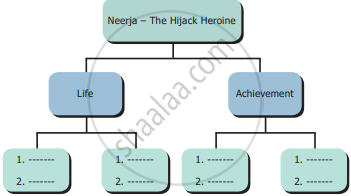
Work in pairs and answer the following.
Pick out the rhyming words.
Find out the idiom that relates to ‘whatever the circumstances’, from the first paragraph.
Is the brother boastful? What makes you think so?
Read scene I of the play carefully and answer the questions below.
Tabaqui acts as ______ to the pack of wolves.
Vicky's dad bought a ______ robot.
Kaliyan worked in a ______.
Why do we discover a mystery?
They fed fish with______.
Bala and Janani acted like the______.
Choose the correct picture for the passage.
There is a table under a tree. A man with a big hat and a hare with long ears are sitting. A young girl is sitting between them. There are many cups on the table. The girl has a cup in her hand, and the man has a pot in his hand. It seems like they are having tea. Yes, they are having tea at the tea party in Wonderland. The girl is Alice, and she is in Wonderland.
______is next to parents in care.
Number the actions of Pandi and Nandhini in order.
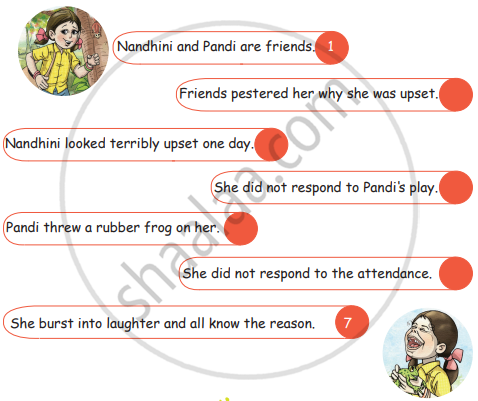
What did Kani realize in the story?
At the end of the festival , Kamali and Senthil saved______.
What does she paint?
“Something is wrong,” said Helen’s mother. What was wrong with Helen?
Complete the dialogue.
| Anil: | Which is your favourite book? |
| Sunil: | ________________________ |
| Anil: | What type of book is it? |
| Sunil: | ________________________ |
