Advertisements
Advertisements
Question
How do Shahid and the writer react to the knowledge that Shahid is going to die?
Advertisements
Solution
A model answer has been provided for students' reference.
It is strongly recommended that students prepare the answer on their own.
“Oh dear! I cant see a thing...I hope this doesn't mean that I am dying,” The fear of death was very vividly visible in Shahid's tone of voice and usage of words. He got scared when he felt for the first time that he was dying. When his occasional memory lapses became more serious with passage of time, the realisation of death drawing nearer becomes stronger. When he was in a conversation with Amitav Ghosh, he said in a clear ringing voice- “When it happens, I hope you will write something for me.” The writer could think of nothing to say on such a topic. At last, he had to promise, “I'll do the best I can.” From that day, the writer started keeping a record of all the conversations and meetings he had with Shahid. This record helped him to fulfil his promise.
RELATED QUESTIONS
Attempt the following in 150-200 words.
Why does Anne call herself 'a bundle of contradictions'?
Answer any four of the following in 30 – 40 words each
(a) What precautions were taken for the smooth conduct of Evan's O-Level examination ?
(b) How did Jo want the Roger Skunk story to end ?
(c) What makes human beings love life inspite of all the troubles they face?
(A Thing of Beauty)
(d) What is suggested by the phrase, 'massive weight of Uncle's wedding band' ?
(e) How did Douglas remove his residual doubts about his fear of water ?
(f) Why did M. Hamel write 'Vive La France' on the blackboard ?
How is the social life at Raveloe different from that at Lantern Yard ?
Answer the following question in 150-200 words:
Why did Anne like her father more than she liked her mother?
How do you distinguish between information gathering and insight formation?
The episode has been narrated in a light vein. What social mores does the author seem to ridicule?
Examine the communication channels in the story between Paul and his uncle.
Fibreglass kites led to creating power - driven aeroplanes.
Using points from the lesson, give the details of the following in a short paragraph.
Different types of kites.
Write 3 to 4 lines about the following in your own words.
First Cardiac Surgery
The drone is given a death sentence because he ______.
Form pairs and decide whether the following statements are those of a Great Indian Bustard or not.
| Statements | Great Indian Bustard | Some Other Bird |
| (a) I am the heaviest flying bird in India. | ||
| (b) I am known as Maldhok or Hoom in Marathi. | ||
| (c) I live in mountainous regions. | ||
| (d) I don’t like grasshoppers or beetles. | ||
| (e) We don’t believe in building nests. | ||
| (f) Our chick stays with the mother for a period of nearly one year. | ||
| (g) I am the State bird of Maharashtra. | ||
| (h) We have been pushed away from more than 90 percent of our home regions. |
Fill in the gap, choosing a word from the bracket to make an appropriate comparison.
(tall / quiet / humble / merry / busy / slippery / fast / sly / slow / big)
as ______ as a snail
State whether the following statement is True or False:
Lysander and Demetrius fall in love with Helena as a result of the love potion.
Shakespeare’s poetry has come to be valued for its own sake on the stage. Comment with reference to the play ‘A Midsummer Night’s Dream.’
Enact the advertisement:
Seven children wait in different places, striking a suitable pose as shown in the ad. The character ‘Krispy Krunchy’ comes in dancing. He goes near every child, singing the words shown in the ad. He offers a Krispy Krunchy piece to every child.
The child eats it and begins to smile and clap. At the end, the character faces the class, shows a big pack of Krispy Krunchy, and presents the last few lines.
Answer the following question in one sentence.
What examples of man’s progress have been given in the poem?
Write a conversation between a donkey and a school boy.
Write the following in short:
The story of the three caskets.
Who is the speaker in the poem?
Complete the following sentence with reference to the passage:
Gautama, the Buddha, was born over two thousand five hundred years ago, as ______.
A parody is a playful, comic imitation of a writer’s style. A parody is like a verbal cartoon. Compare the original poem and its parody given on page 35 using the following points:
|
How doth the little busy bee |
How doth the little crocodile (parody) |
| Choice of a subject (an animal) | __________________ |
| __________________ | __________________ |
| Number of lines and stanzas | __________________ |
| __________________ | __________________ |
| Same or similar constructions | __________________ |
| __________________ | __________________ |
| Tone of the poem | __________________ |
| __________________ | __________________ |
Observe the picture and the labels carefully. Then match the words and the meanings given in the following table.
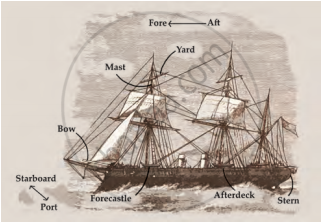
| Words | Meaning |
| 1. yard | (a) a floor, flat area built on a ship |
| 2. mast | (b) the forward part of the main body of a ship |
| 3. bow | (c) the forward part of a deck |
| 4. deck | (d) tall, upright pole on a ship |
| 5. forecastle | (e) a pole slung across a ship’s mast. A sail hangs from a yard. |
| 6. starboard | (f) the rearmost (back) part of a ship |
| 7. stern | (g) the part which is always at the front while the ship is sailing. |
| 8. afterdeck | (h) the right-hand side of a ship as one faces forward |
| 9. fore | (i) an open deck near the back |
Read the following words aloud and copy them in your notebook.
- idle
- enough
- exclaimed
- commotion
- astounded
- antics
- wander
- wielding
Read the poem and answer the following.
Which strawberries are sweeter?
Name the following.
Not comfortable with the wet ground.
- Form groups of 5–8. Then make pairs of groups. Decide which group will be hosts and which will be guests. Arrange mock parties in the classroom so that the roles of hosts and guests can actually be played out.
- Later on, hold groupwise discussions on how your party went. Make lists of the tips you followed and those you forgot to follow.
What did he try to take the milk from?
What will happen to the bird in imprisonment?
Read the following incident carefully to answer the question that follow.
The tie that does not bind
“Oh, so you’re going abroad? Can you bring me back…..?” I’ve been asked to bring back a vaccine for a course. Once I searched the suburbs of Paris for two days for a special brand of ceramic paint. Having spent a lot of money for Cartier lighter refills, I had them confiscated at the airport just before boarding because the gas might be dangerous in the air.
Now, two months before a trip, I stop talking to people so they won’t suspect I’m about to travel. But someone always catches me.” I’ve heard you’re going to New York, and I want you to get something for me. It’s just a little thing you can find anywhere. I don’t know exactly how much it costs, but it shouldn’t be much. We’ll settle up when you get back”.
What Gilson asked me to buy was, in fact, a little thing: a tie. But not just any tie. He wanted a tie with a small embroidered G. Any colour would do, as long as it had his initials. Look, this is a special flight, I explained. We are only staying Saturday through Tuesday. On the day we arrived I didn’t have time to think about the tie, but strolling around on Sunday I did see ties bearing various letters in more than one shop window. They were cheap, just a dollar, but all the shops were closed.
On Monday, lunch lasted the whole afternoon. Then it was Tuesday morning, time to leave. It was only when I saw our airport bus waiting outside the hotel that I remembered the tie.
I told the group to go on. I would get a taxi to the airport. And so I went in search of a nearby shop where I had seen ties.
But I couldn’t find it. I walked further down the street-one, two, three blocks - all in vain. Back at the hotel, a bit anxious now, I took my suitcase, got a taxi and asked the driver to rush to the street where I had seen them.
The driver stopped at each shop we passed so I could look from the window. The stores had all sorts of ties, but not the kind I was looking for.
When I finally thought I had located the right shop, I decided to go in and check. The driver refused to wait. Parking was prohibited, he said. I promised to double the fare, jumped out and ran into the shop. Was I going to miss the plane just for a damned tie?
The salesman was unbearably slow. When I realized that the smallest change I had was a ten dollar note , I grabbed ten ties of different colours so I wouldn’t have to wait for change. I rushed out with the ties in a paper bag.
On the street I looked around. The taxi had vanished, taking my suitcase. What is more, I was going to miss the plane.
I ran to the corner, and hope flared up again: the taxi was waiting in the next street. Quick to the airport! As I settled down inside the taxi. I sighed with relief. Gilson was going to have enough initialized ties to last him a lifetime.
When I reached the airport, I paid the taxi driver the double fare and grabbed my suitcase. Panting, I boarded the plane under the reproachful gaze of the other passengers, all primly seated with their seat belts fastened. Ready to take off. Departure had been delayed because of me.
“At least I hope you found your tie”, said one who knew the story.
“I did”, I answered triumphantly.
After making myself comfortable, I reached for the paper bag to show the ties.
I had left it behind; in the taxi.
Fernando Sabino.
Read the incident again and answer the following question.
What was the writer always asked to do whenever he planned to go abroad?
Read the incident again and answer the following question.
When did the writer remember the fact that he had to buy something for Mr. Gilson?
Why did Dr. Ashok’s cousin call him?
What did Aravind confess?
Hamid’s friends enjoyed the ride in the merry-go-round. But Hamid didn’t go on it. Why?
How did Hamid’s friends enjoy the games in the fair?
Read the poem and fill in the blanks with the correct option.
It is better far to rule by ______, than ______.
- soft
- vain
- fear
- joy
- love
- heard
- toiled
- mild
- good
- sand
- life
- harsh
Read the line and answer the question.
And all I ask is a merry yarn from a laughing fellow rover.
What kind of human company does the poet want?
The eggs of an Olive Ridley are in the shape and size of a cricket ball.
According to the author the tendril was moving towards grandfather because it______.
Women should not be compared with men in cricket, says Mithali.
The pit was comfortable for the wild boar to sleep in.
Complete the sentence given below with word/phrase.
The rains came and poured______.
Read the lines and answer the questions given below.
Spring is pretty
but short and sweet
when you can smell the grass
from your garden seat
- How does the poet describe the spring season?
- Which line tells you that the garden is fresh?
- Who does ‘you’ refer to?
How do we keep our integrity?
Why do we discover a mystery?
The bird-catcher had a pigeon in his _______.
Name the character or speaker.
“Believe yourself.”
Pick and write the adverbs to complete the sentence.
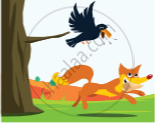
A jackal cheated the crow ______.
Teddy took his pillow as a sign of ______ them.
List the things that humans should save.
Match the rhyming words.
| 1. | say | fall |
| 2. | go | day |
| 3. | all | grow |
Nithin had many ______toys.
What did Bala teach Nithin?
What is the main idea of the story?
What was the event Megala participated?
What strange things did Alice see?
When should we not water the plants?
Read the following passage and do the activities.
A1. State whether the following sentences are True or false. [2]
- The king’s temperament also changed.
- The king was happy with prediction of the astrologer.
- The courtiers sought an audience with Tenali Raman.
- Courtiers advised the king to regulate his diet.
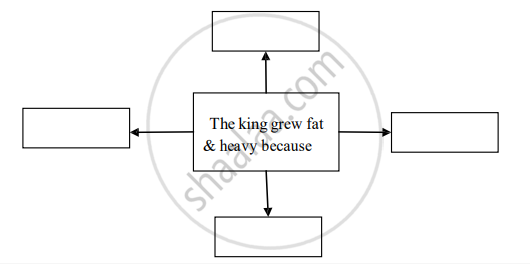
A2. Complete the web. [2]
|
King Krishnadeva Raya would perform heavy exercises every morning. He regularly applied oil on his body and thereafter worked out till all the oil came out with the sweat. This was followed by a long ride on his horse. Once the king started leading a sedentary lifestyle, and he stopped exercising. He no longer went horse-riding either. The king overate and as a result grew fat and heavy. The king‟s temperament also underwent a sea change. Noticing this, the royal physicians cautioned the king against the ill effects of overeating and explained to him the risks posed by obesity. They advised the king to regulate his diet, exercise, and take care of his health. The repeated advice he got from the physicians to eat less made him so angry that one day he announced a reward for anyone who could find him an easy cure. But there was one condition: those who failed would have their heads off. None dared to advise the king in this regard. The situation became precarious and as usual Tenali Raman was approached by the courtiers for a remedy. Tenali heard the problem and assured the courtiers of a viable solution. The next day, an astrologer predicted that the king had only a month left to live. When the king came to know of this, he was furious. The astrologer was ordered by the king to be imprisoned for a month so that his prediction could be put to test and so the hapless forecaster was sent to prison. |
A3. Find out describing words from the passage for the words given below. [2]
- exercise - ...........
- lifestyle - ...........
- ride - ...........
- physician - ...........
A4. Do as directed. [2]
- King Krishnadeva Raya would perform heavy exercises every morning.
(Use ‘used to’) - They advised the king to regulate his diet. (Pick out the infinitive)
A5. What are the benefits of daily exercise? [2]
What should parents do to ensure the safety of children in cyber space?
Enact any one anecdote in the classroom.
