Advertisements
Advertisements
Question
Now, read the following passage on “Laughter Therapy” and answer the questions that follow.

- Laughing is an excellent way to reduce stress in our lives; it can help you to cope with and survive a stressful life. Laughter provides full-scale support for your muscles and unleashes a rush of stress-busting endorphins. Since our bodies cannot distinguish between real and fake laughter, anything that makes you giggle will have a positive impact.
- Laughter Therapy aims to get people laughing, in groups and individual sessions and can help reduce stress, make people and employees happier and more committed, as well as improve their interpersonal skills. This laughter comes from the body and not the mind.
- Laughter Yoga (Hasya yoga) is a practice involving prolonged voluntary laughter. It aims to get people laughing in groups. It is practiced in the early mornings in open-parks. It has been made popular as an exercise routine developed by Indian physician Madan Kataria, who writes about the practice in his 2002 book ‘Laugh for no reason'. Laughter Yoga is based on the belief that voluntary laughter provides the same physiological as well as psychological benefits as spontaneous laughter.
- Laughter yoga session may start with gentle warm-up techniques which include stretching, chanting, clapping, eye contact and body movements to help break down inhibitions and encourage a sense of playfulness. Moreover, laughter is the best medicine. Breathing exercises are used to prepare the lungs for laughter followed by a series of laughter exercises that combine a method of acting and visualization techniques. Twenty minutes of laughter is sufficient to augment physiological development.
- A handful of small-scale scientific studies have indicated that laughter yoga has some medically beneficial effects, including cardiovascular health and mood. This therapy has proved to be good for depressed patients. This laughter therapy also plays a crucial role in social bonding.
Answer the following.
a. How does laughter help one to cope with stress?
b. Which word in the text (para 2) means the same as ‘dedicated'?
c. Why do you think voluntary laughter provides the same physiological as well as psychological benefits as spontaneous laughter?
d. ‘Laughter is the best medicine’. Explain.
e. Given below is a set of activities. Which of these are followed in the ‘Laughter Yoga’ technique?
- sitting on the ground with legs crossed
- body movements
- clapping
- closed eyes
- breathing exercises
- chanting
- stretching of arms and legs
- bending backwards
- running/jogging
- eye contact
f. ‘Laughter therapy also plays a crucial role in social bonding’. How?
Advertisements
Solution
a. Laughter provides full-scale support for one’s muscles and unleashes a rush of stress-busting endorphins. Thus it helps one to cope with stress.
b. ‘Committed’ means dedicated.
c. Human body cannot distinguish between real and fake laughter. Anything that makes a person giggle has a positive impact on one’s health. That is why I think voluntary laughter provides the same psychological and physiological benefits as spontaneous laughter.
d. Twenty minutes of laughter is sufficient to augment physiological development. Laughter has some medical benefits such as cardiovascular health and mood. Hence, “Laughter is the best medicine”.
e.
- Body movements
- Clapping
- Breathing exercises
- Stretching of arms and legs
- Bending backwards
f. Man is a social animal. Laughing breaks the ice and enables friendly conversations. A person endowed with spontaneous laughter naturally attracts large number of friends. In his company, even distressed relatives feel relieved and happy. Thus, laughter plays a crucial role in social bonding.
APPEARS IN
RELATED QUESTIONS
Read the extract given below and answer the questions that follow:
Wear skins peeped through by bones and spectacles of steel
With mended glass, life bottle bits on stones.
(b) Explain: 'slag heap'.
(c) What future awaits these children?
(d) Name the figure of speech used in the third line.
(a) crushing/destructive (pars 1)
(b) used to (pare 2)
(c) searching (pare 4)
Answer the following question in 30-40 words:
“The sight of the food maddened him.” What does this suggest? (His First Fight)
What has not changed over the years? Does this suggest something to you?
Notice these expression in the text. Infer their meaning from the context.
cairn of rocks
Divide the article into four sections based on the shifts in the sub-topics and give a suitable sub-heading for each section. One has been done for you in the article as an example.
The story begins and ends with Iona and his horse. Comment on the significance of this to the plot of the story.
Read the story and complete the following.
Revathi’s grief knew no bounds because, ____________.
Read the poem aloud and you will find some old outdated words that we do not use in the everyday language now.
However, some writers/poets use them to impart an old-fashioned flavour to suit the background of their write-up. Such words are called Archaic words.
Give the modern words for the archaic words from the poem.
- thy
- being
- bestow'd
- thee
- thou
- cans't
Fill in the gap, choosing a word from the bracket to make an appropriate comparison.
(tall / quiet / humble / merry / busy / slippery / fast / sly / slow / big)
as ______ as a giraffe
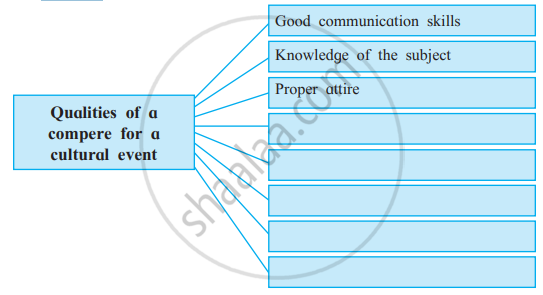
Imagine that you wish to organize a cultural event at your college. Prepare your own web-chart to indicate the qualities that you expect to have in a compere.
Visit a library:
Find more information/stories about scholars of the ancient world - Aryabhatta, Bhaskaracharya, Varahamihira, Charaka, Nagarjuna, Jeevaka.
Start a collection of new and interesting words. Write the words in colored ink on cards of equal size and arrange them in alphabetical order. Try to use the words in your writing or conversation from time to time.
Turn the story into a play as a group activity and present the scenes in the classroom.
What changes do we see in the life of human beings when the season changes? Write with reference to their celebrations.
The Emperor says he had realised earlier that Abdul has great talent. Does this tally with his actions? Give your opinion.
Read aloud a couple of stanzas of the poem ‘Invictus’ and ‘Please Listen’. In what ways do they differ? Think and fill up the table with ‘Yes’ or ‘No’.
| Invictus | Please Listen | |
| Rhyming lines | ______ | ______ |
| Steady rhythm | ______ | ______ |
| Uniformity in the length of lines | ______ | ______ |
| Uniformity of the number of lines in each stanza. | ______ | ______ |
| Figurative language | ______ | ______ |
What does the poet want to know from the goldfish?
What was the grandfather wearing?
What game did Anne choose to play?
Read the line and answer the question.
And all I ask is a merry yarn from a laughing fellow rover.
What kind of human company does the poet want?
Fill in the table given below.
| S. No | Problems faced by the hatchlings | Effect | Solution |
| 1. | Pollution | Survival of sea turtles becomes difficult. | Reduce the usage of plastics. |
| 2. | Predators | ||
| 3. | Human Activities |
Gulliver managed to reach the land as he was______.
When do we land on Mars?
Why did everyone ridicule the boy?
Leafcutter ants grow fungus.
Where do ants pile their food?
How many marks did he score in his 12th board exam?
What is the one thing you will try and improve after reading the story? How?
How does Tagore acknowledge Gandhi’s noble work?
