Advertisements
Advertisements
प्रश्न
Which language do you use to talk to elderly relatives in your family?
Advertisements
उत्तर
I speak in Hindi to talk to the elderly relatives in my family.
(A model answer has been provided for students' reference. It is strongly recommended that students prepare the answer on their own.)
APPEARS IN
संबंधित प्रश्न
How did a story book, 'Little Lord Fauntleroy' open a window of knowledge to Helen and help to shape her career?
Read the extract and do the activities that follow:
The duke senior and his follower were sitting down to a meal one day when Orlando rushed out from among the trees, his sword in his hand. ‘Stop, and cat no more!’ he cried. The Duke and his friends asked him what he wanted.
‘Food,’ said Orlando. ‘I am almost dying of hunger’. They asked him to sit down and eat, but he would not do so. He told them that his old servant was in the woods, dying of hunger. ‘I will not eat a bite until he has been fed,’ Orlando said.
So the good Duke and his followers helped him to bring Adam to their hiding-place, and Orlando and the old man were fed and taken care of. When the Duke learned that Orlando was a son of his old friend sir Rowland de Boys, he welcomed him gladly to his forest court.
Orlando lived happily with the Duke and his friends, but he had not forgotten the lovely Rosalind. She was always in his thoughts andevery day he wrote poetry about her pinning it on the trees in the forest. ‘These trees shall be my books,’ he said, ‘so that everyone who looks in the forest will be able to read how sweet and good Rosalind is’.
Rosalind and Celia found some of these poems pinned on the trees. At first they were puzzled, wondering who could have written them; but one day Celia came in from a walk with the news that she had seen Orlando sleeping under a tree, and she and Rosalind guessed that he must be the poet. Rosalind was happy to think that Orlando had not forggoten her, because she loved him as much as he loved her.
A1. Complete - (2)
Complete the following sentences:
(i) Rosalind was happy to think _______
(ii) The Duke and his followers helped Orlando to bring _________
(iii) Orlando pinned the poems written about Rosalind on ______
(iv) When the Duke cam to know that Orlando was a son of his old friend, he _________
A2. Write a gist: (2)
Write a gist of the above given extract in about 50 words.
Attempt a character sketch of Squire Cass.
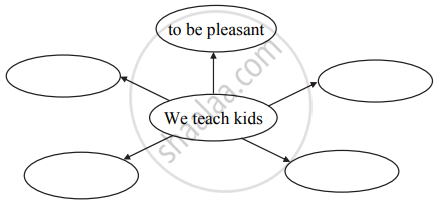
A1 Web :
Complete the following web with the help of the passage :
My dictionary tells me that personality is the “Personal or individual quality that makes one person be different and act differently from another.” Personality is, “the total physical, intellectual and emotional structure of an individual, including abilities, interests, and attitudes.”
There are many benefits to having a pleasant personality. There is only one opportunity to make a first impression, and all of us instinctively make decisions or judgments about an individual within the first few seconds of crossing paths. With that in mind, I believe when we teach our kids to smile, to be pleasant and cheerful, to be courteous and respectful of others, to pleasantly respond to requests or questions, we are helping them develop a personality that will open many doors for them. Once the doors are opened, the character will keep them open; but personality, not character, is on display in the first few seconds. Therefore, it’s important to develop a pleasant personality and use it for life.
A2 Personality :
Personality of an individual is recognized by :
(i) _______ (ii) _______
(iii) _______ (iv) _______
A3 Vocabulary :
Find out words for the following from the passage and write:
(i) polite =
(ii) relating to feelings =
(iii) to do anything naturally without thinking =
(iv) a chance to do something =
A4 Complete the following table :
| Noun | Adjective | Adverb |
| – | different | differently |
| Instinct | – | instinctively |
Select any word from the table and use it meaningfully in a sentence of your own.
A5 Personal Response :
Why do you thing, personality development is necessary?
Identify the phrases and lines that indicate distance between father and son.
Put down the images that come to your mind immediately when you see the words in the box.
| Cat cupboard wall pond bird |
Discuss the following statement in groups of two pairs, each pair in a group taking opposite points of view.
The methods of inquiry of history, science, and philosophy are similar.
Tick the item that is closest in meaning to the following phrase.
to be wound up
Tick the item that is closest in meaning to the following phrase.
to meet one's match
We 'draw up a deed'. Complete the following phrase with an appropriate word.
________a loan
What are the criteria that Ruskin feels that readers should fulfil to make themselves fit for the company of the Dead?
Discuss in pairs
Choice of diction is very crucial to the communication of meaning.
How is colour highlighted in the poem and why? List all the words in the poem that suggest colour.
Discuss the importance of time in the narration of a story.
Read the extract 'Being Neighborly' and complete the following statement:
To Jo, the fine house seemed like ______.
Think and answer in your own words.
What could be the age group of the speaker in the poem?
Who said to whom and when / why?
| Who said | To whom? | When / why? | |
| ......the world is full of inequalities. | |||
| I want to do something interesting. | |||
| It is against the will of God. | |||
| Our home is full of love....... | |||
| ...... we can affirm along with United Nations that men and women are equal. |
State whether the following statement is True or False. Correct the false statement by finding evidence from the poem to support your remark.
Birds and insects were benefitted from the tree.
Pick out a word from the poem to complete the sentence meaningfully.
Handicapped people should never be ______. (ignored and avoided)
Which two sayings about God are conveyed through the poem 'The Plate of Gold'?
- God helps those, who help themselves.
- God loves those, who love their fellow beings.
- God loves those, who give away their wealth, to please Him.
- Service to mankind is service to God.
Read the descriptions of the following from the story and describe any one of them using your own words.
- The ivy vine
- Behrman
- The last leaf that Johnsy saw
Answer the following question in short.
Why was Tenali Raman summoned to the court?
The whole world is happy because children are going to school. Why is it so? Discuss it in the classroom.
List all the words specially used in the game of Kabaddi.
Form groups and discuss the following question:
The events described in the poem take place at a certain place, at a certain period of the year, under specific weather conditions. Describe the place, the time, and the weather conditions.
The description of the character is given below. Identify the character from the play. Find some sentences which support your choice.
He is a brave but irresponsible person.
Choose the odd one out :
Flute, Snug, Quince, Cobweb.
Imagine that there is a Mr Somebody who has to correct all the wrongs that are done by Mr Nobody. Write in the following table, what Mr Somebody will have to do.
| Mr Nobody’s Actions | Tasks for Mr Somebody |
| 1. The plate is broken / cracked | Mend the plate. / Throw it away carefully. |
| 2. The book is torn | ____________ |
| 3. The door is ajar. | ____________ |
| 4. The buttons are pulled from the shirt | ____________ |
| 5. The pins are scattered. | ____________ |
| 6. The door is still squeaking. | ____________ |
| 7. There are finger marks upon the door. | ____________ |
| 8. The ink has spilled over. | ____________ |
| 9. Boots are lying around. | ____________ |
| 10. ____________ | ____________ |
| 11. ____________ | ____________ |
Add a few more things to the list in the above table, using your own ideas and experience.
List the phrases that indicate sorrow or pain.
Find the meaning of the following word.
thee
Write the following:
The sights mentioned in the second stanza.
List the lines that begin with 'Here' or 'And here'.
Also, list the sentences or phrases that begin with ‘And there’.
These phrases and sentences tell us about things that appear one after the other as the carriage moves. Can we tell which ones are closer to the train and which ones are at a distance? How?
Answer the following question and write in short, why the parody sounds funny.
Why does the crocodile work?
Describe a crocodile in your own words.
Why did Marouckla’s stepmother hate her?
In what season does the story take place?
Share a memorable trip from your life
Who were the inhabitants of the island?
Answer the question in a paragraph of about 100 – 150 word.
Write a detailed character sketch of Prospero.
What conclusions did grandfather jump to when he saw the cops?
Complete the following table with information from the anecdote about Mr. Scotti’s short trip.
| Name | Nicholas Scotti |
| Occupation | |
| Reason for his trip | |
| Means of transport | |
| Destination |
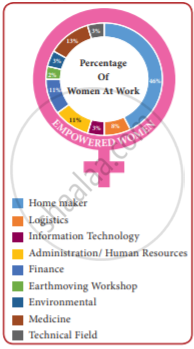
Read the data below and answer the following question.
Choose the correct answer.
In which field of work is women’s involvement the second highest?
‘My tongs are like a tiger among toys.’ It means ______
What scared Usha during the dark rainy night?
Neerja was sent to London based on______.
Can courage be developed suddenly? Why?
Work in pairs and answer the following.
Pick out the alliterated words.
Write a summary based on the story map.

Who is Muthu?
How do we work?
Find the rhyming word from the poem.
Language - ______.
Jaswant managed to kill _________ Chinese soldiers.
Try your own.
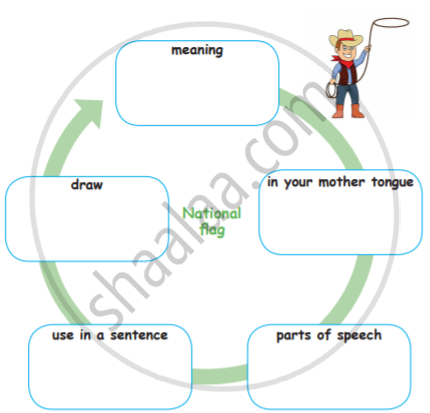
Vicky's dad bought a ______ robot.
Look at the picture and tick choose the correct word.

Choose the best answer.
The animals ______ the boat.
Choose the best answer.
Suddenly there was a______.
What would you like to learn in school? why?
Why is the play called ‘The Giving Tree’?
Activity: Live English: Packs, packets, pouches, wrappers

Given above is the picture of an imaginary food item’s packet. Let us see how to ‘read’ the matter on the packet as a vigilant consumer.
- Look at the wrapper and complete the sentences.
- The name of the food item is ______.
- It is made by ______.
- It is a ______ food item. (Veg/Non-veg)
- The ______ sign indicates whether it is a Veg or Non-veg food item.
- The ingredients are ______, ______, ______, ______.
- The date of packing is ______ and the expiry date is ______.
- It should be consumed before ______ from the date of manufacturing.
- Try and obtain more information about the various symbols printed on the packet.
- Discuss the following -
- Why the ‘recipe’ is given on the packet.
- Why the packet tells us to visit the website of the company.
- What ideas are used to make the packet attractive?
- How you will verify whether something is good for you to eat.
