Advertisements
Advertisements
प्रश्न
What does the line 'I never writ, nor no man ever loved' imply?
Advertisements
उत्तर
Shakespeare, in his poem, Let Me Not to the Marriage of True minds, approaches the idea of love or ideal love, the other way round. Throughout the poem, he talks and explains all the negatives that an ideal love must not comprise. Similarly, the poet maintains his tone at the end of the poem as well. He closes the poem with the couplet 'I never writ, nor no man ever loved'. In an unnatural or inverse fashion, rather than saying that men have loved and so he writes, Shakespeare says that if what he has written is to be an error, then he would not have written it all and that no man would have loved at all. Confidently, he challenges anyone to prove his idea of love to be wrong; he knows that it is impossible and that his knowledge stands true.
APPEARS IN
संबंधित प्रश्न
Read the extract given below and answer the questions that follow:
Far far from gusty waves these children's faces.
Like rootless weeds, the hair torn round their pallor;
The tall girl with her weighed-down head.
(a) Who are these children?
(b) Which figure of speech has been used in the first two lines?
(c) Why is the tall girl's head weighed down?
(d) What does the word, 'pallor' mean?
Read the following extract and then do all the activities that follow :
I rain into a stranger as he passed by
“Oh, excuse me please” was my reply.
He said, “please excuse me too; wasn't even watching for you.”
We were very polite, this stranger and I.
We went on out way and we said good-bye.
But at home a different story is told.
How we treat out loved ones, young and old.
Later that day, cooking the evening meal,
My daughter stood beside me very still.
When I turned, I nearly knoked her down.
“Move out of the way,” I said with a frown.
She walked away, her little heart broken.
I didn't realize how harshly I'd spoken.
While I lay awake in bed,
God's still small voice came to me and said,
“While Dealing with a stranger, common courtesy you use,
But children you love, you seem to abuse.”
A1. Order-
The incidents narrated in the extract are arranged in a jumbled manner here, Rearrange them in a proper order as they occur in the extract:
(i) The poet and the stranger went on their way saying good-bye.
(ii) Seeking excuse politely from the stranger, she went her way.
(iii) The poet ran into a stranger on the road.
(iv) The poet yelled at her daughter.
A2. Poetic device:
Make a list of rhyming pairs from the second stanza and note down the rhyme scheme of the same stanza.
A3. Personal Response:
Understanding and politeness are the essentials of out everyday life. Explain your views in brief.
A4. Creativity -
Frame two poetic lines on the following situation using a rhyming pattern with the help of clues given:
“While introducing great personalities, we praise them highly and talk about their qualities, but while speaking
about our friends we may not follow the same trend.”
While introducing great personalities, — a
------------------------------------ — a
But while speaking about our friends, — b
------------------------------------ — b
Read the extract and do the following activities :
B1 Likes and dislikes :
(i) The child likes eating _______
(ii) The child dislikes eating _______
They won’t eat peas, don’t like your bread -
For something in it crunches;
They gag on fat, the gravy’s gross,
They won’t eat grapes in bunches.
Tomatoes, onions, peppers, fish
Garlic nor cottage cheese;
Oh, it’s a dish uncommon rare
That truly seems to please.
No red sauce may the ice cream have,
“It’s bleeding,” they will say;
And gravely hand it to their mum
To take it to clean away
But let us speak of chocolate cake,
It must be frosted o’er;
They’ll devour three full slabs,
And calmly ask for more.
Oh, I do so always love to eat
With picky little pests,
Whose parents joy to make them
The most undesirable guests!
B2 What message does the poem convey for children?
B3 Pick out two pairs of rhyming words from the poem.
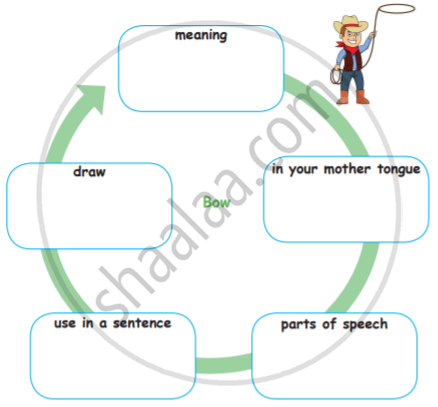
How would you say ‘a dilapidated drum’ in your language?
Briefly comment on:
The purpose of the author’s journey to Mount Kailash.
Divide the article into four sections based on the shifts in the sub-topics and give a suitable sub-heading for each section. One has been done for you in the article as an example.
We 'draw up a deed'. Complete the following phrase with an appropriate word.
________one's will
Suggest a few instances in the poem which highlight humour and irony.
What was the importance of the watch to the author?
Identify the common characteristics shared by tribal communities all over the world.
'Constancy' is the theme of the poem. Indicate the words, phrases, and images that suggest the theme.
Comment on the contemporary concern that the poem echoes.
Read the extract 'Being Neighborly' and complete the following statement:
Jo entered the old stone house carrying _______________.
Think and answer in your own words.
How do parents react when they see children soil their clothes in dust and heat?
Which pictures reflect gender equality? Write their numbers.
Answer in your own words.
What are the provisions in the Declaration of the United Nations, to ensure the equality of men and women?
Think and answer in your own words in your notebook.
‘Live and let live’ is a famous proverb. Which lines from the poem support this proverb?
Everyone admired the statue of the Happy Prince.
Read the story and choose the appropriate meaning.
Palette __________________.
Answer the following question in short.
Explain the significance of the title.
What do fairy-tale witches do?
Shylock demanded a pound of Antonio’s flesh.
Read the poem : ‘Where lies the land...’ by A. C. Clough.
We find the following in the script of a skit or play. Rearrange these steps in the proper order and write them down in the form of a flow chart.
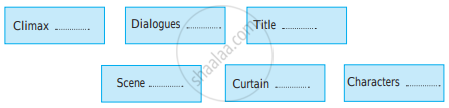
Answer in your own words.
How many chores did the ancestor from 1800 have to do?
In what season does the story take place?
What made the reporter gaze at the author?
Read the following lines from the poem and answer the question given below.
There's a family nobody likes to meet;
They live, it is said, on Complaining Street
- Where does the family live?
- Why do you think the street is named as ‘Complaining Street’?
What do Tamil Nadu folk dances and folk arts represent?
Read the data below and answer the following question.
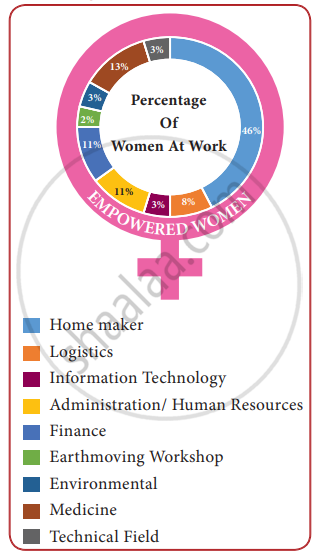
Choose the correct answer.
What is the data about?
They may have______ in______.
- soft
- vain
- fear
- joy
- love
- heard
- toiled
- mild
- good
- sand
- life
- harsh
Read Section – III (para 1 and 4) and answer the following questions.
Paragraph 1
1. Who listened to the chipping sound of the chisel? ______
2. Who was working with the hammer and chisel? ______
Paragraph 4
1. Who was staring? ______
2. Who was the young stone carver? ______
3. What was he working on? ______
Identify the speaker/character.
Wake up, child.
Sea turtles come to the shore to ______.
It is a problem for sea turtles to come ashore because ______.
Why do we need trees? List four reasons that Grandfather gives.
What did Amma mean when she said tomatoes, ladies' fingers and corn came from other countries?
The eggs hatched and the babies flew away.
Which line tells you that the girl was faster than the boy?
Try your own.
Who sews the cloth?
Try your own.
Choose the correct option from the given homophones.
The wind ______off the leaves.
The pigeon flew away for dry twigs.
Akilan learnt Judo for ______.
Name the character or speaker.
“Believe yourself.”
What did the oil seller perform?
Try your own.
Choose and write the adverbs to complete the sentence.

She coloured the picture ____.
Why relationships are more important than wealth?
Name the character or speaker.
"Do you have a fever?"
Moles trap worms and store them.
Tenzin is from ______.
Mostly piggy banks look like______.
Do you tell the truth always? Why?
Match the rhyming words.
| 1. | earn | day |
| 2. | fend | learn |
| 3. | glow | end |
| 4. | play | slow |
What should we do to ensure Safe Surfing?
Should children be discouraged from playing online games?
Which of the following should one avoid while using social media? Tick against the correct options.
