Advertisements
Advertisements
प्रश्न
Why did Granny scold Hamid?
Advertisements
उत्तर
Granny scolded Hamid for buying her a pair of tongs.
APPEARS IN
संबंधित प्रश्न
How does Russell's definition of knowledge differ from what is commonly understood by the term?
Discuss in pairs or in small groups
'Our daily life reflects a double allegiance to 'the life in time' and 'the life by values'.
Kite - flying in Gujarat, is a competitive sport - cum - festival.
What is implied in the following phrases or lines?
- A silver house in the lovely sky
- It takes two weeks to build it up
- And two to pull it down.
Write a short note on the following:
The ‘four signs’ that Prince Siddharth beheld.
Use the following expressions in your own sentences:
- We all agree that
- It is he/she who
- Don’t you see
- None of us
We should learn to ______questions.
- ask
- answer
- discard
Who first brought these vegetables to India?
Read the passage given below and answer the questions that follow
Humans have long been fascinated by fiction. We experience excitement in assigning supernatural power to imaginary characters in fictional stories – and so we have Spider man, Batman, He–man, Titans and many more. The ‘Cyborg’ was an offshoot of such wild imagination of humans to invest our species with superhuman powers. Today, the Cyborg is no more an imaginary organism. We are living in a world where a sizeable population of humans have merged their bodies with technological implants. The term ‘Cyborg’, short for ‘cybernetic organism’, was coined to describe a man, whose body is implanted with technological devices to supplement and substitute body functions.
Cyborgs include people with cardiac pacemakers, contact lenses, bionic ears and eyes, prosthetics and so on. In other words, a cyborg is partly human and partly machine. The technological innovations in the field of medicine and healthcare augment humans with machines, producing a beta version of the human body. The advent of brain machine interfaces is certain to blur the boundary between humans and machines. Scientists are working hard to find a technique for age reversal too. People do not want to die, so mankind is striving to get to the final frontier, which is development of machines and devices that would accord man immortality.
The needs of humans are not limited. As time passes, food habits change, thinking patterns change, and even appearances change. We are about to travel by driverless, fully automated vehicles. Computers and smart phones have become our masters. The more we depend and merge with technological advancements, the more the humanness in us slowly erodes. Intelligence is sought to be infused into machines and robotics are designed in such a way to give man a virtual human companion. The field of artificial intelligence is overtaking the human brain and many fear that it could even harm the human race. Despite certain limitations and potential threats, many believe that cyborgs will be the next step in the evolution of mankind. The amalgamation of man and machine is sure to add a new dimension to the life of mankind and this will prove to be the ‘biggest evolution in Biology’ since the emergence of life, four billion years ago.
Questions:
a) Account for the popularity of characters with supernatural powers.
b) Who is referred to as a ‘Cyborg’?
c) What is expected to happen with the advent of the brain machine interface?
d) The needs of humans are not limited. How is this statement elaborated in the passage?
e) How can a machine turn into a virtual companion for humans?
f) Explain the flipside of the rapid technological advancement.
g) Identify the word in para 1 which means ‘everlasting life’.
h) Which of the following words is synonymous with ‘amalgamation’?
- recreation
- integration
- exploration
- proposition
i) Which of the following options is the antonym of the word ‘advent’?
- drawback
- dispute
- departure
- danger
j) Find out the word which is the antonym of ‘natural’ in para 3.
Read the following passage and do the activities:
A1. Fill in the blanks: (2)
- ______ percent of our daily communication is non-verbal.
- Eye contact is another type of ______ communication.
- Frequent blinking is a sign of the person feeling ______.
- One can readily detect _______.
|
According to some experts, a staggering 93 percent of our daily communication is non-verbal. Facial expressions are easy to decipher. One can readily detect happiness, sadness, anger. Physicians can tell a patient is doing well (or not) by looking at his/her face. Eye contact is another type of non-verbal communication, which can tell a lot about the other person. The eyes convey a range of emotions-happiness, sadness, boredom, surprise, confidence .......... even emotional interest. Staring at someone's forehead may intimidate the recipient, staring at the mouth is sometimes interpretated as a sign of emotional interest. In fact, staring into someone's eyes is a sign of lying, and so is looking away. In certain cultures, lack of eye contact is taken as a sign of respect. If body language is to be defined, it is a combination of facial expression, gestures, eye contact, body movements and posture and voice. Frequent blinking is a sign of the person feeling distressed or uncomfortable. If the pupils are dilated, it ofter indicates interest, even emotional interest. The lips also reflect our body language, and lip biting indicates worry and/or anxiety; tightening of the lips may be an indication of disapproval. Slightly turned-up lips indicate happiness and slightly turned-down lips indicate sadness. |
A2.
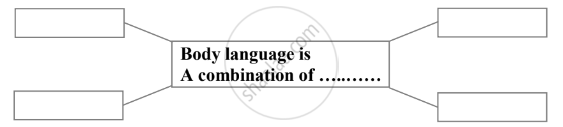
A3. Find the antonyms of: (2)
- verbal × ______
- entertaining × ______
- sender × ______
- comfortable × ______
A4. Do as Directed: (2)
- The eyes convey a range of emotions. (Frame a 'Wh' question in order to get the underlined part as answer).
- Physicians can tell about a patient's wellness. (Rewrite using 'able to')
A5. Personal Response: (2)
Non-verbal communication plays an important role in our daily life. Comment.
