Advertisements
Advertisements
प्रश्न
Discuss in pairs or in small groups
What does a novel do?
Advertisements
उत्तर
A novel reflects human condition in terms of a narrative involving character or characters.
It basically tells a story that entertains us and even gives us messages. A novel may be realistic based on real life incidents or fictitious.
APPEARS IN
संबंधित प्रश्न
We sang our school fight song dozens of times – en route to Arlington National cemetery, and even on an afternoon cruise down the Potomac River. We visited the Lincoln Memorial twice, once in day – light, the second time at dusk. My classmates and I fell silent as we walked in the shadows of those 36 marble columns, one for every state in the Union that Lincoln laboured to preserve. I stood next to Frank at the base of the 19 foot seated statue. Spotlights made the white Georgian marble seem to glow. Together we read famous words from Lincoln’s speech at Gettysburg remembering the most bloody battle in the war between the status : “………….we here highly resolve that these dead shall not have died in vain – that this nation, under God, shall have a new birth of freedom………..”
As Frank motioned me into place to take my picture, I took one last look at Lincoln’s face. He seemed alive and so terribly sad.
The next morning I understand a little better why he wasn’t smiling. “Clifton,” a chaperone said, “could I see you for a moment?”
(1) When did the boys visit Lincoln Memorial?
(2) What made the Georgian marble glow?
(3) What did the words: “………. We here highly resolve that these dead shall not have died in vain – that this nation, under God, shall have a new birth of freedom …………” remind them?
(4) Do you believe in building memorials? What kind should they be, if your answer is ‘yes’? If no, give reasons why you do not believe in memorials?
The black kite may start a fire because
Complete the call-outs:
A.1)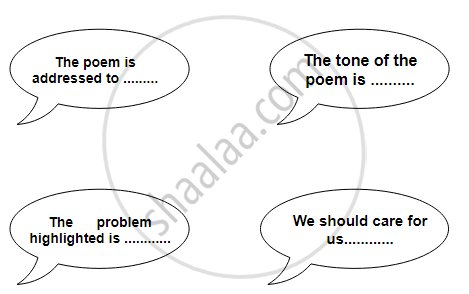
Our world is an institution
Of environmental pollution
We choose not to care
For our future generations
And I for one am guilty
For buying the hundreds of electronic gadgets
That attracts the industries to produce like maggots
environmental pollution is at the heart of our planet
The forests are dying
Wildlife is crying
Millions of fish are dying
Mother earth is sighing
Tell me is it right
That we sleep well at night
Replenishing ourselves
For tomorrow’s greedy fight
Overcrowded trains
Overloaded brains
Where is the light? What is our plight?
While the river break their banks
And greedy industries play their polluted pranks.
A.2) Find the examples that show that we do not care for our future generation
A.3) Match:
Match the lines in Column ‘A’ with the figures of speech in Column ‘B’:
| Column ‘A’ | Column ‘B’ | ||
| (i) | Our world is an institution | (a) | Personification |
| (ii) | Mother earth is sighing | (b) | Simile |
| (c) | Metaphor |
Divide the article into four sections based on the shifts in the sub-topics and give a suitable sub-heading for each section. One has been done for you in the article as an example.
'The Address' is a story of human predicament that follows war. Comment
Tick the item that is closest in meaning to the following phrase.
to be wound up
Did the boys return the horse because they were conscience-stricken or because they were afraid?
What facet of political life does the behaviour of Ajamil illustrate?
Divide the class into 5 groups. Each group can prepare a decorative chart/poster using an epigrammatic line from the poem. You may use calligraphy/painting/or Paint program on a computer. (With permission, put up these charts in your school.)
Think and answer in your own words.
What could be the age group of the speaker in the poem?
Read other poems by Leigh Hunt, especially 'Abou Ben Adhem'.
Compare the messages in that poem with those in 'The Plate of Gold'. What do you observe?
Behrman did not know anything about the last leaf on the ivy.
Correct the following statement.
Sue ignored Johnsy completely.
Go through the poem and state whether the following statement is true or false.
Planners are concerned about the environment of the area.
Akbar wanted to punish the person who pulled his moustache.
The consequences of Oberon’s jealousy for Titania are comic rather than tragic. Comment.
Explain the use of the following property in the development of the play.
Hat
Present the information in the box ‘My Teacher says’. Translate the box ‘My Teacher says’ into your mother tongue.
Have you seen non-commercial advertisements - those that are not ‘selling’ anything but are only giving people useful information?
Discuss and write 1-2 lines about the following,
The lesson that Bushi learned.
What did the Clean Brigade do?
What time is being described in the poem?
Complete the following sentence with reference to the passage:
For six years did Gautama practise ____________.
List the phrases that indicate sorrow or pain.
Write one line about the following with the help of the poem.
wind in the autumn evening
Write about Malti and Rima using the following points:
 |
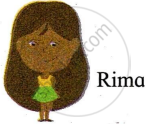 |
| Appearance... | Appearance... |
| Studies... | Studies... |
| Singing... | Singing... |
| Attitude to others... | Attitude to others... |
| Weak points... | Weak points... |
Use details from the story and your own imagination when you write the above descriptions.
How do you behave with your classmates? Write about your attitude and behaviour in the appropriate column.
Some actions:
- Ask others for help
- Refuse help
- Judge others by their appearance
- Judge others by their accent
| Always | Sometimes | Never |
| ____________ | ____________ | ____________ |
| ____________ | ____________ | ____________ |
| ____________ | ____________ | ____________ |
Rohan desperately wished for ______.
Think about what you do and you must learn to do when you speak. Make a list of such 'Do's' and Don'ts' for yourself.
Do you long to be something else? Write about your longing.
Find a word that has a similar meaning.
Whole
Find a word that has a similar meaning.
unfair
Find out the difference between the fingerspelling method, sign language and Braille.
What are the common Rangoli designs or motifs?
What did the narrator think the unusual sound was?
What did the Bodwells think when they heard the mother shout.
Answer the following question in about 80-120 word.
If you were to live in the Complaining Street, how would you deal with the people who grumble?
Which gift did Anne value the most?
Hamid’s granny scolded him for buying iron tongs. Then she understood that Hamid had bought it ______.
Tom lay thinking. Presently it occurred to him that he wished he was sick; then he could stay home from school. He examined himself. He found no symptoms or sickness, and he investigated again. This time he felt he had a stomach ache, but it soon grew feeble, and presently died wholly away. He reflected further.
What did he detect?
Write down the word that alliterate in the poetic line below
Festival of Flowers.
What challenges does Alice face and how does she overcome them?
Can a courageous man be defeated? Why?
When the author returned from England to Dehradun, he found Grandfather's dream had come true because the______.
How should one react to adversity?
What kind of a boy was Vicky?
Who will be the fortunate?
The bird-catcher had a pigeon in his _______.
Identify the character or the speaker.
“I will camp here for the night.”
Who were the friends referred in the story?
List the things that humans should save.
Speak and win.
Join in one of the two groups. Choose two characters. Support or oppose any one of the characters. Say some sentences for the one you support and say some sentences against the other one, to win.
| I support | I oppose |
Do you tell the truth always? Why?
Match the rhyming words.
| strokes | floor |
| shore | rush |
| brush | chokes |
What was Farhan's father's advice to his son?
What should we do for success?
Pencil asked him to draw ______.
Where did the rabbit go?
Who said – “Oh, my ears and whiskers? How late it’s getting!”
What did he make out of it?
