Advertisements
Advertisements
प्रश्न
Discuss the importance of time in the narration of a story.
Advertisements
उत्तर
Forster brings out the importance of time in the narration of a story. He says that time is an integral part of a story. Though its appearance is both unlovely and dull, according to the essayist, yet he exhorts us to consider it first in connection with daily life. Forster says that daily life is also full of the time sense. But in daily life one can think of any situation, even going beyond the time sequence. One can chose to think of any situation in the past or in the future without going by the strict order or sequence. This one does according to the value one attaches to a particular situation. In other words, according to Forster, daily life is practically composed of two lives-- the life in time and the life by values. Our conduct reveals a double allegiance. According to the essayist, the story narrates the life in time. In our daily life one can deny that time exists and act accordingly. But in case of a story, time sense cannot be denied otherwise it becomes unintelligible. The essayist mentions about many experiments made by the story tellers and novelists in which they wanted to narrate events by not following the exact time sequence. But these experiments failed to sway the readers. According to the essayist, the basis of a novel is a story and a story is a narrative of events in time sequence.
APPEARS IN
संबंधित प्रश्न
Describe the role of Mr. Keith in the life of Helen in ‘The Story of My Life’.
Complete the call-outs:
A.1)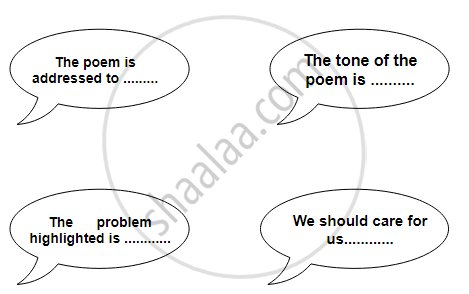
Our world is an institution
Of environmental pollution
We choose not to care
For our future generations
And I for one am guilty
For buying the hundreds of electronic gadgets
That attracts the industries to produce like maggots
environmental pollution is at the heart of our planet
The forests are dying
Wildlife is crying
Millions of fish are dying
Mother earth is sighing
Tell me is it right
That we sleep well at night
Replenishing ourselves
For tomorrow’s greedy fight
Overcrowded trains
Overloaded brains
Where is the light? What is our plight?
While the river break their banks
And greedy industries play their polluted pranks.
A.2) Find the examples that show that we do not care for our future generation
A.3) Match:
Match the lines in Column ‘A’ with the figures of speech in Column ‘B’:
| Column ‘A’ | Column ‘B’ | ||
| (i) | Our world is an institution | (a) | Personification |
| (ii) | Mother earth is sighing | (b) | Simile |
| (c) | Metaphor |
Notice this expression in the text. Infer their meaning from the context.
the thought was almost revolting
Put down the images that come to your mind immediately when you see the words in the box.
| Cat cupboard wall pond bird |
This play, written in the 1950s, is a humorous and satirical depiction of the status of the mother in the family.
Do you think it caricatures these issues or do you think that the problems it raises are genuine? How does the play resolve the issues? Do you agree with the resolution?
We 'draw up a deed'. Complete the following phrase with an appropriate word.
________one's will
Discuss in pairs or groups of four.
Replacing old machines with new is better than getting them repaired.
How did the author feel about her mother's passion to make her a dancer?
Read the extract and state whether the following statement is true or false. Correct the false statement.
The author wanted to grow the desi variety of rice.
Arrange the following set of words in the alphabetical order in your notebook.
ship, small, successful, scoldings, stone, saving, someone, stood, streets, still, screamed, sat, seemed, saint, share.
Answer in your own words.
How did the plants respond when Revathi played her favourite tune?
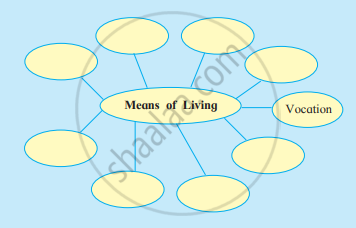
Pick out words that refer to ‘means of living’ and fill them in the Web.
(profession/recreation/occupation/job/ pastime/employment/hobby/career/entertainment/mission/trade/buisness/sports/retirement/placement)
Answer in your own words.
What are the provisions in the Declaration of the United Nations, to ensure the equality of men and women?
Johnsy was hopeful that she will live.
Discuss in your group and write down the most important reason, why Pediatrician and Veterinarians have, a tougher job to diagnose their patients' illnesses.
Go through the poem and state whether the following statement is true or false.
Planners make tactful changes so that citizens do not recognize familiar landmarks.
Say WHY. . . . . .
Hardy and Ramanujan could not talk freely with each other.
Answer the following question in short.
Why was Tenali Raman taken to the court in a palanquin?
Read the following conversation and complete the activities given below:
| Minnie: | Exams are over. I feel so relaxed! Let us plan something interesting. |
| Ritu: | How about a movie? |
| Paddy: | Great! Let’s go for “Aladdin”! |
| Minnie: | Oh, no! I have seen it. It has only a ‘one star’ rating. |
| Ritu: | How about that new release ummm... yes, “Harry Potter? |
| Della: | It is boring. I have read the review this morning. I don’t want to waste my time. |
| Paddy: | Wait, friends. I will check. Let’s decide later. |
(i) Choose the correct alternative from the following-
From one star given to the movie we conclude that-
- The movie is very short.
- The movie is not worth watching.
- The movie is serious.
- The movie is in black and white.
(ii) Discuss with your teacher how/why are ‘stars’ given to a movie.
(iii) The word ‘Review’ is different from summarizing and appeal writing. Choose the correct statements of the following.
- A film review is an expression of your personal views towards a particular film, documentary or movie.
- A film review gives you an opportunity to express opinions about the movie, including its characters, plot and background.
- A film review gives appealing sentences that make your reader curious or anxious about the film.
- A review means explanation of each and every event of the film.
Find a suitable object for each comparison.
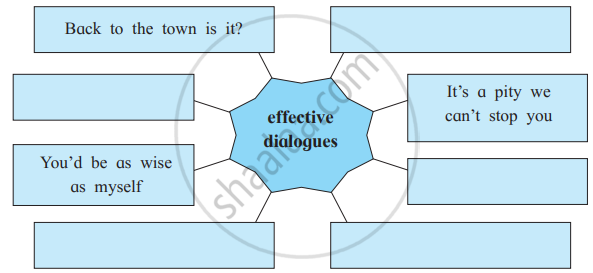
There are some dialogues that are short, but quite effective. They give us enjoyment and add beauty to the main story. Find some more from the text.
State whether the following statement is True or False:
Oberon transforms Bottom's head into that of an ass.
Shylock was not at all generous.
You want to start human settlement somewhere else other than the earth, in the universe. Will you select a star or a planet? Why? What features supporting life will you look for? Try to find answers to such questions and make a presentation using scientific information and your imagination.
Find three lines, that contain images of nature in the autumn season.
At night
- ______________________
- ______________________
- ______________________
Using your imagination, write about a beautiful region - its landforms, water bodies, flora and fauna, night sky, people, etc.
Who said the following, to whom, and when?
“As you desire, Huzoor.”
Who said the following, to whom, and when?
“O Holy Master, bless us with thy song !”
Think of other funny names for imaginary creatures. Write any 3 of them.
List the rhyming words in the (On the water) poem.
Read the following and say whether the statement tells you about a fact or whether it is imaginary.
There is a man in the Moon.
What did Ahmad tell Kasim when he dug a channel and began to draw water?
What different names is ‘Rangoli’ known by in different regions?
Make a collection of Rangoli motifs and patterns.
Write about each motif or pattern in your own words -
it could just be a label or a description or some information or comment.
What were the various sounds the brothers heard when they went downstairs?
Why did Herman and the author slam the doors?
Use this passage to play the game. You can collect information on other famous personalities and play too.
Charlie Chaplin was born on April 16, 1889, in London England. His birth name was Charles Spencer Chaplin, though he had many nicknames growing up such as Charlie, Charlot, and The Little Tramp. His father, Charles Chaplin, and his mother, Hannah Chaplin, were inducted into the music hall of fame, leading the way to his exposure even as a young boy. His first onstage moment was when he was 5 years old; he sang a song that was intended to be sung by his own mother; she had become ill at the time of the performance, so little Charlie Chaplin stood instead and performed for his mother.
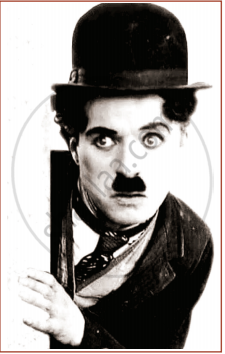
Charlie Chaplin came to the United States in 1910, at the age of 21. He was brought to New York, which was known to be a great place to start out for anyone trying to become a professional actor. Two years later, in 1913, Chaplin signed his very first contract at Keystone and it was no time before he headed to Hollywood. His first movie premiered in 1914, “Making a Living,” and went on to make over 35 movies total in that year alone. Charlie Chaplin grew to become one of the most popular and successful actors of all time. The moment that really kicked off his long career was in 1921 when he starred in, and produced, his first full-length film called “The Kid.” From then on, most people all over the world knew Charlie Chaplin and loved his movies. He had a great career and life, dying on December 25, 1977, in Vevey, Switzerland. He had apparently died of natural causes in his sleep from old age.
He decided to find his cousins’ home without their help. He asked the policeman for information in Italian because he.
Write the name of the toys against each picture.

Hamid’s heart sank because the price of the tongs was______for him.
We should learn to ______questions.
- ask
- answer
- discard
The______ of ______ are nearly run.
- soft
- vain
- fear
- joy
- love
- heard
- toiled
- mild
- good
- sand
- life
- harsh
Ridleys come to lay their eggs in the month of January.
Amma bought the vegetables from the______.
Mithali’s mother tongue is Telugu.
The blue lights seen through the window were aliens.
What were Anandhan and Yazhini watching in the television?
Read the passage three times and colour a bull for each time.
Mr. Murugan is a farmer. He has a small piece of land and two bulls. He takes good care of his bulls as they help him in farming. Every morning, he takes the bulls for grazing. When it rains he ploughs the land with the bulls. As he has no one to help he starts sowing the seed before sunrise. He irrigates the crop till it grows. He reaps and binds the crop then takes it to thrash the paddy. Finally, with the help of the bulls, he takes the paddy to his house.

Vicky decided to______ the robot at the end.
Who asked the Robot to charge the phone?
What did Anitha eat in the expo?
Why should we read?
The hen-pigeon got dry _______ for the bird catcher.
Some words sound the same but their spelling and meaning are different. Such words are called homophones. There are many homophones.
Anbu was talented in catching______.
Identify the character/speaker.
He set the fish free.
What will you do with your savings?
Who lived in the old house?
Choose the right word.
The tamarind tree grows over Tansen’s ______.
