Advertisements
Advertisements
प्रश्न
What causes the element of surprise when the child comes on the scene of 'adult reconciling'?
Advertisements
उत्तर
As Larkin is absorbed in the resonant humming of the thrush, he transcends present to his boring childhood, which he feels is best forgotten. The poet is transformed into a child. He feels happy like a child who feels happy just by watching elders reconciling with each other. The child comprehends nothing yet smiles just because the adults are happy. This might appear surprising, however, if one may look more closely, the scene reflects the innocence of a child. Probably the poet has tried to make a point that our happiness lies in other's happiness. The whole thought makes Larkin happy and he wonders about the mystiques of the universe and human life.
APPEARS IN
संबंधित प्रश्न
Answer any three of the following questions in 30-40 words each:
(a) What did M. Hamel tell them about the French language? What did he ask them to do and why?
(b) Why does Asokamitran call Subbu, ‘a charitable and improvident man’?
(c) How did the instructor turn Douglas into a swimmer?
(d) Why did Sophie like her brother, Geoff more than any other person?
Answer any four of the following in 30−40 words each:
(a) What did garbage mean to the children of Seemapuri and to their parents?
(b) How did Rajkumar Shukla establish that he was resolute?
(c) 'Life is what it is all about;...' How is keeping quiet related to life?
(d) Mention any four things of beauty that add joy to our life.
(e) The manner of his (the Tiger King's) death is a matter of extraordinary interest. Comment.
(f) In what condition did Dr. Sadao find the American soldier at the seashore?
Big male elephants throw logs at electric fences because
Why do dolphins cover their long noses with sponges or shells ?
Read the passage and complete the activities given below :
B1 Pick out
The correct answers from the statements given below:
B2 Fill in the gaps with the information given in the passage :
Notice these expression in the text. Infer their meaning from the context.
manoeuvres
Notice this expression in the text. Infer its meaning from the context.
blow-by-blow account
'Have you come back?' said the woman.'I thought that no one had come back.'
Does this statement give some clue about the story? If yes, what is it?
The episode has been narrated in a light vein. What social mores does the author seem to ridicule?
We 'draw up a deed'. Complete the following phrase with an appropriate word.
________one's will
Notice this word in the poem and guess its meaning from the context.
turquoise
Who said to whom and when / why?
| Who said | To whom? | When / why? | |
| ......the world is full of inequalities. | |||
| I want to do something interesting. | |||
| It is against the will of God. | |||
| Our home is full of love....... | |||
| ...... we can affirm along with United Nations that men and women are equal. |
Find evidence from the lesson and write in your own words.
In Israel, the media have a positive outlook and self-respect.
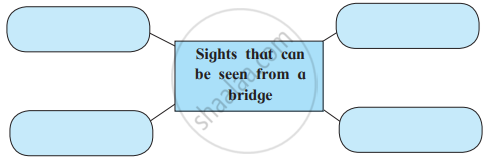
You might have visited a bridge. Complete the web describing the sights you could see from the bridge.
‘Dull would he be of soul who could pass by.’
This line of the poem can be rewritten as:
'He would be of a dull soul.'
The figure of speech is known as ‘Inversion’.
Find out one more example of Inversion from the poem.
Go through the poem and state whether the following statement is true or false.
Planners make their plans mathematically perfect, at the same time they calculate their profit.
Answer the following question in short.
How did Tenali Raman outwit Pundit Shahane?
Read the following sentence carefully and choose the correct meaning.
Fine feathers don’t make fine birds.
What is described in the poem?
Find a suitable object for each comparison.
Mayor Peter Stockmann is a contrast to Dr. Thomas Stockmann. Justify.
Write a short monologue using one of the following ideas. Write down the monologue and present it in the class.
Yonamine’s father worrying about getting her married.
Form groups and hold debates on the following topics. Make bulleted lists of points in favour of the topic (pros) and those against it (cons). (3-6 points each)
You should never lose a match.
Portia had many brothers and sisters.
An activity:
Speak fast, think faster ! Form groups of 4-6. Discuss each of the following topics. Then each person in the group should choose a topic and speak about it for one minute. Try to say as many sentences as you can in that time.
What may happen...
I may study... A bird may fly into the classroom. The Principal may call me... It may rain... A dog may chase a cat... A king may lose his kingdom... My friend may give me a storybook to read... Mother may make idlis today...’ etc.
Write one or two sentences about something beautiful, using your own experience or imagination. Then rearrange the words in the sentences in a poetic form. You may write about a beautiful day, a beautiful night, a stream, a crop standing in a field, a graceful bird or animal, etc.
Fill in the following blanks with reference to the poem.
'In time of rain when spring and life are ______, the butterflies lift ______ wings to catch a ______ cry and trees put forth ______ leaves to sing in ______ beneath the sky as ______ boys and girls too ______ singing down the roadway'.
Write the symbol that is used in the poem to represent the following idea.
Choice of two options.
Form a group of four to six. As a group activity, write a conversation in which a person/a group of person thanks to someone.
Who said the following, to whom, and when?
“Mighty thy Teacher must be and divine.”
In what season does the story take place?
How was Gulliver tied down on the seashore?
Imagine that you are in a land of tiny people like Lilliput. Write about some of the interesting things you might see there, including animals, houses, plants, vehicles, etc. Find an interesting name for this land.
Find two examples of the following from the lesson.
A Statement
Guess the meaning of weary.
What did the narrator think the unusual sound was?
How did the Bodwells react, when a shoe was thrown into their house?
Why did Chulong catch the bird?
What story did grandfather tell them about the haunted hill?
drenched – thoroughly wet
He is drenched to the skin. ______
Turtles come ashore to lay eggs
They rode back home quickly.
| Our national emblem is taken from Ashoka’s pillar at Sarnath. It is found on all government documents, coins, currency notes, postcards, and envelopes. It consists of four lions standing back to back but, we can see only three lions at a time. There is a Dharma chakra in the centre of the base plate, with the figure of a bull in the right and that of a horse in the left. The entire structure is sitting on a lotus. The words ‘Sathyameva Jayate’ is written under it in Devanagari script. These words mean, ‘Truth alone Triumphs’. |
- Where is our national emblem taken from?
- Where is our national emblem found?
- What does ‘Sathyameva Jayate’ mean?
- What are the animals found in the emblem?
Read the passage and colour one flag each time you read.
Our national emblem is taken from Ashoka’s pillar at Sarnath. It is found on all government documents, coins, currency notes, postcards, and envelopes. It consists of four lions standing back to back but, we can see only three lions at a time. There is a Dharma chakra in the centre of the base plate, with the figure of a bull in the right and that of a horse in the left. The entire structure is sitting on a lotus. The words ‘Sathyameva Jayate’ is written under it in Devanagari script. These words mean, ‘Truth alone Triumphs’.

Write the rhyming word.
culture - ______.
Whose hospitality is described in the poem?
Look at the picture and tick choose the correct word.

Uthaman was skilled in _____.
Choose and write the adverbs to complete the sentence.

She coloured the picture ____.
Pick and write the adverbs to complete the sentence.
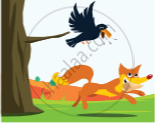
A jackal cheated the crow ______.
Do you think Ani will be a good leader? Why?
Read the passage and colour one bag each time you read.
There lived a poor but an honest farmer in a village. He supported himself, his wife and seven children using his small piece of land.
One day while he was walking in his field, he found a bag of gold.
He took it home and showed it to his wife. His wife told him to keep some of the gold. He told his wife that honesty is the best policy. He tried to find the person who lost it. At last, he found that the owner of the bag and gave it back. The rich man took the bag and thanked him.

Let us learn a few more word by joining the dots. Join the dots and fill the table below.
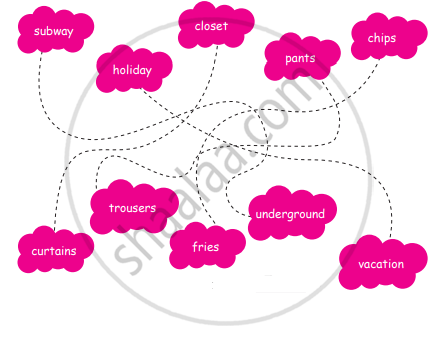
| subway | |
| holiday | |
| closet | |
| pants | |
| chips |
Why did Nasruddin say, “It was my aim,” the third time?
The garden Alice saw was
Who came to Akbar’s court?
Choose the right word.
“Eat the leaves of the tamarind tree, and you’ll also sing like ______.
What did Pinocchio say in the end?
Circle the words where you get a zzzzz sound. One is done for you.
| honeybees | |||
| price | prize | maze | face |
| rice | rise | blaze | fizz |
| lazy | lacy | busy | racy |
| raise | rays | race | ace |
| chase | this | these | frosty |
Read the following passage carefully and answer the following questions.
Pollution is the introduction of contaminants into the environment that cause harm to the ecosystem. The different kinds of pollution are air pollution, water pollution and land pollution. The release of various gases, finely divided solid particles, or liquid droplets that escape into the atmosphere to disperse and dilute in the environment is called air pollution. Modern society is also concerned about specific types of pollutants, such as noise pollution, light pollution, and plastic pollution.
Particulate Matter (PM), also known as particle pollution, is a complex mixture of extremely small particles and liquid droplets that get into the air. These particles if inhaled can affect health. The impact of PM 2.5 is particularly high in South Asia. Outdoor pollution is caused by a variety of pollutants like public and private vehicles, waste burning in the open, power production industries and construction and even cigarette smoking in public places.
Presently, air pollution is a major and growing risk factor for ill health in India. Delhi is one of the most air polluted cities in India. The air in the city as well as areas surrounding it has worsened to extremely hazardous levels in the recent years. This year’s pollution level is the worst in four years. Several studies have shown that poor air quality is a cause for many health issues among people with lower respiratory disorders with symptoms like dry cough, breathlessness, wheezing, chest discomfort, serious lung infections and cardio vascular diseases. Some studies throw light on the fact that about 16 per cent of the deaths worldwide in 2015 were due to pollution.
Air Masks are an option to protect oneself outdoor. Air masks can be used while commuting or while one is exposed to a polluted area. Some of these masks also include a layer of Activated carbon to filter the air. They protect us from suspended air particles and particulate matter up to the size of 2.5 microns and above. Their usage is limited to some days and should be disposed off after their prescribed duration of usage. The price for air masks starts from Rs 100 and can go up to Rs 500 and more.
We have to take active measures to control pollution and protect ourselves to lead a healthy and pollution free life.
- What is meant by pollution? Mention the different kinds of pollution.
- How does Particulate Matter cause air pollution?
- Identify three major causes of pollution in air
- Name the types of pollution we encounter now.
- What sort of health issues do people face due to air pollution?
- How can we protect ourselves outdoor from air pollution?
- Suggest a suitable title to the passage.
- Identify the meaning of the word similar to the one used in the fourth para:
- emerging
- filtering
- floating
- falling
