Advertisements
Advertisements
प्रश्न
What two things are compared in the poem?
Advertisements
उत्तर
It is difficult to judge whether the poet is trying to compare or is drawing a relation. Philip Larkin, in his poem Coming, celebrates the advent of the new season, spring, with the “fresh-peeled voice” of the thrush. He creates the imagery of the spring peeled out of the winter. The old season giving birth to the new season. Nature had been sleeping in the cold and gloomy winter and now the freshness of the new season sparked a new life in it. The birds, houses, gardens, the whole nature has joined the party to welcome the spring. Seeing this transformation the poet is so happy that he himself transcends into childhood.
Here Larkin highlights the difference between innocence and experience. He presents an innocent watching the adults, laughing and reconciling, probably after a fight or reconciling with life. How he begins to feel happy though he understands nothing. This is the innocence of the child that his happiness lies in others' happiness, which is juxtaposed with the experienced adults, who engage themselves in trivial issues creating troubles for themselves and others.
The poet has tried to bring out the difference between the two seasons and stages of human life. This mystique is beyond Larkin's comprehension and he is only left wondering about it all.
APPEARS IN
संबंधित प्रश्न
Describe the progress made by Helen Keller during the two years she spent at Wright-Humason School for the Deaf in New York City.
Read the following extract carefully and complete the activities given below :
A1 Complete the following :
(i) Books were found on the _____________ and ____________.
(ii) The tales are described as ______________ and __________.
|
Have you forgotten? Don't you know?
We'll say it very loud and slow:
THEY ... USED ... TO ... READ! They'd READ and READ,
AND READ and READ, and then proceed
To READ some more. Great Scott! Gadzooks!
One-half of their lives was reading books!
The nursery shelves held books galore!
Books cluttered up the nursery floor!
And in the bedroom, by the bed,
More books were waiting to be read!
Such wondrous, fine, fantastic tales
Of dragons, gypsies, queens, and whales
And treasure isles, and distant shores
Where smugglers rowed with muffled oars,
And pirates wearing purple pants,
And sailing ships and elephants,
And cannibals crouching 'round the pot,
Stirring away at something hot.
(It smells so good, what can it be?
Good gracious, it's Penelope.)
|
Read the following extract of the poem and complete the activities given below :
B1 State which of the following statements are
True or False :
(i) The elderly are nearest to our own exalted personality.
(ii) The elderly are those persons whose growth is stunted.
(iii) We should know our elderly people well, in order to receive guidance.
(iv) The elderly hold on to the frivolous aspects of life.
Elderly people should be around us. Justify.
(b) abb
(c) abba
What is the meaning of the line “Both wry with the laboured ease of loss”.
Notice these expressions in the text. Infer their meaning from the context.
-
honing our seafaring skills
-
ominous silence
-
Mayday calls
-
pinpricks in the vast ocean
-
a tousled head
This short story revolves around a single important event. Discuss how the narrative is woven around this central fact.
How does the connection drawn between the tail and the eyes add to the descriptive detail of the poem?
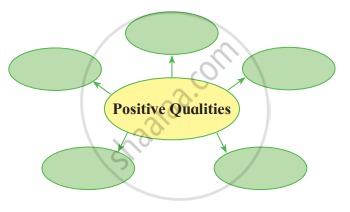
Find from the poem, positive qualities to fill up the web.
Have you heard of birds that fly from one part of the world to another in small or large flocks?
They are called Migratory birds.
Discuss and write down two reasons why they migrate and return.
Prepare an Acrostic from the word ‘Leisure’. The words should be related to what one likes to do in free time.
L______
E______
I______
S______
U______
Reading stories
E______
Complete the phrase using a word from the poem.
______ march
Akbar wanted to punish the person who pulled his moustache.
Visit a library:
Find stories about hosts and guests. Share them with the class. Classify the stories into funny and serious stories.
What did the Clean Brigade do?
Discuss:
Is it necessary to develop a good accent? Why? What efforts can you take to improve your pronunciation? With your teacher’s help, find out how to use online dictionaries for the purpose.
This story takes an unexpected turn when the lion decides to spare the camel’s life. Choose any fable, a story that you like, and rewrite it giving it an unexpected turn.
Think and answer:
Why are the sights said to ‘fly’?
Gather more information about the following from your Science textbook, the internet, and other sources.
Gravitational force
Answer in your own words.
How is the boy from the 1500s dressed?
Choose the appropriate phrase to insert in the gap, to make the sentence meaningful. Use the appropriate form of the verb.
Before we do the experiment in the Laboratory, let me ______ you all about it.
Read the poem and answer the following.
What are the two different ways of eating strawberries?
Read the poem and answer the following.
Which strawberries are plump and juicy?
Read the word. Write the words that combine to make it.
footprint
Write other meaningful words that begin/end with springtime.
How was Gulliver taken to the city?
Write any one of these stories, not as told by Gulliver, but by some other person.
Find a picture of a computer with the help of your teacher and label the different parts you see.
For example, monitor, screen, speakers, processor, mouse, mousepad, keyboard, etc.
Have you ever been on an adventurous journey? If yes, share your experience.
____________ raised a dreadful storm.
Who was Caliban? What was he employed for?
Were the policemen willing to leave the house?
Where did Chulong catch the bird?
Title summarises the story. Each paragraph is a part of the story. Look at the following expressions and find out the paragraphs that best suit these expressions.
- Oh, No! But it happens!
- Don’t let out your travelling dates
- Anyway, people will be people
- Search begins
- Things are not that easy
- Hurry invites worry
Read the following line from the poem and answer the question given below.
Nothing goes right with the folks you meet
Down on that gloomy Complaining Street.
- What is the opinion about the folks you meet down the street?
- What does the word ‘gloomy’ mean here?
The parents noticed some changes in the child. What were they?
Look at the number pattern. Fill the blank in the middle of the series or end of the series.
FAG, GAF, HAI, IAH, ______
Can a courageous man be defeated? Why?
Read the lines and answer the questions given below.
Autumn is English
in red, yellow and brown
Autumn is Indian
Whenever leaves fell down
- How is autumn in India?
- Compare the English autumn with the Indian autumn.
What is the setting of the story?
Who shattered the windows?
Try your own.
Why did Yazhini want to join the military?
Name the character or speaker.
"You want me to strain my back?"
Does it work its best?
Choose the odd one out.
Write the homophone for the given word and draw the picture.

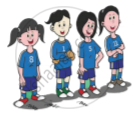
Write the events won by these players.
 |
______ |
 |
______ |
 |
______ |
______ over heard her father’s talking on the phone about the robbery.
Answer the following yes or no question.
Did all visit the waterfall?
Choose and write the adverbs to complete the sentence.

She coloured the picture ____.
The official's family visited the rehabilitation centre for ______ years.
People ran off when the seawater receded.
Where did Kani see the old cracked cup?
Miss Malliga teaches _______.
Write the rhyming word.
larder- ______.
Choose the correct one.
Rooster

What did his mother say in his dream?
What did he make out of it?
Read the extract and complete the activities given below:
|
“I don’t believe in taking the right decisions. I take decisions, I take decisions and then make them right:” One of them make them right. One of Ratan Tata’s inspiring words which made me dream beyond shadows. I feel fortunate that I discovered him in the early stage of my life, and now I am using his teachings to mould my future the way I want. Even though Ratan Tata was born into a very posh family in India, he never took money and power for granted. He graduated from Riverdale country from New York, Ratan Tata began his career in the Tata Group working on the shop floor of Tata Steel. After working for almost 10 years, he was appointed as the director-in-charge of the National Radio and Electronics Company Limited (NELCO) in order to help its struggling finances. He worked hard to build a better consumer electronics division, but the economic recession and union strikes prevented him from achieving success, and this success helped Tata to be appointed as the chairman of the Tata Group of companies. He started with a very basic job in his father’s company, and today he owns a billion-dollar company. The tag of greatness does not come without making any sacrifices, and this tag on Ratan Tata suits to its best. Tata Group launched its passenger car Tata Indica in the year 1998 but Tata Indica was a failure in its first year, and the experiment seemed to be failing. Many people started advising Ratan Tata that he should sell the passenger car business. Ratan Tata also agreed to this, and a proposal was given to Ford; they showed interest too. The three-hour meeting at Ford headquarters in Detroit, chairman of Ford (Bill Ford) said to Ratan Tata, “Why did you enter in the passenger car business when you were not knowing of it. It will be a favour if we buy this business from you.” Ratan Tata decided to move back home. While travelling, he was very tense as the feeling of being insulted was on his mind. After earlier failures, Tata Motors did well with its business of passenger cars but in the same period, Ford did very bad. In 2008 when Ford was on it way of bankruptcy, Tata Group offered Ford to buy its luxury car brand, Jaguar Land Rover. Ford arrived in Mumbai for the meeting. In the meeting, Bill Ford said to Ratan Tata, you are doing a big favour for us by buying-Jaguar-Land Rover is now owned by Tata Group and is currently making profits. |
A1. Rewrite the following sentences as per their occurrence in the extract: (2)
- He was appointed as the Director-in-charge of the National Radio and Electronics Company Limited.
- Tata Group launched its passenger car “Tata Indica” in the year 1998.
- Billi Ford said to Ratan Tata, "You are doing a big favour for us by buying Jaguar-Land Rover."
- He graduated from Riverdale country from New York.
A2. Explain: (2)
The writer says, "I don't believe in taking right decisions. I take decisions and then make them right."
A3. Give reasons: (2)
Ratan Tata decided to sell his passenger car business.
A4. Personal Response: (2)
Right decision at the right time is important success. Express your opinion.
A5. Grammar: (2)
Do as directed:
- He worked hard building a better consumer electronics division.
(Rewrite the sentence using the infinitive form of the underlined word) - Tata Group launched the passenger car Tata Indica.
(Rewrite it beginning with 'The passenger car Tata Indica......')
A6. Vocabulary:
Give antonyms.
- Profit × ______
- Prevent × ______
