Advertisements
Advertisements
Question
What does the line 'I never writ, nor no man ever loved' imply?
Advertisements
Solution
Shakespeare, in his poem, Let Me Not to the Marriage of True minds, approaches the idea of love or ideal love, the other way round. Throughout the poem, he talks and explains all the negatives that an ideal love must not comprise. Similarly, the poet maintains his tone at the end of the poem as well. He closes the poem with the couplet 'I never writ, nor no man ever loved'. In an unnatural or inverse fashion, rather than saying that men have loved and so he writes, Shakespeare says that if what he has written is to be an error, then he would not have written it all and that no man would have loved at all. Confidently, he challenges anyone to prove his idea of love to be wrong; he knows that it is impossible and that his knowledge stands true.
APPEARS IN
RELATED QUESTIONS
Read the text below and summarise it.
The Great Desert Where Hippos Once Wallowed
The Sahara sets a standard for dry land. It’s the world’s largest desert. Relative humidity can drop into the low single digits. There are places where it rains only about once a century. There are people who reach the end of their lives without ever seeing water come from the sky.
Yet beneath the Sahara are vast aquifers of fresh water, enough liquid to fill a small sea. It is fossil water, a treasure laid down in prehistoric times, some of it possibly a million years old. Just 6,000 years ago, the Sahara was a much different place.
It was green. Prehistoric rock art in the Sahara shows something surprising: hippopotamuses, which need year-round water.
“We don’t have much evidence of a tropical paradise out there, but we had something perfectly liveable,” says Jennifer Smith, a geologist at Washington University in St Louis.
The green Sahara was the product of the migration of the paleo-monsoon. In the same way that ice ages come and go, so too do monsoons migrate north and south. The dynamics of earth’s motion are responsible. The tilt of the earth’s axis varies in a regular cycle — sometimes the planet is more tilted towards the sun, sometimes less so. The axis also wobbles like a spinning top. The date of the earth’s perihelion — its closest approach to the sun — varies in cycle as well.
At times when the Northern Hemisphere tilts sharply towards the sun and the planet makes its closest approach, the increased blast of sunlight during the north’s summer months can cause the African monsoon (which currently occurs between the Equator and roughly 17°N latitude) to shift to the north as it did 10,000 years ago, inundating North Africa.
Around 5,000 years ago the monsoon shifted dramatically southward again. The prehistoric inhabitants of the Sahara discovered that their relatively green surroundings were undergoing something worse than a drought (and perhaps they migrated towards the Nile Valley, where Egyptian culture began to flourish at around the same time).
“We’re learning, and only in recent years, that some climate changes in the past have been as rapid as anything underway today,” says Robert Giegengack, a University of Pennsylvania geologist.
As the land dried out and vegetation decreased, the soil lost its ability to hold water when it did rain. Fewer clouds formed from evaporation. When it rained, the water washed away and evaporated quickly. There was a kind of runaway drying effect. By 4,000 years ago the Sahara had become what it is today.
No one knows how human-driven climate change may alter the Sahara in the future. It’s something scientists can ponder while sipping bottled fossil water pumped from underground.
“It’s the best water in Egypt,” Giegengack said — clean, refreshing mineral water. If you want to drink something good, try the ancient buried treasure of the Sahara.
Staff Writer, Washington Post
Look for pictures in newspapers and magazines that depict the urban civic problems discussed in the text. Cut them out and pin them to the text at appropriate places.
What do you understand of the natures of Ramanand and Azam Khan from the episode described?
Discuss the following in pairs or in small groups.
Although Paul’s mother liked to be rich she did not approve of betting on horses.
'The author's treatment of the subject matter makes the readers identify themselves with the experience.' Comment on the statement.
Explain the metaphor in the line: ‘Poets are the mirrors of gigantic shadows that futurity casts on the present’.
Identify the lines that reveal the critical tone of the poet towards the felling of the tree.
Fill in the blank.
The author wanted to grow ______________.
Think and answer in your own words.
Why is the street light compared to a one-red-eyed-giant?
Think and answer in your own words in your notebook.
Why does the poet appeal to us, to respect the life of a worm?
The mother was working, when the Swallow brought the yellow jewel.
A bridge connects people on either side of a river or valleys in cities or villages. Discuss with your partner the importance of a bridge to both the cities and the villages and complete the table.
| Cities | Villages |
Building a bridge needs careful planning. Think about what goes on before the actual construction begins.
- Proper planning
- ________________
- ________________
- ________________
- ________________
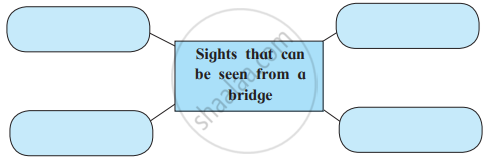
You might have visited a bridge. Complete the web describing the sights you could see from the bridge.
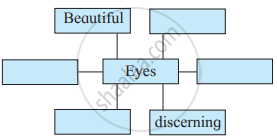
Complete the web with the help of adjectives used to describe eyes and nose in all respects. Two are done for you.

Prove with the theme of the play/extract that the deeper human emotion which profoundly interested Shakespeare was jealousy.
Form groups and hold debates on the following topic. Make bulleted lists of points in favour of the topic (pros) and those against it (cons). (3-6 points each).
Boys cannot cook or do any housework.
Write a short speech for the State of Maharashtra.
Bassanio borrowed money from Shylock in Antonio’s name.
Explain the idea of ‘Conservation of Nature through Livelihood’ briefly, using the example given here.
Fill in the following blanks with reference to the poem.
'In time of rain when spring and life are ______, the butterflies lift ______ wings to catch a ______ cry and trees put forth ______ leaves to sing in ______ beneath the sky as ______ boys and girls too ______ singing down the roadway'.
Read the poem: ‘Home they brought her warrior dead’ by Alfred Lord Tennyson.
Discuss the following.
Abdul gets what he wants in the end. What is the major factor that contributes to this success?
Form a group of four to six. As a group activity, write a conversation in which a person/a group of person thanks to someone.
Fill in the blank choosing the appropriate word/idiom from the lesson.
While arguing with his elders he had ______.
Read the word. Write the words that combine to make it.
anywhere
Find a word that has a similar meaning.
Sorry
Find out the difference between the fingerspelling method, sign language and Braille.
Who used the zither and how?
Read the following incident carefully to answer the question that follow.
The tie that does not bind
“Oh, so you’re going abroad? Can you bring me back…..?” I’ve been asked to bring back a vaccine for a course. Once I searched the suburbs of Paris for two days for a special brand of ceramic paint. Having spent a lot of money for Cartier lighter refills, I had them confiscated at the airport just before boarding because the gas might be dangerous in the air.
Now, two months before a trip, I stop talking to people so they won’t suspect I’m about to travel. But someone always catches me.” I’ve heard you’re going to New York, and I want you to get something for me. It’s just a little thing you can find anywhere. I don’t know exactly how much it costs, but it shouldn’t be much. We’ll settle up when you get back”.
What Gilson asked me to buy was, in fact, a little thing: a tie. But not just any tie. He wanted a tie with a small embroidered G. Any colour would do, as long as it had his initials. Look, this is a special flight, I explained. We are only staying Saturday through Tuesday. On the day we arrived I didn’t have time to think about the tie, but strolling around on Sunday I did see ties bearing various letters in more than one shop window. They were cheap, just a dollar, but all the shops were closed.
On Monday, lunch lasted the whole afternoon. Then it was Tuesday morning, time to leave. It was only when I saw our airport bus waiting outside the hotel that I remembered the tie.
I told the group to go on. I would get a taxi to the airport. And so I went in search of a nearby shop where I had seen ties.
But I couldn’t find it. I walked further down the street-one, two, three blocks - all in vain. Back at the hotel, a bit anxious now, I took my suitcase, got a taxi and asked the driver to rush to the street where I had seen them.
The driver stopped at each shop we passed so I could look from the window. The stores had all sorts of ties, but not the kind I was looking for.
When I finally thought I had located the right shop, I decided to go in and check. The driver refused to wait. Parking was prohibited, he said. I promised to double the fare, jumped out and ran into the shop. Was I going to miss the plane just for a damned tie?
The salesman was unbearably slow. When I realized that the smallest change I had was a ten dollar note , I grabbed ten ties of different colours so I wouldn’t have to wait for change. I rushed out with the ties in a paper bag.
On the street I looked around. The taxi had vanished, taking my suitcase. What is more, I was going to miss the plane.
I ran to the corner, and hope flared up again: the taxi was waiting in the next street. Quick to the airport! As I settled down inside the taxi. I sighed with relief. Gilson was going to have enough initialized ties to last him a lifetime.
When I reached the airport, I paid the taxi driver the double fare and grabbed my suitcase. Panting, I boarded the plane under the reproachful gaze of the other passengers, all primly seated with their seat belts fastened. Ready to take off. Departure had been delayed because of me.
“At least I hope you found your tie”, said one who knew the story.
“I did”, I answered triumphantly.
After making myself comfortable, I reached for the paper bag to show the ties.
I had left it behind; in the taxi.
Fernando Sabino.
Read the incident again and answer the following question.
What was the writer always asked to do whenever he planned to go abroad?
Read the story again and write how these character reacted in these situation:
You’re both quite mistaken.
Dr. Krishnan ........…………………….
Mrs. Krishnan……....…………………
Read the comic strip again. Make groups of four and frame some questions on what you have read. Each group should ask a question in turns. You cannot repeat the same question. The team which asks more questions is the winner.
e.g:
- Which are the foreign vegetables mentioned?
- What was sad for Columbus?
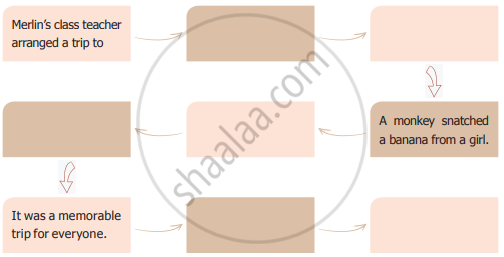
Recall Merlin’s memories and complete the story map.
Read the lines and answer the question given below.
Each a glimpse and gone forever;
a. What is ‘each’ over here? Why is it gone forever?
Gulliver was the captain of the ship.
The land was wet and green.
Find example of alliteration and write them in the blank.
to muddy roads
monsoons and mangoes
How is water produced in Mars?
Read the events of the story. They are in the wrong order. Put them in the correct order.
| 1. And it charged straight at the cavalry officers on horseback. |
| 2. And so she flew onto the back of the cow. |
| 3. So everybody panicked and made a general rush to safety |
| 4. The startled cow charged off in fear |
| 5. She applied brakes, but was thrown off the cycle. |
| 6. Just then she saw a lone cow in the middle of the road. |
| 7. Finally the cow fell into a ditch and dislodged the girl. |
| 8. The girl cried out in delight as she overtook her brother on her cycle. |
The girl admitted to her brother that she was badly frightened.
Match the rhyming words.
| filth | farmer |
| cook | harm |
| charm | wealth |
| armour | look |
Jaswant decided to stay in his post.
Choose the odd one out.
The rich man ______ at the beggar.
Akilan learnt Judo for ______.
What did they use as net?
What party is that?
Who were the friends referred in the story?
Does the poet want diversity? why?
What do you save? Why it is needed?
Join the word with the correct prefix.
| paid | un |
| send | dis |
| able | re |
| continue | pre |
The merchants sold things made of______.
Write the word with same meaning.

post- ______
Why did he rub the circle again and again?
The fir tree was not happy with the gold leaves ______.
Draw the garden of your dreams.
How did he challenge everybody?
Read the poem.
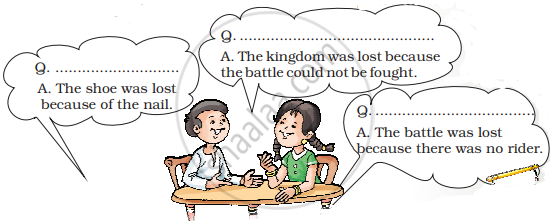
For Want of a Nail
For want of a nail, the shoe was lost,
For want of a shoe the horse was lost,
For want of a horse, the rider was lost,
For want of a rider, the battle was lost,
For want of a battle, the kingdom was lost,
And all for the want of a horseshoe nail!
[traditional rhyme]
Now form questions for the answers given in the speech bubbles.
Read the following passage and do the activities:
A1. Fill in the blanks: (2)
- ______ percent of our daily communication is non-verbal.
- Eye contact is another type of ______ communication.
- Frequent blinking is a sign of the person feeling ______.
- One can readily detect _______.
|
According to some experts, a staggering 93 percent of our daily communication is non-verbal. Facial expressions are easy to decipher. One can readily detect happiness, sadness, anger. Physicians can tell a patient is doing well (or not) by looking at his/her face. Eye contact is another type of non-verbal communication, which can tell a lot about the other person. The eyes convey a range of emotions-happiness, sadness, boredom, surprise, confidence .......... even emotional interest. Staring at someone's forehead may intimidate the recipient, staring at the mouth is sometimes interpretated as a sign of emotional interest. In fact, staring into someone's eyes is a sign of lying, and so is looking away. In certain cultures, lack of eye contact is taken as a sign of respect. If body language is to be defined, it is a combination of facial expression, gestures, eye contact, body movements and posture and voice. Frequent blinking is a sign of the person feeling distressed or uncomfortable. If the pupils are dilated, it ofter indicates interest, even emotional interest. The lips also reflect our body language, and lip biting indicates worry and/or anxiety; tightening of the lips may be an indication of disapproval. Slightly turned-up lips indicate happiness and slightly turned-down lips indicate sadness. |
A2.

A3. Find the antonyms of: (2)
- verbal × ______
- entertaining × ______
- sender × ______
- comfortable × ______
A4. Do as Directed: (2)
- The eyes convey a range of emotions. (Frame a 'Wh' question in order to get the underlined part as answer).
- Physicians can tell about a patient's wellness. (Rewrite using 'able to')
A5. Personal Response: (2)
Non-verbal communication plays an important role in our daily life. Comment.
