Advertisements
Advertisements
प्रश्न
How is the idyllic juxtaposed with the pedestrian in the poem?
Advertisements
उत्तर
Nissim is known for bringing out the extraordinary in the ordinary. His poems are based on ordinary settings and ordinary issues. The fashion with which he presents the common issues is appreciated by many critics. In fact, he was the first Indian poet to have abandoned romance and write on ordinary issues in poetry composed in English. In his poems like The Night of the Scorpion, he portrays the emotions of the ordinary human being. An ordinary p0edestrian scene of a village out of which he created a hyperbole presenting it in a very idyllic fashion. Even in the poem For Elkana, Ezekiel has exploited a very ordinary home situation in which the parents are discussing their household issues. It is just that through various figures of speech such as meiosis, undertones, asides, and understatements he personifies the ordinary that any married couple may undergo or a parent may have for her/his child. Thus, through his creation, Nissim has given the reader that even in a pedestrian lies an idyllic expression.
APPEARS IN
संबंधित प्रश्न
Read the following extract and answer the questions given below:
How do you know
Peace is a woman?
I know, for
I met her yesterday
on my winding way
to the world's fare.
She had such a wonderful face
just like a golden flower faded
before her prime.
(1) How does the poet describe the face of peace?
(2) Do you think there is a way out of the war-ridden world? What is it?.
(3) Name and explain the figure of speech in the following line:
"I met her yesterday
on my winding way."
(4) The poet asks the question and herself answers it. What effect does it create in the extract?
Mention the way in which the sparrows expressed their sorrow when the author’s grandmother died.
Talk to your partner about the following.
Describe the changing relationship between the author and his grandmother. Did their feelings for each other change?
|
The energy stored in coal and petroleum originally came to the earth from the sun. The bulk of the present-day supplies was laid down some 200 to 600 million years ago, when tropical conditions were widespread. Lush, swampy forests produced huge trees; warm coastal seas swarmed with microscopic forms of life. When these organisms died, much of their tissue was recycled as it is today — through scavenging and decay. But a significant amount of dead plant and animal material was covered with mud, which prevented complete decomposition. With the passage of time, layer upon layer of the fine sediment was deposited over the once-living material; the sheer weight turned the sediments to rock. Sandwiched between the layers, both coal and petroleum were produced and preserved under pressure. Coal was formed mostly of giant fern-like plants that have only small counterparts today. Coal may still be forming here and there on earth, but conditions are not right for the production of significant quantities. |
Combine related points.
Look for pictures in newspapers and magazines that depict the urban civic problems discussed in the text. Cut them out and pin them to the text at appropriate places.
Discuss the following in pairs
Behind the public face of the people in various occupations is a whole saga of personal suffering and joy which they wish to share with others.
Why does Ruskin feel that reading the work of a good author is a painstaking task?
Read the following statement and mark those that apply to you.
I wish to be friends with someone but my friendship is rejected.
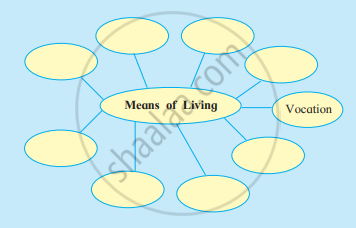
Pick out words that refer to ‘means of living’ and fill them in the Web.
(profession/recreation/occupation/job/ pastime/employment/hobby/career/entertainment/mission/trade/buisness/sports/retirement/placement)
The cherry tree has inspired the poet to compose the poem. Such poems, describing Nature or aspects of Nature are called ‘Nature poems’. Find out some expressions from the poem that bring out the elements of the beauty of Nature.
Answer the given question in your own words.
Why did the swallow decide to stay under the statue of the Happy Prince at night?
Name the festival that you enjoy most of all. Fill in the facts about that festival.
- Name of the festival:
- When it is celebrated:
- Why it is celebrated:
- How it is celebrated:
- Special cuisine:
- Other special features:
Life is an amalgam of happy and sad moments. Think of such moments in your life, pair with your classmate, and share both the aspects of life.
| Happy Moments | Sad Moments |
| 1. Winning the first prize in a competition | Losing your mobile, bicycle, or wallet |
| 2. | |
| 3. |
Johnsy realised that her thinking was wrong.
Select a season of your choice and give the following details:
- Time of the year -
- Characteristics- crops, festivals, etc.
- Features/changes - climate/weather/temperature etc.
- Advantages/Disadvantages -
State the difference between drama and novel.
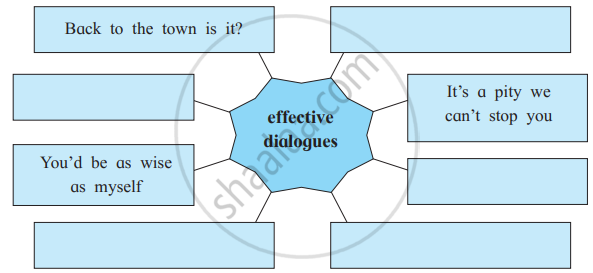
There are some dialogues that are short, but quite effective. They give us enjoyment and add beauty to the main story. Find some more from the text.
State whether the following statement is True or False:
Titania falls in love with an ass.
Write about the various wheel-like objects you see at home, in school, and on the road.
Present any one of the speeches given above.
Rewrite the poem in the form of a prose passage.
How early did the preparations for the Science Fair begin?
Read the passage and name the following.
He persuaded Helen to elope with him.
This story takes an unexpected turn when the lion decides to spare the camel’s life. Choose any fable, a story that you like, and rewrite it giving it an unexpected turn.
Write the following:
The sights mentioned in the second stanza.
Write about the sights you may see from a bus or an airplane. You may write it in the form of a short poem.
Present these points in the form of a review, and give it a suitable title.
Find the different units of measurement mentioned in the passage and get more information about them from the internet.
Read the following from the Language Study pages:
- adjective clause
- adverb clause
- noun clause
Find one example of each from the passages. (Note the linking word when you do that.)
Using your imagination, write how the other pets in the house could have objected to Caesar living in their house.
List 5 of the sounds that you like.
What did Anshuman’s father compare bad habits to?
Which event in the story tells us that the scarecrow was intelligent?
Make a collection of Rangoli motifs and patterns.
Write about each motif or pattern in your own words -
it could just be a label or a description or some information or comment.
Read the following line from the poem and answer the question that follow.
My heart will keep the courage of the quest And hope the road's last turn will be the best.
|
My heart will keep the courage of the quest, And hope the road's last turn will be the best. |
- What kind of quest does the poet seek here?
- What is the poet’s hope?
How did the Bodwells react, when a shoe was thrown into their house?
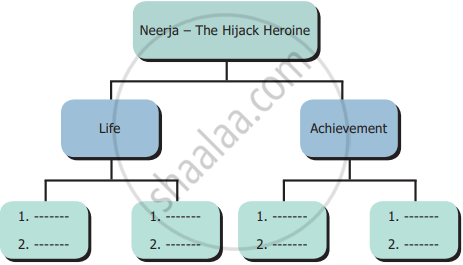
Read the “Story of Self Sacrifice and Bravery” once again and complete the flow chart.
The boar slept until the fading sun told him it was time to get up. What does the phrase until the fading sun mean?
Find example of alliteration and write them in the blank.
Spring Is pretty
but short and sweet
The girl was badly hurt.
It is used in the fisher’s _____.
How do we keep our integrity?
Write the rhyming word.
face - ______.
The hen-pigeon returned home when it started to _______.
Recite the poem ‘Mother Nature’.
Identify the character/speaker.
He bought a new fish tank.
Look at the picture and tick choose the correct word.

Write the rhyming word.
one
Choose the best answer.
The animals ______ the boat.
Choose the best answer.
Suddenly there was a______.
Where did Kani see the old cracked cup?
Recite the poem The Painter with correct intonation.
The fir tree was not happy with the gold leaves ______.
Where did the rabbit go?
Are these sentence TRUE or FALSE
The poet says that stars will always shine at night.
Who was Hiawatha?
Who came to Akbar’s court?
Why did he go there?
Find words from the passage which are antonyms of the following.
- artificially (para 1)
- strength (para 2)
On the basis of your understanding of the given passage, make notes in any appropriate format.
The Sherpas were nomadic people who first migrated from Tibet approximately 600 years ago, through the Nangpa La pass and settled in the Solukhumbu District, Nepal. These nomadic people then gradually moved westward along salt trade routes. During 14th century, Sherpa ancestors migrated from Kham. The group of people from the Kham region, east of Tibet, was called “Shyar Khamba”. The inhabitants of Shyar Khamba, were called Sherpa. Sherpa migrants travelled through Ü and Tsang, before crossing the Himalayas. According to Sherpa oral history, four groups migrated out of Solukhumbu at different times, giving rise to the four fundamental Sherpa clans: Minyagpa, Thimmi, Sertawa and Chawa. These four groups have since split into the more than 20 different clans that exist today
Sherpas had little contact with the world beyond the mountains and they spoke their own language. AngDawa, a 76-year-old former mountaineer recalled “My first expedition was to Makalu [the world’s fifth highest mountain] with Sir Edmund Hillary’’. We were not allowed to go to the top. We wore leather boots that got really heavy when wet, and we only got a little salary, but we danced the Sherpa dance, and we were able to buy firewood and make campfires, and we spent a lot of the time dancing and singing and drinking. Today Sherpas get good pay and good equipment, but they don’t have good entertainment. My one regret is that I never got to the top of Everest. I got to the South Summit, but I never got a chance to go for the top.
The transformation began when the Sherpa Tenzing Norgay and the New Zealander Edmund Hillary scaled Everest in 1953. Edmund Hillary took efforts to build schools and health clinics to raise the living standards of the Sherpas. Thus life in Khumbu improved due to the efforts taken by Edmund Hillary and hence he was known as ‘Sherpa King’.
Sherpas working on the Everest generally tend to perish one by one, casualties of crevasse falls, avalanches, and altitude sickness. Some have simply disappeared on the mountain, never to be seen again. Apart from the bad seasons in 1922, 1970 and 2014 they do not die en masse. Sherpas carry the heaviest loads and pay the highest prices on the world’s tallest mountain. In some ways, Sherpas have benefited from the commercialization of the Everest more than any group, earning income from thousands of climbers and trekkers drawn to the mountain. While interest in climbing Everest grew gradually over the decades after the first ascent, it wasn’t until the 1990s that the economic motives of commercial guiding on Everest began. This leads to eclipse the amateur impetus of traditional mountaineering. Climbers looked after each other for the love of adventure and “the brotherhood of the rope” now are tending to mountain businesses. Sherpas have taken up jobs as guides to look after clients for a salary. Commercial guiding agencies promised any reasonably fit person a shot at Everest.
