Advertisements
Advertisements
प्रश्न
What is Gandhiji’s ideal?
Advertisements
उत्तर
Gandhi’s ideal is to observe passive resistance against the cowardliness of hidden revenge and the cowed submissiveness of terror.
APPEARS IN
संबंधित प्रश्न
Indian society has moved a long way from the way the marriage is arranged in the story. Discuss.
'New Literature' is a misnomer for the wealth of the Indian Literary tradition. How does G. N. Devy explain this?
The peacock is a colourful bird. How does the poem capture the various colours that its plumage displays?
What two things are compared in the poem?
Bring out the parallel suggested between the predatory instincts of the bird and human behaviour.
No trees except the one which grows and seethes in one's dreams'– why is the phrase 'grows and seethes' used?
Fill in the blank.
Moru Dada wanted to spray __________ on the moong crop.
Find out from the internet the poem ‘Song of Youth’ by Dr APJ Abdul Kalam.
- Copy it down in your notebook and write its theme in your own words.
- Using information from your school library or the Internet, prepare a Profile of any great Indian Scientist.
Johnsy realised that her thinking was wrong.
Read the poem aloud. Recite any stanza of your choice from memory.
Give reasons :
Oberon and Titania fight for the custody of the Indian boy because - Titania wants ______________________.
Shylock demanded a pound of Antonio’s flesh.
Start a collection of new and interesting words. Write the words in colored ink on cards of equal size and arrange them in alphabetical order. Try to use the words in your writing or conversation from time to time.
Summarise this poem in your own words in 8 to 10 lines, highlighting only the main points.
Do you agree with the poet’s thoughts? Why?
How do we come to know that Kasim was a generous man?
Identify the speaker/character.
Stop ship. Drop anchor. Quick!
How can you balance your academic goals and your passion for sports or arts?
Identify the speaker/character.
"Don't let us down now, Gulliver; we need your help."
| Mr. Murugan is a farmer. He has a small piece of land and two bulls. He takes good care of his bulls as they help him in farming. Every morning, he takes the bulls for grazing. When it rains he ploughs the land with the bulls. As he has no one to help he starts sowing the seed before sunrise. He irrigates the crop till it grows. He reaps and binds the crop then takes it to thrash the paddy. Finally, with the help of the bulls, he takes the paddy to his house. |
Choose the main idea of the passage.
Look at the picture and Choose the correct word.

Identify the character or the speaker.
“Oh no! What shall I do now?”
If we didn’t have boundaries, we don’t need _______.
Why did Tenzin cry every day?
What will you do with your savings?
Why did Bala go to Chennai with his father?
Who wins the world at the end?
Who fell down and down and down?
Read the following passage and do the activities.
A1. State whether the following sentences are True or false. [2]
- The king’s temperament also changed.
- The king was happy with prediction of the astrologer.
- The courtiers sought an audience with Tenali Raman.
- Courtiers advised the king to regulate his diet.
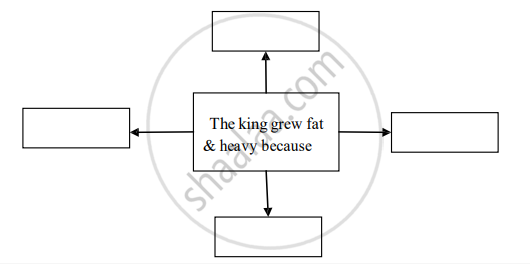
A2. Complete the web. [2]
|
King Krishnadeva Raya would perform heavy exercises every morning. He regularly applied oil on his body and thereafter worked out till all the oil came out with the sweat. This was followed by a long ride on his horse. Once the king started leading a sedentary lifestyle, and he stopped exercising. He no longer went horse-riding either. The king overate and as a result grew fat and heavy. The king‟s temperament also underwent a sea change. Noticing this, the royal physicians cautioned the king against the ill effects of overeating and explained to him the risks posed by obesity. They advised the king to regulate his diet, exercise, and take care of his health. The repeated advice he got from the physicians to eat less made him so angry that one day he announced a reward for anyone who could find him an easy cure. But there was one condition: those who failed would have their heads off. None dared to advise the king in this regard. The situation became precarious and as usual Tenali Raman was approached by the courtiers for a remedy. Tenali heard the problem and assured the courtiers of a viable solution. The next day, an astrologer predicted that the king had only a month left to live. When the king came to know of this, he was furious. The astrologer was ordered by the king to be imprisoned for a month so that his prediction could be put to test and so the hapless forecaster was sent to prison. |
A3. Find out describing words from the passage for the words given below. [2]
- exercise - ...........
- lifestyle - ...........
- ride - ...........
- physician - ...........
A4. Do as directed. [2]
- King Krishnadeva Raya would perform heavy exercises every morning.
(Use ‘used to’) - They advised the king to regulate his diet. (Pick out the infinitive)
A5. What are the benefits of daily exercise? [2]
Pick out word which mean the same as
keep a check on (para 3)
