Advertisements
Advertisements
प्रश्न
'New Literature' is a misnomer for the wealth of the Indian Literary tradition. How does G. N. Devy explain this?
Advertisements
उत्तर
According to the essayist, the tribal Literature should not be called 'New Literature' as this has been in existence for many years. The songs and stories of the tribals have been transmitted orally and as these have not been written down so many people have been unaware of them. The essayist contradicts the views of the western literary critics who have termed tribal literature as 'New Literature'. He says that there is nothing new in this, what might be new is the present attempt to see imaginative expression in tribal language not as folklore but as literature and to hear tribal speech not as a dialect but as a language.
APPEARS IN
संबंधित प्रश्न
Can you think of a song or a poem in your language that talks of homecoming?
The story is called ‘The Adventure’. Compare it with the adventure described in ‘We’re Not Afraid to Die...’
We 'draw up a deed'. Complete the following phrase with an appropriate word.
________one's word
We 'draw up a deed'. Complete the following phrase with an appropriate word.
________ends meet
The lecture was delivered in 1864. What are the shifts in style and diction that make the language different from the way it is used today?
How did the author feel about her mother's passion to make her a dancer?
No trees except the one which grows and seethes in one's dreams'– why is the phrase 'grows and seethes' used?
What message does this story bring out for youngsters?
Read the story and complete the following.
Revathi’s grief knew no bounds because, ____________.
Answer the given question in your own words.
Why did the swallow decide to stay under the statue of the Happy Prince at night?
Pick out a word from the poem to complete the sentence meaningfully.
The Government made a ______ (announcement) about their new taxation policy.
The special thread for kite - flying is sharpened by adding sugar and glass pieces.
The tongue justifies the possession of the spectacles on behalf of the nose. Pick up the expressions from the poem that argues in favour of the Nose and complete the following web diagram.

Read the lesson and name the following.
The First surgeon to perform operations ______
Find at least two things from the poem that show the following:
The atmosphere is pleasant.
Read aloud with the leader: Form groups of five. Read the passage aloud in groups. The leader begins every sentence and stops after a few words. The other members complete the sentence, reading it aloud in the chorus.
In each of the following line, spot the sound that is used repeatedly -
- There’s a silver house in the lovely sky.
- As round as a silver crown
- It takes two weeks to build it up. And two to pull it down.
Listen and complete:
Close your books. The teacher will dictate some lines from the poem. She will say the first half and you have to write the entire line/verse.
- I know a funny ____________ As quiet as a ____________ Who does the mischief that is done ____________.
- There’s no one ever sees his face, And yet we all ____________ That every plate we break was ____________ By ____________.
What do the following events/actions tell us about the characters? Discuss.
Sir Ector asked Sir Kay to show him whether he could draw the sword out of the stone.
Write about Malti and Rima using the following points:
 |
 |
| Appearance... | Appearance... |
| Studies... | Studies... |
| Singing... | Singing... |
| Attitude to others... | Attitude to others... |
| Weak points... | Weak points... |
Use details from the story and your own imagination when you write the above descriptions.
Correct the following sentence using facts from the passage.
The great heroes avoided one another.
A parody is a playful, comic imitation of a writer’s style. A parody is like a verbal cartoon. Compare the original poem and its parody given on page 35 using the following points:
|
How doth the little busy bee |
How doth the little crocodile (parody) |
| Choice of a subject (an animal) | __________________ |
| __________________ | __________________ |
| Number of lines and stanzas | __________________ |
| __________________ | __________________ |
| Same or similar constructions | __________________ |
| __________________ | __________________ |
| Tone of the poem | __________________ |
| __________________ | __________________ |
Answer in your own words.
What did the ancestor from 1910 wish to do instead of making his bed?
Rohan had finished ______ rounds of the tree before Mrs. Groover discovered him.
Name the following.
Scored the first goal in the match.
Read the word. Write the words that combine to make it.
springtime
Have you ever seen or used a computer?
How did the cops manage to enter the locked house?
Use this passage to play the game. You can collect information on other famous personalities and play too.
Charlie Chaplin was born on April 16, 1889, in London England. His birth name was Charles Spencer Chaplin, though he had many nicknames growing up such as Charlie, Charlot, and The Little Tramp. His father, Charles Chaplin, and his mother, Hannah Chaplin, were inducted into the music hall of fame, leading the way to his exposure even as a young boy. His first onstage moment was when he was 5 years old; he sang a song that was intended to be sung by his own mother; she had become ill at the time of the performance, so little Charlie Chaplin stood instead and performed for his mother.
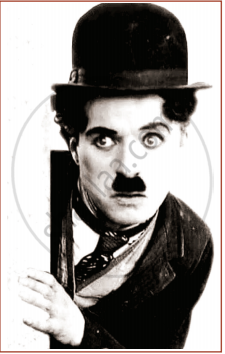
Charlie Chaplin came to the United States in 1910, at the age of 21. He was brought to New York, which was known to be a great place to start out for anyone trying to become a professional actor. Two years later, in 1913, Chaplin signed his very first contract at Keystone and it was no time before he headed to Hollywood. His first movie premiered in 1914, “Making a Living,” and went on to make over 35 movies total in that year alone. Charlie Chaplin grew to become one of the most popular and successful actors of all time. The moment that really kicked off his long career was in 1921 when he starred in, and produced, his first full-length film called “The Kid.” From then on, most people all over the world knew Charlie Chaplin and loved his movies. He had a great career and life, dying on December 25, 1977, in Vevey, Switzerland. He had apparently died of natural causes in his sleep from old age.
Read the following line from the poem and answer the question given below.
| And so it were wisest to keep our feet From wandering into Complaining Street; |
- What is the wisest thing that the poet suggests?
- What does the phrase ‘to keep our feet from wandering’ refer to?
What did Suresh ask Usha? Why?
What is good or effective communication?
Identify the character/speaker.
Wake up. You've been sleeping for too long.
Amma bought the vegetables from the______.
Why does the poet fly out of the universe?
Why do the soldiers (people) die? When will it stop?
Rearrange the story in order.
- Jaswant stayed back in his post.
- He killed 300 chinese soldiers in the battle.
- He fired weapons from separate points.
- Sela and Nura helped him in the battle.
- Jaswant shot himself to death.
- Chinese soldiers caught the man who supplied food.
- He was awarded the Mahavir Chakra.
What day is it?
Where is the key?
What is your hobby?
Identify the character or the speaker.
“Oh no! What shall I do now?”
Who was Akilan’s inspiration?
What was the age of Robinson Crusoe when he left for sea?
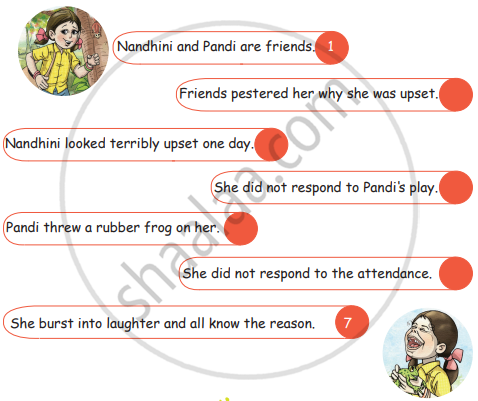
Number the actions of Pandi and Nandhini in order.
Muthu collected ______ from every house.
Try your own.
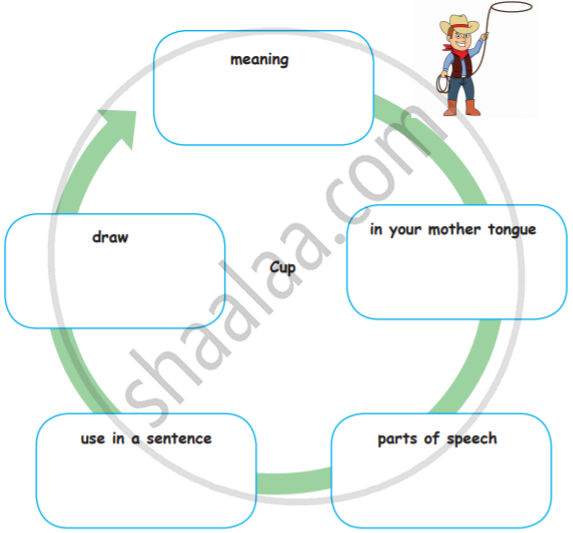
Write a paragraph on the topic ‘Park’.
Who is responsible for the society?
Kamali gave her savings to______.
The king shouted at Ani.
Write the word with same meaning.

post- ______
Write the word with same meaning.

pants- ______
Write the word with same meaning.

queue- ______
One day Chris tried to draw a ______.
What is the one thing you will try and improve after reading the story? How?
The fir tree was not happy with the gold leaves ______.
Draw the garden of your dreams.
Who fell down and down and down?
What secrets did he learn about beasts?
Look up the following entries in the Language Study pages given at the end.
- stress
- intonation
- sound
- consonant
- vowel
