Advertisements
Advertisements
प्रश्न
Discuss in groups of four.
The sensitive behaviour of hill-folk.
Advertisements
उत्तर
Hill folk are innocent and rustic people. They are very conservative and cultural. They do not have the exposure of a city life. They are simple and humble. They are habitual to country life, which is not fast. They are always ready to help. People who are from small towns are religious and humane.
APPEARS IN
संबंधित प्रश्न
B1. What does the poet want us to do in the following situation?
(a) While struggling ………..
(b) While making money ………
(c) While dreaming ………………
(d) While losing …………..
It's doing your job the best you can,
And being just to your fellow man;
It's making money-but holding friends,
And being true to your aims and ends.
It's figuring how and learning why,
And looking forward and thinking high;
And dreaming a little and doing much,
It's keeping always in closest touch.
With what is finest in word and deed,
It's being through, yet making speed;
It's daring blithely the field of chance,
While making labour a brave romance.
It’s going onward despite defeat
And fighting staunchly, but keeping sweet;
It's struggling on with the will to win,
But taking loss with a cheerful grin.
B2. Achieving Success
Hints given by the poet to become successful are
(a) Doing your job the best
(b)
(c)
(d)
(e)
B3. Poetic Device
Select the appropriate rhyme scheme for the 3rd stanza.
(1) abab
(2) aabb
(3) aaba
India, my India, where the first human eyes awoke to heavenly light! All Asia’s holy place of pilgrimage, great Motherland of might! World – mother, first giver to humankind of philosophy and sacred lore, knowledge thou gav’st to an, God – love, works, art, religion’s opened door.
O even with all that grandeur dwarfed or turned and can vaunt thy mighty name?
Before us still there floats the idea of those splendid days of gold; a new world in our vision wakes, Love’s India we shall rise to mould. India, my India, who dare call thee a thing for pity’s grace today? Mother of wisdom, worship, works nurse of the spirit inward ray!
(1) The poem is a ……………………
(a) Praise
(b) Prayer
(c) Story in the form of poem
(d) Song of condolence [Choose the correct alternative]
(2) What has India given to the world?
(3) How does the poet visualize New India?
(4) Give the rhyme scheme of the first four lines.
(5) Name and explain the figure of speech that dominates the poem.
How does Anne criticize the attitude of the grown-ups in her diary?
Write a character sketch of Mr. Barrymore in about 125 words
Aunt Jennifer's tigers prance across a screen,
Bright topaz denizens of a world of green.
They do not fear the men beneath the tree;
They pace in sleek chivalric certainty.
(a) Why are the tigers called Aunt Jennifer's tigers?
(b) How are they described here?
(c) How are they different from Aunt Jennifer?
(d) What does the word, 'chivalric' mean?
Answer any four of the following in 30 − 40 words each:
(a) "It is his karam, his destiny." What is Mukesh's family's attitude towards their situation?
(b) What were the terms of the indigo contract between the British landlords and the Indian peasants?
(c) How will 'keeping quiet' protect our environment?
(d) Which objects of nature does Keats mention as sources of joy in his poem, 'A Thing of Beauty'?
(e) Why did the Tiger King decide to get married?
(f) What was Sadao's father's dream for him? How did Sadao realise it?
Complete the following table :

In ‘The Diary of a Young Girl’ how did the Franks and others celebrate two festivals, Hanukkah and St. Nicholas Day in the Annexe ?
This short story revolves around a single important event. Discuss how the narrative is woven around this central fact.
Narrate 'The Tale of Melon City' in your own words.
Read the following statement and mark those that apply to you.
Someone has extended a hand of friendship towards me and I have not accepted it.
Say why the speaker of the poem wishes to be a -
watchman
Think and answer in your own words in your notebook.
Why do you think God created worms? What is their ecological importance?
‘But the peasant bowed and prayed to God ...........’ What could he have prayed for?
Read the story and choose the appropriate meaning.
Skeleton branches ____________.
Discuss in your class.
Name some gadgets and appliances that we use in day-to-day life?
The ______ bees make honey from nectar.
Your friend fell down learning to ride a bicycle and now has given it up altogether. What do you think will be the poet’s advice? Write it down.
Play the roles of an interviewer and a Great Indian Bustard and present the interview in the classroom.
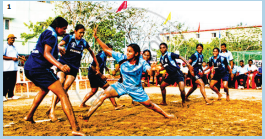
Read the description of the Kabaddi match and do the following:
Describe, in your own words, the important events in the first half.
Language Study: Degrees of comparison.
We use different forms of adjectives and adverbs to show comparison. They are known as degrees of comparison.
- Positive: Mangesh was as strong as Ravi.
She is as tall as her sister. - Comparative: Mangesh was stronger than other players.
She is taller than her sister. - Superlative: Mangesh was the strongest player in the team.
Their sister is the tallest amongst the three.
Write the following in short:
What the young lawyer pleaded.
What two basic rules were followed in the Science Fair?
Read the passage and answer the following:
Which book is introduced in the passage?
Read the passage and name the following.
He led the defense of Troy for nine years.
Prepare a ‘PowerPoint’ presentation, using one slide for each of the above points. Present your review in a PPT format in the classroom.
How long does the whole event described in this passage take? Work it out by reading the passage.
Read the lines of the following poem. Guess and fill in suitable words to make the lines rhyme -
Golden Glow
Soon after dawn, rises the _________________.
It wakes and enlivens every _________________.
It scares away the long, dark _________________.
The shining stars go out of _________________.
From tree to tree birds flit and, _________________.
Searching for food, with a sharp _________________.
The buds that open now show their, _________________
As flowers, they dance with beauty and _________________.
The hill slope wears a grassy green,_________________
The curved sparkling river, it's gold _________________.
The cock then crows to give a loud, _________________
Come on! wake up, folks! One and _________________.
I, then wake up, ‘Good Morning’ to,_________________
Let’s all look forward to a golden _________________.
The poet uses a free, conversational style in his poem. It is also called Colloquial style.
Pick out and write down such lines or expressions that support the above statement.
- ______ you have not done what I asked.
- _______________________.
- _______________________.
- _______________________.
- _______________________.
- _______________________.
Write in your own words.
What does the poet miss?
What common qualities did the three brothers have?
List and say whether the following statement agrees with the passage or not.
In a discussion, you should share your ideas with others.
Read the word. Write the words that combine to make it.
gentle-hearted
How was Gulliver taken to the city?
Form groups of four or five.
Try to find the answers to the following questions through observation and by talking to your teachers, parents and others. Discuss your answers in the group.
- How is waste generated?
- How is it removed or cleared?
- How can we help in the task of clearing or removing garbage?
What is the ‘Internet’?
Who am I?
Who Am I? is a guessing game where players use ‘yes’ or ‘no’ questions to guess the identity of a famous person. Questions are based upon the traits and characteristics of a person everyone will be able to identify.
Divide the class into groups. One group should decide the personality while the other group should ask ‘yes’ or ‘no’ type questions. To win the game, a team needs to find out the person within 10 clues.
Sample questions to ask. Answers must be ‘yes’ or ‘no’ only
- Are you a male (female)?
- Are you a famous personality?
- Are you a singer (dancer, actor)?
- Are you a historical figure?
- Are you young (old)?
- Are you alive now?
- Does your name start with ‘___’?
- Is he/she ____ ?
How does the ability to question help us?
Write down the word that alliterate in the poetic line below
Festival of Flowers.
Identify the character/speaker.
Oh no, I'll never get back to the right size.
Why did Alice follow the rabbit?
Read the following article about the amazing similarities between the assassination of John F. Kennedy and Abraham Lincoln; then underline the passive forms.
Abraham Lincoln was elected to Congress in 1846. Voters elected John F. Kennedy to Congress in 1946.
Lincoln was elected president in 1860. Voters elected Kennedy president in 1960.
Both men were particularly concerned with civil rights.
Both wives lost their children while living in the White House.
Lincoln was shot on a Friday. Someone shot Kennedy on a Friday.
Lincoln was shot in the head. The gunman shot Kennedy in the head.
Lincoln’s secretary was called Kennedy. Kennedy’s secretary was called Lincoln.
Lincoln was assassinated by a Southerner. A Southerner assassinated Kennedy.
Lincoln was succeeded by a Southerner named Johnson. A Southerner named Johnson succeeded Kennedy.
Andrew Johnson, who succeeded Lincoln, was born in 1808.
Lyndon Johnson, who succeeded Kennedy, was born in 1908.
John Wilkes Booth, who assassinated Lincoln, was born in 1839. Lee Harvey Oswald, who assassinated Kennedy, was born in 1939.
Both assassins were known by their three names and both names are composed of fifteen letters.
Lincoln was shot at a theatre named “Ford”. The gunman shot Kennedy in a car called a “Lincoln” that the company Ford made.
Booth ran from the theatre and was caught in a warehouse. Oswald ran from a warehouse and the police caught him in a theatre.
Booth was assassinated before his trial. Someone assassinated Oswald before his trial.
Were the girl and her brother friendly with each other?
How did the aliens know the boys' language?
It ploughs soil before _________.
How should we treat everyone?
Read the passage three times and colour a bull for each time.
Mr. Murugan is a farmer. He has a small piece of land and two bulls. He takes good care of his bulls as they help him in farming. Every morning, he takes the bulls for grazing. When it rains he ploughs the land with the bulls. As he has no one to help he starts sowing the seed before sunrise. He irrigates the crop till it grows. He reaps and binds the crop then takes it to thrash the paddy. Finally, with the help of the bulls, he takes the paddy to his house.

What did you learn from this lesson?
What are the three parts of a robot
Some words sound the same but their spelling and meaning are different. Such words are called homophones. There are many homophones.
Answer the following yes or no question.
Did all visit the waterfall?
Mugund learnt the art from his ______.
Mugund loved wild animals.
The Delhi government did not allow blind children to study Science after ____________.
Finally, ______, he got permission to study Science.
What did Helen learn when the teacher put her hand into running water?
Choose the right word.
Chintha Chettu is a tamarind ______.
Read the extract and complete the activities given below:
|
The call of the seas has always found an echo in me. Not being rich enough to roam in a private yacht, I have taken the poor man's way out. I swim across them. I have always been fascinated by the Indian ocean, whether at Mumbai, at Puri or at Gopalpur. I have swam in all these places and have felt the thrill. But the idea of swimming the Palk Strait did not occur to me until after I swam in the English channel. Steeped in the history and tradition of this nation, practically unconquered. teaming with hair-raising hazards, the sea between India and Sri Lanka had all the elements of challenge, danger and difficulty that tempted me. By the way, for preparation, I continued a strict and rigorous course of training which began in 1960. I also had to collect a comprehensive range of facts and information about this sea. Neither of these was easy. Despite all the information I had gathered, I soon found that very little was known about the Palk Strait, especially about the tides and currents. Everything about the English channel is known-there is the Channel Swimming Association, there are trained pilots there are wants to be hired, accurate weather forecasts, dependable tide tables and every other form of assistance was readily available. All that one needed was money. Here in the Palk Strait one has to find out firstly from where information could be obtained and then decide how much of it could be incorrect or misleading! |
A1. Rewrite the following as per their sequence in the extract: (2)
- I also had to collect a comprehensive range of facts and information about this sea.
- I have swam in all these places and have felt the thrill.
- All that one needed was money.
- Despite all the information I had gathered, I soon found that very little was known about the Palk Strait.
A2. Explain: (2)
What does the writer man by saving, "Steeped in the history and tradition of this nation, practically unconquered, teeming with hair-raising hazards, the sea between India and Sri Lanka had all the elements of challenge, danger and difficulty that tempted me"?
A3. Give reason: (2)
The narrator had an intense desire to swim in the Palk Strait. Explain the reasons for it.
A4. Personal Response: (2)
Do you like to have an adventurous life? Express your opinion.
A5. Grammar:
Do as directed: (2)
- Very little was known about the Palk Strait. (Rewrite as a negative sentence)
- I had to collect a comprehensive range of facts. (Rewrite the sentence beginning with 'A comprehensive ........)
A6. Vocabulary: (2)
Give the synonyms of the following words:
- rigorous - ______
- thrill - ______
Enact any one anecdote in the classroom.