Advertisements
Advertisements
प्रश्न
Comment on the contemporary concern that the poem echoes.
Advertisements
उत्तर
Poet is concerned about the pace with which the traditions are changing and are affected by modern notions. The value attached to the trees in earlier times is not of concern to people living in modern society. The old cultural values are breaking free giving way to western science and studies. The religious values that were inculcated in a child from her/his childhood are payed no heed. Life is busy and is consuming not just our time and space but our lifestyle. The moral values our tradition was raised on are now treated as bygones. The poet wonders at the change our society is undergoing and has written the poem on it.
APPEARS IN
संबंधित प्रश्न
How does Anne criticize the attitude of the grown-ups in her diary?
Read the passage given below and answer the questions that follow:
The term dietary fibres refers collectively to indigestible carbohydrates present in plant foods. The importance of these dietary fibres came into the picture when it was observed that the people having diet rich in these fibres, had low incidence of coronary heart disease, irritable bowel syndrome, dental caries and gall stones.
The foodstuffs rich in these dietary fibres are cereals and grains, legumes, fruits with seeds, citrus fruits, carrots, cabbage, green leafy vegetables, apples, melons, peaches, pears etc.
These dietary fibres are not digested by the enzymes of the stomach and the small intestine whereas most of other carbohydrates like starch and sugar are digested and absorbed. The dietary fibres have the property of holding water and because of it, these get swollen and behave like a sponge as these pass through the gastrointestinal tract. The fibres add bulk to the diet and increase transit time in the gut. Some of these fibres may undergo fermentation in the colon.
In recent years, it has been considered essential to have some amount of fibres in the diet. Their beneficial effects lie in preventing coronary heart disease, and decreasing cholesterol level. The fibres like gums and pectin are reported to decrease postprandial (after meals) glucose level in blood. These types of dietary fibres are recommended for the management of certain types of diabetes. Recent studies have shown that the fenugreek (Methi) seeds, which contain 40 per cent gum, are effective in decreasing blood glucose and cholesterol levels as compared to other gum containing vegetables.
Some dietary fibres increase transit time and decrease the time of release of ingested food in colon. The diet having less fibres is associated with colon cancer and the dietary fibres may play a role in decreasing the risk of it.
The dietary fibres hold water so that stools are soft, bulky and readily eliminated. Therefore high fibre intake prevents or relieves constipation.
The fibres increase motility of the small intestine and the colon and by decreasing the transit time there is less time for exposure of the mucosa to harmful toxic substances. Therefore, there is a less desire to eat and the energy intake can be maintained within the range of requirement. This phenomenon helps in keeping a check on obesity. Another reason in helping to decrease obesity is that the high-fibre diets have somewhat lower coefficients of digestibility.
The dietary fibres may have some adverse effects on nutrition by binding some trace metals like calcium, magnesium, phosphorus, zinc and others and therefore preventing their proper absorption. This may pose a possibility of nutritional deficiency especially when diets contain marginal levels of mineral elements. This may become important constraints on increasing dietary fibres. It is suggested that an intake of 40 grams dietary fibres per day is desirable.
(Extracted from ‘The Tribune’)
(a) On the basis of your reading of the above passage make notes on it in points only, using recognizable abbreviations wherever necessary. Also suggest a suitable title. (5)
(b) Write a summary of the above in about 80 words. (3)
Briefly comment on:
“As a Buddhist, he told me, he knew that it didn’t really matter if I passed away, but he thought it would be bad for business.”
In which language do you think Bhausahebanchi Bakhar was written?
Discuss in pairs or groups of four.
Replacing old machines with new is better than getting them repaired.
How is colour highlighted in the poem and why? List all the words in the poem that suggest colour.
Many sentences and paragraphs in the excerpt begin with the word ‘And’. To what extent does this contribute to the rhetorical style of the lecture?
Why is the poem entitled 'Hawk Roosting'?
Make sentence of your own using the following expression.
overcome:
Read the poem and fill in the table.
| Time of the day | Location | Poet’s Activity | Hawker’s Activities | Gardener’s Activities | Watchman’s Activities |
| Morning | __________ | __________ | __________ | __________ | __________ |
| Afternoon | __________ | __________ | __________ | __________ | __________ |
| Night | __________ | __________ | __________ | __________ | __________ |
Make a list of the preparations made for an assault on Tiger Hill.
Throughout the last week of June 1999, 18 Grenadiers ____________.
Pick out a word from the poem to complete the sentence meaningfully.
The Government made a ______ (announcement) about their new taxation policy.
Compare and contrast the two opposing human feelings as expressed by the poet.
Form pairs. Make a list of as many games as you can. (At least 25) Then classify the games using the following criteria:
- Indoor and outdoor games.
- Games played with and without any equipment.
- Games which have one-to-one matches and those in which teams play against each other (Single-player or team)
- Games played mostly by children and games played by adult players.
- Shape and size of the court or field.
Use the following figures to show your classification.
Visit a library:
Read the biographies of other Indian Saints. Share at least one story from their life with your friends. What message does it contain?
Can you name different types of fabrics? Which is the most expensive fabric you know? Talk to your parents or to a textile shop assistant. Collect samples of as many types as you can and paste them into your scrapbook. Name each type.
Read the story and write about the following in short.
Yonamine Chiru of Okinawa
Discuss and write 1-2 lines about the following,
Yonamine’s ideas about marriage.
‘Smart Answers’: Form a large group. Each person asks the next one a question to get him to say ‘yes’ or ‘no’. He/She can use appropriate statements, requests, or even other questions as a response. But if he/she says ‘yes’ or ‘no’, he/she is out. Otherwise, he/she continues the game. Questions cannot be repeated.
Explain the meaning of the following phrase:
An eagle’s eye
Find four words ending with ‘-ous’ from the story.
Can you add three more words ending with ‘-ous’ to this list?
How was the committee formed?
Form groups of five and discuss:
There are many things that seem small, minor, or insignificant to some people but the same may be the cause of great pain, suffering for others. Can you list such things? What can you do to provide help on those occasions?
Put the following expressions in a table of Do’s and Don'ts as expressed by the poet.
- Please listen
- give me advice
- tell me why
- solve my problem
- just hear me
- accept as a simple fact
- contribute to my fear
- wait a minute
| Do’s | Don'ts | |
| 1. | ||
| 2. | ||
| 3. |
What methods did Anshuman's parents use to warn Anshuman about his bad habits?
What part did Anne Sullivan play in Helen’s life?
Helen Keller’s life is the story of ______.
Answer the following question in about 80 – 100 word.
Describe the journey of life as depicted in the poem by Henry Van Dyke.
Read the following line from the poem and answer the question given below.
The worst thing is that if anyone stays
Among them too long, he will learn their ways;
- What is the worst thing that can happen if anyone stays with them?
- What are the ways of the Grumble family?
Who baked the homemade cookies?
Hamid’s heart sank because the price of the tongs was______for him.
Why was it a struggle for the children to dry their clothes?
Write down the word that alliterate in the poetic line below
That spreads treasures on a tree.
What do you think is going to happen next?
Read these lines and answer the questions given below.
With lutes in our hands ever-singing we roam,
All men are our kindred, the world is our home.
- Who does ‘we’ refer to? What do they have in their hands? What is its name?
- How are the men in the world related to the singers?
Fill in the table
| Problems Faced By Mr. Fogg And His Team | Solution |
| The train stopped in the middle of the forest. | |
| They couldn’t hire the elephant. | |
| They were in need of an elephant driver. |
Read the line and answer the question.
I must go down to the sea again, to the lonely sea and the sky
Where does the poet want to go?
It is a problem for sea turtles to come ashore because ______.
Describe what the author saw when he went back to the island.
Grandmother had wanted the peepul tree cut down because______.
What did Raj buy?
Complete the sentence given below with word/phrase.
The rains came and poured______.
Where is the poet going in the dream?
Why does the poet fly out of the universe?
Why did Yazhini want to join the military?
Choose the odd one out.
Identify the character or the speaker.
“I will camp here for the night.”
Did she give up the fight?
Answer using Yes or No and pick sentence from the story to support your answer.
Do cannibals eat people?
______helped Bujju to reach his family.
What was the reason behind Nandhini’s dullness?
Fill in the blank with rhyming word.
tunnels- ______
In real the plate was made of ______.
Choose the word with same meaning.
Foot hills- ______
______ was helpful for his father to drive out the wild animals.
Read the passage and write a summary of it. Suggest a suitable title for the summary.
|
A sparrow is a small bird which is found throughout the world. There are many different species of sparrows. Sparrows are only about four to six inches in length. Many people appreciate their beautiful songs. Sparrows prefer to build their nests in low places-usually on the ground clumps of grass low trees and low bushes. In cities, they build their nests in building nooks or holes. They rarely build their nests in high places. They build their nests out of twigs grasses and plant fibers. Their nests are usually small and well-built structures. Female sparrows lay four to six eggs at a time. The eggs are white with reddish-brown spots. They hatch within eleven to fourteen days. Both the male and female parents care for the young. Insects are fed to the young after hatching. The large feet of the sparrows are used for scratching seeds. Adult sparrows mainly eat seeds. Sparrows can be found almost everywhere where there are humans. Many people throughout the world enjoy these delightful birds. The sparrows are some of the few birds that engage in dust bathing. Sparrows will first scratch a hole in the ground with their feet then lie in it and fling dirt or sand over their bodies with flicks of their wings. They will also bathe in water or in dry or melting snow. Water bathing is similar to dust bathing with the sparrow standing in shallow water and flicking water over its back with its wings also ducking its head under the water. Both activities are social with up to a hundred birds participating at once and are followed by preening and sometimes group singing. |
Read the following passage and do the activities:
A1. Fill in the blanks: (2)
- ______ percent of our daily communication is non-verbal.
- Eye contact is another type of ______ communication.
- Frequent blinking is a sign of the person feeling ______.
- One can readily detect _______.
|
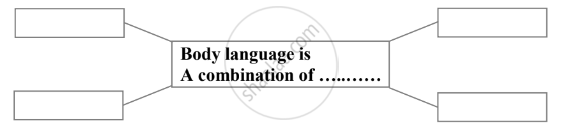
According to some experts, a staggering 93 percent of our daily communication is non-verbal. Facial expressions are easy to decipher. One can readily detect happiness, sadness, anger. Physicians can tell a patient is doing well (or not) by looking at his/her face. Eye contact is another type of non-verbal communication, which can tell a lot about the other person. The eyes convey a range of emotions-happiness, sadness, boredom, surprise, confidence .......... even emotional interest. Staring at someone's forehead may intimidate the recipient, staring at the mouth is sometimes interpretated as a sign of emotional interest. In fact, staring into someone's eyes is a sign of lying, and so is looking away. In certain cultures, lack of eye contact is taken as a sign of respect. If body language is to be defined, it is a combination of facial expression, gestures, eye contact, body movements and posture and voice. Frequent blinking is a sign of the person feeling distressed or uncomfortable. If the pupils are dilated, it ofter indicates interest, even emotional interest. The lips also reflect our body language, and lip biting indicates worry and/or anxiety; tightening of the lips may be an indication of disapproval. Slightly turned-up lips indicate happiness and slightly turned-down lips indicate sadness. |
A2.
A3. Find the antonyms of: (2)
- verbal × ______
- entertaining × ______
- sender × ______
- comfortable × ______
A4. Do as Directed: (2)
- The eyes convey a range of emotions. (Frame a 'Wh' question in order to get the underlined part as answer).
- Physicians can tell about a patient's wellness. (Rewrite using 'able to')
A5. Personal Response: (2)
Non-verbal communication plays an important role in our daily life. Comment.
Collect the outer coverings of fast food items. Discuss the following points in groups and then write your observations in your notebook.
- Ingredients
- Manufactured by
- Net weight
- Veg or Non-veg
- Recipe
- Nutrition facts
- MRP
- Mfg date
- Website
- Other instructions, if any
