Advertisements
Advertisements
प्रश्न
Briefly comment on:
“As a Buddhist, he told me, he knew that it didn’t really matter if I passed away, but he thought it would be bad for business.”
Advertisements
उत्तर
Buddhism talks of rebirth. It does not propound Moksha. Hence, death is not an end and Tsetan understood this, being a Buddhist. So, he told the author that even if he would have died it would not have mattered as he will be reborn as the soul never dies and just wears a new body, his soul would have still lived on. Besides, they were in Kailash, the holy place in Buddhist culture. It would have been a blessing to have died in a place like that when he was almost done with the Kora. However, as a business person he would have felt bad. First of all loosing a customer like him would have not been good for his business. Plus, it might have affected his business' reputation badly.
APPEARS IN
संबंधित प्रश्न
B1. Complete the following statements:
(i) The poet is talking about............................. .
(ii) As a nation weare missing our .................................... .
(iii) Old people havekeys ........................... .
(iv) The elderly remember .......................... .
"Oh the value of the elderly! How could anyone not know? They hold so many keys, so many
things they can show.
We all will read the other side this I firmly believe.
And the elderly are closest oh what clues we could retrieve.
For their characters are closest to how we'll be on high.
They are the ones most developed, you can see it if you try.
They've let go of the frivolous and kept things that are dear.
The memories of so sweet, of loved ones that were near.
As a nation we are missing our greatest true resource,
To get to know our elders and let them guide our course."
B2 Express
State what the underlined words mean:
(i) Oh the value of the elderly! State the value ............. .
(ii) They are the ones most developed. 'They' stand for ............. .
B3: Match the words in Column A with their rhyming word in Column B:
| Column A | Column B |
| (i) Course | (a) Show |
| (ii) Believe | (b) resource |
| - | (c) retrieve |
Answer any three of the following in 30-40 words each:
(a) Why has the poet’s mother been compared to the ‘late winter’s moon’?
(b) The poet says, ‘And yet, for these Children, these windows, not this map, their world.’ Which world do these children belong to? Which world is inaccessible to them?
(c) What was the plea of the folk who had put up the roadside stand?
(d) What will happen to Aunt Jennifer’s tigers when she is dead?
Read the following extract and answer the questions given below:
How do you know
Peace is a woman?
I know, for
I met her yesterday
on my winding way
to the world's fare.
She had such a wonderful face
just like a golden flower faded
before her prime.
(1) How does the poet describe the face of peace?
(2) Do you think there is a way out of the war-ridden world? What is it?.
(3) Name and explain the figure of speech in the following line:
"I met her yesterday
on my winding way."
(4) The poet asks the question and herself answers it. What effect does it create in the extract?
Complete the following table :
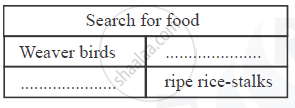
How is the social life at Raveloe different from that at Lantern Yard ?
This play, written in the 1950s, is a humorous and satirical depiction of the status of the mother in the family.
Do you think it caricatures these issues or do you think that the problems it raises are genuine? How does the play resolve the issues? Do you agree with the resolution?
Look at the following set of words and mention what is common to them both in form and meaning.
|
Snuffle |
snort |
sniffle |
snore |
Find from the story one word for the following.
a low constant sound made by cats ______
Make sentence of your own using the following expression.
overcome:
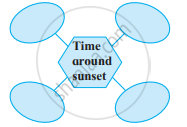
Pick out words from the poem to fill in the web diagram. They should be related to the theme in the web.
Read the story and complete the following.
Revathi was confident of proving her ownership of her pot of plants because, ____________.
Write the Rhyming word and Scheme of the 2nd stanza.
“Old man,” said a fellow pilgrim near,
“Why waste your time in building here?
Your journey ends with the close of the day You never again will pass this way.
You have crossed the chasm deep and wide Why build ye here at even tide?”
Make a list of the preparations made for an assault on Tiger Hill.
Bofors guns _____________.
Expand the idea inherent in the following proverb:
A Bad workman blames his tools.
Expand the idea inherent in the following proverb :
Fools rush in where angels fear to tread - Alexander Pope.
Describe the following with the help of the story.
Thiruvalluvar
Comment on the given statement after reading the given dialogue -
It’s a pity some honest man not to be better of that ________________________________________________.
Present the information in the box ‘My Teacher says’. Translate the box ‘My Teacher says’ into your mother tongue.
Read the story and write about the following in short.
Kojo
Who was Shalihotra?
Form groups. Discuss the first two paragraphs. Try to present their content in the form of a series of conversations among the volunteers.
Guess the meaning of the following word:
exorbitantly
Write the smaller and related words that you see within this word.
Read the ode ‘To Autumn’ by the famous poet John Keats. ‘Season of mists and mellow fruitfulness...’
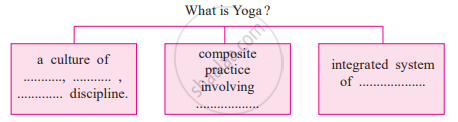
Complete the following diagram.
Write the symbol that is used in the poem to represent the following idea.
Some other time.
List 5 of the sounds that you like.
Name the following.
Ruler of Germany.
List the words or phrases related with computers or the Internet.
What is meant by browsing or surfing?
Read the following line from the poem and answer the question that follow.
So let the way wind up the hill or down, O'er rough or smooth, the journey will be joy: Still seeking what I sought when but a boy, New friendship, high adventure, and a crown,
- How is the way of life?
- How should be the journey of life?
- What did the poet seek as a boy?
Identify the character or speaker
He repented and implored his brother’s forgiveness.
Write the name of the toy against the picture.

What did the coach teach the child?
Read the letter again and write a few lines on each of the following.
- things that the coach taught….
- transformation in the child……..
- things that amazed the writer……..
Teach me to appreciate ______.
- nature
- destruction
- small creatures
What is good or effective communication?
Fill in the blank
______ is the festival which fills our hearts with delight.
Why was Sir Francis angry?
Who inhabited the jungles that the train passed through?
Read the poem aloud in pairs.
According to the author the tendril was moving towards grandfather because it______.
Read the comic strip again. Make groups of four and frame some questions on what you have read. Each group should ask a question in turns. You cannot repeat the same question. The team which asks more questions is the winner.
e.g:
- Which are the foreign vegetables mentioned?
- What was sad for Columbus?
We do not really see the landscape from a normal train because the______.
Describe Gulliver’s encounter with the army of Blefuscu.
Where is Jaswantgarh located?
Read scene I of the play carefully and answer the question below.
Whom does Mother Wolf talk about? How does she describe him?
Vicky’s father decided to change his son’s character.
How was the rich man's house?
Identify the character or the speaker.
“I hope he is safe.”
His father wanted him to do well in ______.
What was his master’s advice?
Write the rhyming word.
gale
Leafcutter ants grow fungus.
When does the world become green?
______will often say to be honest.
How does she move the brush?
What was the truth finally learned by Chris?
What do you think birds say to each other in the morning?
Who are already awake?
What did Pinocchio say in the end?
