Advertisements
Advertisements
प्रश्न
Mention the odd way in which the author’s grandmother behaved just before she died.
Advertisements
उत्तर १
She had omitted to pray, she was not going to waste any more time talking to us. She lay peacefully in bed praying and telling her beads. Even before we could suspect, her lips stopped moving and the rosary fell from her lifeless fingers.
उत्तर २
The author's grandmother exhibits unusual behaviour just before her death. After years of being deeply religious, spending her time in prayer and feeding sparrows, she suddenly changes her routine. On the evening before her death, she refuses to engage in any religious activities. Instead, she gathers the women of the neighbourhood, takes an old drum, and sings songs of the homecoming of warriors. This sudden, joyous celebration of life contrasts sharply with her usual serene and spiritual demeanour. The family finds this behaviour odd, but she seems to know that her time has come. The next morning, she peacefully passes away.
APPEARS IN
संबंधित प्रश्न
Write a character sketch of Mrs. Van Daan.
Read the extract and do the activities that follow:
The duke senior and his follower were sitting down to a meal one day when Orlando rushed out from among the trees, his sword in his hand. ‘Stop, and cat no more!’ he cried. The Duke and his friends asked him what he wanted.
‘Food,’ said Orlando. ‘I am almost dying of hunger’. They asked him to sit down and eat, but he would not do so. He told them that his old servant was in the woods, dying of hunger. ‘I will not eat a bite until he has been fed,’ Orlando said.
So the good Duke and his followers helped him to bring Adam to their hiding-place, and Orlando and the old man were fed and taken care of. When the Duke learned that Orlando was a son of his old friend sir Rowland de Boys, he welcomed him gladly to his forest court.
Orlando lived happily with the Duke and his friends, but he had not forgotten the lovely Rosalind. She was always in his thoughts andevery day he wrote poetry about her pinning it on the trees in the forest. ‘These trees shall be my books,’ he said, ‘so that everyone who looks in the forest will be able to read how sweet and good Rosalind is’.
Rosalind and Celia found some of these poems pinned on the trees. At first they were puzzled, wondering who could have written them; but one day Celia came in from a walk with the news that she had seen Orlando sleeping under a tree, and she and Rosalind guessed that he must be the poet. Rosalind was happy to think that Orlando had not forggoten her, because she loved him as much as he loved her.
A1. Complete - (2)
Complete the following sentences:
(i) Rosalind was happy to think _______
(ii) The Duke and his followers helped Orlando to bring _________
(iii) Orlando pinned the poems written about Rosalind on ______
(iv) When the Duke cam to know that Orlando was a son of his old friend, he _________
A2. Write a gist: (2)
Write a gist of the above given extract in about 50 words.
With reference to ‘The Story of My Life’, describe how a teacher can positively impact a child’s life ?
Dolly Winthrop has a very noble nature. Comment.
Read the following passage and do the activities:
B1 Match:
Match the areas given in Column ‘A’ with the description of Mehendi design given in Column ‘B’:
| 'A' | 'B" | ||
| (i) | North African | (a) | A mix of Indo-Pakistani and Arabic design |
| (ii) | Indian | (b) | Delicate loops and curves, paisleys, teardrops |
| (iii) | Arabic | (c) | Geometrical images |
| (iv) | South Asian | (d) | Local textiles, paintings, and architecture |
Henna comes from the leaves of the plant Lawsonia inertias. The plant grows in hot and dry climes and is native to North Africa, the Indian subcontinent and the Middle East. The leaves of the plant are dried and crushed to powder. Various additives such as coffee decoction, tea, lime juice, Mehendi and eucalyptus oil are mixed with the henna powder to increase the potency of the dry, this also helps to bind the powder to a paste-like consistency. The mixture is applied through cones in intricate patterns depending on the region of use.
Album of Patterns
Four major styles can be found in the vast dictionary of Mehendi designs. Earlier the application was restricted to hand and feet, but the adoption of Mehendi by different cultures throughout the world has seen experimentation on different body parts including the neck naval and back.
North African patterns rely on geometrical images to trace the shape of hands and feet, Arabic designs borrow heavily from local textiles, paintings, and architecture. These are more spaced out, to allow the design to stand out boldly from the skin parts left untouched by henna. The Indian style comprises of delicate loops and curves, paisleys, teardrops and flowers that give a dainty filigreed glow-like effect. Though intricate patterning is the name of the game today, this trend took off in India only during the 20th century. The patterns preferred by the South Asian countries are mixed with Indo-Pakistani and Arabic design schemes. Chinese and Celtic symbols now find a place in the vast repertoire of Mehendi designs as well.
B2 Complete:
Complete the following and write:
(i) The procedure before applying henna _______
(ii) The reasons for using additives _______
(iii) The suitable climatic conditions for the henna plant _______
(iv) Mehendi is used on _______
B3 Find words:
Look at the following description and find out proper words from the passage and write:
(i) Existing naturally in the place : - n _______
(ii) Consist of something: - c _______
(iii) Delicate decoration made from gold, silver and copper wire: - f _______
(iv) Substance that is added in small quantity : - a _______
B4 Language study:
Fill in the blanks with suitable subordinators given in the box:
| as well as, so that, however, which |
(i) The mixture is applied through cones in intricate patterns _______ depend on the region of use.
(ii) The intricate pattern is the name of the game of today _______, this trend took off in India, recently.
(iii) North African pattern relies on geometrical images ______ they can trace the shape of hands and feet.
(iv) The patterns preferred by the South Asian countries are mixed with Indo-Pakistani _______ Arabic design schemes.
B5 Personal Response:
Which Mehendi design do you like? Why?
What does the word ‘cardboard’ denote in the poem? Why has this word been used?
Notice the kind of English Tsetan uses while talking to the author. How do you think he picked it up?
Indian society has moved a long way from the way the marriage is arranged in the story. Discuss.
We 'draw up a deed'. Complete the following phrase with an appropriate word.
________ends meet
Explain the metaphor in the line: ‘Poets are the mirrors of gigantic shadows that futurity casts on the present’.
'New Literature' is a misnomer for the wealth of the Indian Literary tradition. How does G. N. Devy explain this?
An acrostic is a poem or a write· up in which the first letter of each line forms a word. when it is read vertically.
For example,
Faithful
Reliable
Inspiring
Encouraging
Noble
Dedicated
With your benchmate / group, complete the acrostic of BELIEVE and FAITH.
(Please note that the words / phrases should be more or less related to the topic. You can use a thesaurus.)
Be certain of
E ......................
L ......................
I ......................
E ......................
V ......................
E ......................
F ......................
A ......................
I ......................
T ......................
H ......................
Study the pictures below and note down the differences.
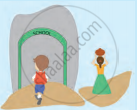
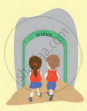
The two best things the servants brought to God were gold and jewel stones.
Divide the story into parts. Make 4 groups in your class. Each group should take one of the 4 parts to convert the story into a play and enact your part.
Discuss in groups and share with one another.
The daily routine of your mother and father on working days.
Say where . . . . . . .
______ do squirrels store their food?
What did one of the fluttering creatures do?
Discuss in groups and think about it.
List a few occasions on which you had become angry. What do you do when you are angry?
How are fabrics used in our daily life? List all the things that are made up of fabrics in your home. (At least 25)
Comment on the given statement after reading the given dialogue -
And if we get him itself, nothing but abuse on our heads for it from the people, and maybe from our own relations -
you may begin like this
We do not think about society at large _________________________________________________.
State whether the following statement is True or False:
Both Demetrius and Lysander fight for Hermia.
Give reasons :
Oberon and Titania fight for the custody of the Indian boy because - Oberon wants __________________.
Look at the following words carefully for one minute. Now close your book and try to write down as many of the words as you can remember.
| crust, tremendous, lava, crater, volcanic, tsunami, island, extinct, disaster, dormant, eruption, plume, inland, molten, active, coast |
Discuss the following question after you have seen a presentation of the ‘ad’.
How many times is the name Krispy Krunchy repeated in the ad? Why?
Write a short note on the following:
Sujata’s offering
Write your own impressions about the news items given in (a), (b), (c), and (d) in the table below.
| News item | Good news Bad news | Reliable Unreliable | Interesting Uninteresting Boring | Others |
| (a) | ||||
| (b) | ||||
| (c) | ||||
| (d) |
Write in your own words.
What message does the poem convey?
Using the following points frame a character sketch of the narrator. Support each character trait with instances from the lesson.
- Diffident and timid
- Unusual behavior
- Ignorant about banking
- Nervous and careless
- Economical.
Imagine the following and write about it in your own words:
What the world looks like to a baby.
Describe the following with the help of the (The Twelve Months) story.
Summer
Rewrite the following line in your own words.
'Never one comes flying by
But will flutter down to drink.'
Guess the meaning of the following word.
magnificent
Mahatma Gandhi, Che Guevera, Guru Nanak, and Gauthama Buddha are some of the famous personalities and thinkers who made extensive journeys to understand life. Do you think journeys can be life-changing?
Who was Caliban? What was he employed for?
Why do you think Mrs. Bodwell wanted to sell the house?
Read the following incident carefully to answer the question that follow.
The tie that does not bind
“Oh, so you’re going abroad? Can you bring me back…..?” I’ve been asked to bring back a vaccine for a course. Once I searched the suburbs of Paris for two days for a special brand of ceramic paint. Having spent a lot of money for Cartier lighter refills, I had them confiscated at the airport just before boarding because the gas might be dangerous in the air.
Now, two months before a trip, I stop talking to people so they won’t suspect I’m about to travel. But someone always catches me.” I’ve heard you’re going to New York, and I want you to get something for me. It’s just a little thing you can find anywhere. I don’t know exactly how much it costs, but it shouldn’t be much. We’ll settle up when you get back”.
What Gilson asked me to buy was, in fact, a little thing: a tie. But not just any tie. He wanted a tie with a small embroidered G. Any colour would do, as long as it had his initials. Look, this is a special flight, I explained. We are only staying Saturday through Tuesday. On the day we arrived I didn’t have time to think about the tie, but strolling around on Sunday I did see ties bearing various letters in more than one shop window. They were cheap, just a dollar, but all the shops were closed.
On Monday, lunch lasted the whole afternoon. Then it was Tuesday morning, time to leave. It was only when I saw our airport bus waiting outside the hotel that I remembered the tie.
I told the group to go on. I would get a taxi to the airport. And so I went in search of a nearby shop where I had seen ties.
But I couldn’t find it. I walked further down the street-one, two, three blocks - all in vain. Back at the hotel, a bit anxious now, I took my suitcase, got a taxi and asked the driver to rush to the street where I had seen them.
The driver stopped at each shop we passed so I could look from the window. The stores had all sorts of ties, but not the kind I was looking for.
When I finally thought I had located the right shop, I decided to go in and check. The driver refused to wait. Parking was prohibited, he said. I promised to double the fare, jumped out and ran into the shop. Was I going to miss the plane just for a damned tie?
The salesman was unbearably slow. When I realized that the smallest change I had was a ten dollar note , I grabbed ten ties of different colours so I wouldn’t have to wait for change. I rushed out with the ties in a paper bag.
On the street I looked around. The taxi had vanished, taking my suitcase. What is more, I was going to miss the plane.
I ran to the corner, and hope flared up again: the taxi was waiting in the next street. Quick to the airport! As I settled down inside the taxi. I sighed with relief. Gilson was going to have enough initialized ties to last him a lifetime.
When I reached the airport, I paid the taxi driver the double fare and grabbed my suitcase. Panting, I boarded the plane under the reproachful gaze of the other passengers, all primly seated with their seat belts fastened. Ready to take off. Departure had been delayed because of me.
“At least I hope you found your tie”, said one who knew the story.
“I did”, I answered triumphantly.
After making myself comfortable, I reached for the paper bag to show the ties.
I had left it behind; in the taxi.
Fernando Sabino.
Read the incident again and answer the following question.
What was the writer always asked to do whenever he planned to go abroad?
Look at the number pattern. Fill the blank in the middle of the series or end of the series.
SCD, TEF, UGH, ______, WKL
Work in pairs and answer the following.
Pick out the alliterated words.
Work in pairs and answer the following.
Pick out the rhyming words.
Write a summary based on the story map.

What does the teak tree give us?
What did Raj buy?
The boy was so inspired by Mithali that he was happy for his sister to play cricket.
Find the rhyming word from the poem.
Crowd - ______.
Arrange the pictures by using numbers.

Whose hospitality is described in the poem?
Meena’s father was a fisher man.
Leafcutter ants drink______.
Where do the moles save their food?
Match the following and write the new word.
| 1. | pre | continue |
| 2. | dis | familiar |
| 3. | un | open |
| 4. | re | view |
Whose word are these? Name the character.
“Utensils made of brass and tin for sale!”
What will you do if you have a gold plate?
Read the passage and colour one bag each time you read.
There lived a poor but an honest farmer in a village. He supported himself, his wife and seven children using his small piece of land.
One day while he was walking in his field, he found a bag of gold.
He took it home and showed it to his wife. His wife told him to keep some of the gold. He told his wife that honesty is the best policy. He tried to find the person who lost it. At last, he found that the owner of the bag and gave it back. The rich man took the bag and thanked him.

How does she move the brush?
Chris enjoyed doing all sorts of things except, writing and ______.art
Replace the bold word/words with a word from the quiver and re-write the sentence –
Nasruddin was surely not a good archer.
What secrets did he learn about beasts?
Read the passage and write a summary of it. Suggest a suitable title for the summary.
|
A sparrow is a small bird which is found throughout the world. There are many different species of sparrows. Sparrows are only about four to six inches in length. Many people appreciate their beautiful songs. Sparrows prefer to build their nests in low places-usually on the ground clumps of grass low trees and low bushes. In cities, they build their nests in building nooks or holes. They rarely build their nests in high places. They build their nests out of twigs grasses and plant fibers. Their nests are usually small and well-built structures. Female sparrows lay four to six eggs at a time. The eggs are white with reddish-brown spots. They hatch within eleven to fourteen days. Both the male and female parents care for the young. Insects are fed to the young after hatching. The large feet of the sparrows are used for scratching seeds. Adult sparrows mainly eat seeds. Sparrows can be found almost everywhere where there are humans. Many people throughout the world enjoy these delightful birds. The sparrows are some of the few birds that engage in dust bathing. Sparrows will first scratch a hole in the ground with their feet then lie in it and fling dirt or sand over their bodies with flicks of their wings. They will also bathe in water or in dry or melting snow. Water bathing is similar to dust bathing with the sparrow standing in shallow water and flicking water over its back with its wings also ducking its head under the water. Both activities are social with up to a hundred birds participating at once and are followed by preening and sometimes group singing. |
The branch of economics that deals with the allocation of resources.
- Microeconomics
- Macro economics
- Economics
- None of these
