Advertisements
Advertisements
प्रश्न
Activity: Live English: Packs, packets, pouches, wrappers

Given above is the picture of an imaginary food item’s packet. Let us see how to ‘read’ the matter on the packet as a vigilant consumer.
- Look at the wrapper and complete the sentences.
- The name of the food item is ______.
- It is made by ______.
- It is a ______ food item. (Veg/Non-veg)
- The ______ sign indicates whether it is a Veg or Non-veg food item.
- The ingredients are ______, ______, ______, ______.
- The date of packing is ______ and the expiry date is ______.
- It should be consumed before ______ from the date of manufacturing.
- Try and obtain more information about the various symbols printed on the packet.
- Discuss the following -
- Why the ‘recipe’ is given on the packet.
- Why the packet tells us to visit the website of the company.
- What ideas are used to make the packet attractive?
- How you will verify whether something is good for you to eat.
Advertisements
उत्तर
(i)
- The name of the food item is Monnie Ooodles.
- It is made by Monnie Foods Corporation Ltd., Mahatma Phule, Road, Pune.
- It is a Vegetarian food item.
- The green
 sign indicates that it is a vegetarian food item.
- The ingredients of noodles are wheat flour, vegetable oil, salt, and carbonates.
- The date of packing is 27/06/2017 and the expiry date is 27/02/2018
- It should be consumed before 8 months from the date of manufacturing.
(ii)
- Vegetarian Mark:
In India, vegetarian packaged food goods must include a green dot in a square with a green border, while non-vegetarian products must have a brown dot. It should be situated such that it is immediately noticeable. The government has established several requirements for its use, including size, colour, and other factors. - Resin Identification Code (Recycling code):

The triangular mark with arrows (no. 7 in the centre and 'other' below) indicates the type of plastic used for food packaging and whether it is recyclable. Standardised symbols distinguish between different types of plastics. The triangle remains constant, but the number in the centre and the abbreviation inscribed underneath change. - Keep Your City Clean:

A man discarding something in a dustbin is the typical mark used to encourage consumers to keep the city clean. Customers are asked to dispose of packaged food in a dustbin to promote city cleanliness.
(iii)
- The recipe is given on the packet to provide the necessary information regarding the preparation of the product.
- The packaging directs us to the company's website for additional recipes. It is done to advertise the company's other items.
- Attractive colours, graphics, slogans, and fonts are just a few of the concepts employed to make the packet more appealing.
- I review the nutrition chart and ingredients to ensure they are suitable for my diet.
APPEARS IN
संबंधित प्रश्न
Read the passage given below and answer the questions that follow:
1. Air pollution is an issue which concerns us all alike. One can willingly choose or reject a food, a drink or a life comfort, but unfortunately there is little choice for the air we breathe. All, what is there in the air is inhaled by one and all living in those surroundings.
2. Air pollutant is defined as a substance which is present while normally it is not there or present in an amount exceeding the normal concentrations. It could either be gaseous or a particulate matter. The important and harmful polluting gases are carbon monoxide, carbon dioxide, ozone and oxides of sulphur and nitrogen. The common particulate pollutants are the dusts of various inorganic or organic origins. Although we often talk of the outdoor air pollutions caused by industrial and vehicular exhausts, the indoor pollution may prove to be as or a more important cause of health problems.
3. Recognition of air pollution is relatively recent. It is not uncommon to experience a feeling of 'suffocation' in a closed environment. It is often ascribed to the lack of oxygen. Fortunately, however, the composition of air is remarkably constant all over the world. There is about 79 per cent nitrogen and 21 per cent oxygen in the air − the other gases forming a very small fraction. It is true that carbon dioxide exhaled out of lungs may accumulate in a closed and over-crowded place. But such an increase is usually small and temporary unless the room is really air-tight. Exposure to poisonous gases such as carbon monoxide may occur in a closed room, heated by burning coal inside. This may also prove to be fatal.
4. What is more common in a poorly ventilated home is a vague constellation of symptoms described as the sick-building syndrome. It is characterized by a general feeling of malaise, head-ache, dizziness and irritation of mucous membranes. It may also be accompanied by nausea, itching, aches, pains and depression. Sick building syndrome is getting commoner in big cities with the small houses, which are generally over-furnished. Some of the important pollutants whose indoor concentrations exceed those of the outdoors include gases such as carbon monoxide, carbon dioxide, oxides of nitrogen and organic substances like spores, formaldehydes, hydrocarbon aerosols and allergens. The sources are attributed to a variety of construction materials, insulations, furnishings, adhesives, cosmetics, house dusts, fungi and other indoor products.
5. By-products of fuel combustion are important in houses with indoor kitchens. It is not only the brining of dried dung and fuelwood which is responsible, but also kerosene and liquid petroleum gas. Oxides of both nitrogen and sulphur are released from their combustion.
6. Smoking of tobacco in the closed environment is an important source of indoor pollution. It may not be high quantitatively, but significantly hazardous for health. It is because of the fact that there are over 3000 chemical constituents in tobacco smoke, which have been identified. These are harmful for human health.
7. Micro-organisms and allergens are of special significance in the causation and spread of diseases. Most of the infective illnesses may involve more persons of a family living in common indoor environment. These include viral and bacterial diseases like tuberculosis.
8. Besides infections, allergic and hypersensitivity disorders are spreading fast. Although asthma is the most common form of respiratory allergic disorders, pneumonias are not uncommon, but more persistent and serious. These are attributed to exposures to allergens from various fungi, molds, hay and other organic materials. Indoor air ventilation systems, coolers, air-conditioners, dampness, decay, pet animals, production or handling of the causative items are responsible for these hypersensitivity − diseases.
9. Obviously, the spectrum of pollution is very wide and our options are limited. Indoor pollution may be handled relatively easily by an individual. Moreover, the good work must start from one’s own house
(Extracted from the Tribune)
(a) (i) What is an air pollutant? (1)
(ii) In what forms are the air pollutants present? (2)
(iii) Why do we feel suffocated in a closed environment? (1)
(iv) What is sick building syndrome? How is it increasing? (2)
(v) How is indoor smoking very hazardous? (1)
(vi) How can one overcome the dangers of indoor air pollution? (2)
(b) Find the words from the above passage which mean the same as the following: (3)
(i) giddiness (para 4)
(ii) constant (para 8)
(iii) humidity (para 8)
Discuss in groups plays or films with a strong message of social reform that you have watched.
Why is the quality of pity earth-bound while the other two passions are elevating?
Many sentences and paragraphs in the excerpt begin with the word ‘And’. To what extent does this contribute to the rhetorical style of the lecture?
What decision taken by Dick changed his fortune?
Answer in your own words.
What did Revathi discover about her balsam plants?
Read the poem aloud and you will find some old outdated words that we do not use in the everyday language now.
However, some writers/poets use them to impart an old-fashioned flavour to suit the background of their write-up. Such words are called Archaic words.
Give the modern words for the archaic words from the poem.
- thy
- being
- bestow'd
- thee
- thou
- cans't
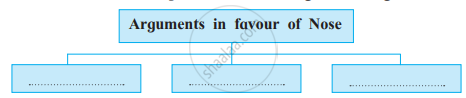
The tongue justifies the possession of the spectacles on behalf of the nose. Pick up the expressions from the poem that argues in favour of the Nose and complete the following web diagram.
Read aloud with the leader: Form groups of five. Read the passage aloud in groups. The leader begins every sentence and stops after a few words. The other members complete the sentence, reading it aloud in the chorus.
Do you know any poem or song about the moon in your own language? Sing it in the class.
Answer the following question in one sentence.
What does the man who misses all the fun do?
Have you seen how wheels move on different surfaces like sand, gravel, grass, or a proper road? What are the differences you see?
An activity:
Speak fast, think faster! Form groups of 4-6. Discuss each of the following topics. Then each person in the group should choose a topic and speak about it for one minute. Try to say as many sentences as you can in that time.
Imagine you are watching a scene. For example, someone learning to ride a bicycle; or a cricket match. Give a running commentary on what you see.
‘Monu is sitting on the bicycle. It has side wheels. Monu tries to push the pedal down - No - he stops. His uncle holds the seat in one hand and the handle in the other hand. He says, ‘Come on, Monu’... etc.
Complete the following sentence with reference to the passage.
Nobody knows for certain who ___________________.
Name the following.
Scored the first goal in the match.
What did the Judge tell Ahmad?
What story did grandfather tell them about the haunted hill?
Match the following.
| 1. | A man of ease | Emanuel |
| 2. | John’s trainer | Lalli and Lolly |
| 3. | Mathew’s secretary | John Mathew |
| 4. | John’s chef | Louise |
| 5. | Mathew’s friends | Basky |
Identify the speaker/character.
Stop ship. Drop anchor. Quick!
Geetha madam couldn’t stop the children running out of the train because they ______.
Narrate the story based on the story map
Gulliver managed to reach the land as he was______.
Try your own.
Why did Yazhini want to join the military?
Match the rhyming words.
| pale | knows |
| boat | gale |
| goes | goat |
Humans give importance to save______.
The squirrel ran to the _________ tree.
Let us learn a few more word by joining the dots. Join the dots and fill the table below.
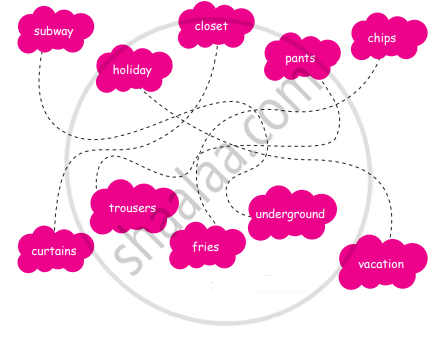
| subway | |
| holiday | |
| closet | |
| pants | |
| chips |
Match the words with similar meaning.
| truck | subway |
| underground | lorry |
| tap | wallet |
| purse | faucet |
What did Helen learn when the teacher put her hand into running water?
