Advertisements
Advertisements
प्रश्न
Briefly explain the following statement from the text.
“You need some interaction to cause a transition.”
Advertisements
उत्तर
The statement is made by Rajendra in the text The Adventure by Jayant Vishnu Narlikar. Rajendra offered a scientific explanation in the light of catastrophic theory to rationalise the fantastic experience undergone by Prof. Gaitonde regarding the course of India's history after the Battle of Panipat. As per the History text books, the Marathas lost the Battle of Panipat after which India gradually fell to the foreign forces. Contrary to this fact, Prof. Gaitonde witnessed that the Marathas emerged victorious in the Battle of Panipat and extended influence all over the country. These two versions of history seemed perplexing to Prof. Gaitonde. Rajendra's explanation convinced Prof. Gaitonde but he was unable to understand how his consciousness level changed so that he could experience a catastrophic event in history. In this context, Rajendra tried to explain that when Prof. Gaitonde was hit by a truck he was at that time thinking about the Battle of Panipat. The neurons in his brain acted as trigger to change his consciouness level leading to his experience of another version of the course of history after the Battle of Panipat.
APPEARS IN
संबंधित प्रश्न
How did the air raids disrupt the Dutch public life?
Answer any four of the following in 30 – 40 words each
(a) What precautions were taken for the smooth conduct of Evan's O-Level examination ?
(b) How did Jo want the Roger Skunk story to end ?
(c) What makes human beings love life inspite of all the troubles they face?
(A Thing of Beauty)
(d) What is suggested by the phrase, 'massive weight of Uncle's wedding band' ?
(e) How did Douglas remove his residual doubts about his fear of water ?
(f) Why did M. Hamel write 'Vive La France' on the blackboard ?
Mention the three phases of the author’s relationship with his grandmother before he left the country to study abroad.
Notice these expression in the text. Infer their meaning from the context.
billowed
Briefly comment on:
The author’s physical condition in Darchen.
Discuss in groups of four.
The accounts of exotic places in legends and the reality.
The narrative has many phrases to describe the scenic beauty of the mountainside like:
A flawless half-moon flated in a perfect blue sky.
Scan the text to locate other such picturesque phrases.
The school system often curbs individual talents. Discuss.
What do you think are the reasons for the references made to the English people and the British monarchy?
Explain the line:
'I seemed to detect in myself a sort of sneaking fellow-feeling for the mummy in the museum, and a desire to swap news with him.
In English, the peacock is associated with pride. ‘As proud as a peacock’ is a commonly used simile. With what qualities is the peacock associated with the literature of your language?
What is the poetic technique used by the poet to convey the plaintive theme of the poem?
Fill in the blank.
Baban’s father and some elders mentioned the name of __________.
The writer of the story is William Blake.
Discuss in groups and share with one another.
How your family relaxes on weekends.
Discuss the following question after you have seen a presentation of the ‘ad’.
What would happen if you ate proper meals like rice and dal or dal-roti?
Now, talk to your friends or elders; refer to books and read about all the objects on which wheels are used. List them. (How many did you miss out on in your first list? Why?)
Complete the following using your own idea:
His head was too big to ______.
Read the passage and answer the following:
Where does the story take place?
Read the passage and name the following.
He composed the Illiad and Odyssey.
Many changes had occurred on the earth in the hundred years before Sayali’s trip to the moon.
Choose the appropriate phrase to insert in the gap, to make the sentence meaningful. Use the appropriate form of the verb.
I ______ just as I was to receive my Report Card.
Read the following from the Language Study pages:
- adjective clause
- adverb clause
- noun clause
Find one example of each from the passages. (Note the linking word when you do that.)
The story has a very heart-warming and touching end. Now try to change the end of the story to make it sound very funny.
Now try to add a contradictory word to the following:
- What a ______ mess you’ve got us into!
- It’s a ______ imitation of a diamond necklace.
- My trip to Matheran was a ______ holiday.
- With such heavy makeup, she looks ______ ugly.
- A ______ crowd gathered to see the magic show.
Note: Contrasting words that go together are examples of the language device called Oxymoron.
Fill in the blank choosing the appropriate word/idiom from the lesson.
While arguing with his elders he had ______.
Pick out Archaic words from the poem and give their modern equivalents.
| Archaic Words | Modern Equivalents | |
| (a) | ||
| (b) | ||
| (c) | ||
| (d) | ||
| (e) |
What did the husband want to buy?
Rewrite the following line in your own words.
.......... ‘till off they flash
Singing sweetly their delight.’
Answer the following question in about 80 – 100 word.
Describe the journey of life as depicted in the poem by Henry Van Dyke.
Answer the following question in about 100-150 word.
Describe the funny incident that caused the confusion in the house.
Use this passage to play the game. You can collect information on other famous personalities and play too.
Charlie Chaplin was born on April 16, 1889, in London England. His birth name was Charles Spencer Chaplin, though he had many nicknames growing up such as Charlie, Charlot, and The Little Tramp. His father, Charles Chaplin, and his mother, Hannah Chaplin, were inducted into the music hall of fame, leading the way to his exposure even as a young boy. His first onstage moment was when he was 5 years old; he sang a song that was intended to be sung by his own mother; she had become ill at the time of the performance, so little Charlie Chaplin stood instead and performed for his mother.

Charlie Chaplin came to the United States in 1910, at the age of 21. He was brought to New York, which was known to be a great place to start out for anyone trying to become a professional actor. Two years later, in 1913, Chaplin signed his very first contract at Keystone and it was no time before he headed to Hollywood. His first movie premiered in 1914, “Making a Living,” and went on to make over 35 movies total in that year alone. Charlie Chaplin grew to become one of the most popular and successful actors of all time. The moment that really kicked off his long career was in 1921 when he starred in, and produced, his first full-length film called “The Kid.” From then on, most people all over the world knew Charlie Chaplin and loved his movies. He had a great career and life, dying on December 25, 1977, in Vevey, Switzerland. He had apparently died of natural causes in his sleep from old age.
The narrator searched for three days to buy ceramic paint.
Read the following line from the poem and answer the question given below.
| And so it were wisest to keep our feet From wandering into Complaining Street; |
- What is the wisest thing that the poet suggests?
- What does the phrase ‘to keep our feet from wandering’ refer to?
Identify the speaker/character.
‘ Remember the tiny penknife he gave me last year’.
An Anagram is a word or a phrase formed by rearranging the letters of a different word or phrase, typically using all the original letters exactly once.

Now try to solve these anagrams
| 1. | ELBOW | |
| 2. | SECTION | |
| 3. | VIEWER | |
| 4. | RIPPLES | |
| 5. | NEEDLESS |
Hamid was like one with wings on his feet. This means ______
What values did the child learn?
Read the poem and fill in the blanks with the correct option.
It is better far to rule by ______, than ______.
- soft
- vain
- fear
- joy
- love
- heard
- toiled
- mild
- good
- sand
- life
- harsh
What kind of joy is unfurled during the festival of sacrifice?
He exercised with Louise every day.
drenched – thoroughly wet
He is drenched to the skin. ______
When should we have courage?
The captain presented a gift to Vasantha because ______
Work in pair, find answer for the question and share in the class.
Why does the poet say the ‘ Spring is pretty’?
Our planet is called the _____.
In the Earth, we get water from ______.
Name the planets the poet flies through.
It is used in the fisher’s _____.
According to the Indian army, Jaswant is still serving.
| Our national emblem is taken from Ashoka’s pillar at Sarnath. It is found on all government documents, coins, currency notes, postcards, and envelopes. It consists of four lions standing back to back but, we can see only three lions at a time. There is a Dharma chakra in the centre of the base plate, with the figure of a bull in the right and that of a horse in the left. The entire structure is sitting on a lotus. The words ‘Sathyameva Jayate’ is written under it in Devanagari script. These words mean, ‘Truth alone Triumphs’. |
- Where is our national emblem taken from?
- Where is our national emblem found?
- What does ‘Sathyameva Jayate’ mean?
- What are the animals found in the emblem?
Name the character or speaker.
"You want me to strain my back?"
What is the main idea of the story?
Write the events won by these players.
 |
______ |
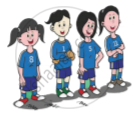 |
______ |
 |
______ |
Match the rhyming words.
| pale | knows |
| boat | gale |
| goes | goat |
Write the word with same meaning.

Flat
Why did the headmaster give Megala a special prize?
Based on the poet’s idea of true success, think of four people in your surroundings - your family, neighbours, friends, teachers, classmates, etc. who have achieved true success. Write, in short, what makes them successful.
Enact any one anecdote in the classroom.
Being a bachelor, the stranger had no patience with children.
