Advertisements
Advertisements
प्रश्न
How do the words in bold, in the lines below, illustrate the poet’s ability to convey criticism cryptically?
Our meddling intellect
Misshapes the beauteous forms of things:
We murder to dissect.
Advertisements
उत्तर
The poet wished to convey the exploitative nature of science and invention. He, therefore, used the above-mentioned words to indicate the same.
APPEARS IN
संबंधित प्रश्न
Answer the following question in 120 – 150 words:
How do you perceive Dr. Kemp based on his interaction with Griffin ? (The Invisible Man)
Answer any four of the following questions in 30-40 words each:
(a) Why did Franz not want to go to school that day?
(b) What was Sophie's ambition in life? How did she hope to achieve that?
(c) What kind of pain does Kamala Das feel in 'My Mother at Sixty-six'?
(d) How can 'mighty dead' be things of beauty?
(e) Why was the Maharaja once in danger of losing his kingdom?
(f) What was the basic plot of each story told by Jack?
Describe the role of Mr. Keith in the life of Helen in ‘The Story of My Life’.
Read the passage and complete the activities given below
B1 Complete the table :
A few facts about the Mehendi rituals during marriage ceremonies are given below :
Write them into appropriate columns :
(i) A simple family affair.
(ii) Song and dance performances accompanied by lavish food and entertainment.
(iii) Creative family members, apply Mehendi to the bride.
(iv) Beauticians are appointed to apply Mehendi to the bride.
Fill in the table as :
| Yesteryears | Present times |
| (i) | (i) |
| (ii) | (ii) |
Mehendi enjoys special attention during the wedding. In India, the day before the wedding is devoted exclusively to the elaborate ritual of applying Mehendi on the hands and feet of the bride. This practice is followed in Arab countries as well, except that it is held a few days prior to the wedding day. Songs are woven around the healing properties and lucky omens associated with mehndi are sung by the bride’s family and friends. An age-old belief handed down to generations lays great emphasis on the color of the bride’s Mehendi – a darker color suggests bountiful love and affection from the future in-laws and husband, and for this reason, brides take the pain to ensure that only the best quality henna is used for her wedding day.
The ritual of adorning the bride with henna is a sacred one and in some communities requires the initiation by the mother-in-law. A popular game during marriage function is the search for their names, by the bride and groom hidden within the elaborate pattern on the bride’s hands.
In certain parts of India, the bridegroom has his hands decorated with henna. The Mehendi function during marriages has evolved from simple family affairs of yesteryears to elaborate events of today. A lavish spread of food and entertainment in the form of song and dance performances have transformed it from a small function to a gala prelude. In earlier days, the task of applying Mehendi on the bride was the sole prerogative of creative family members. The demand for intricate and different style now, sees this job outsourced to beauticians skilled in this art. Beauty salons charge according to the style and complexity of pattern desired by the clients.
B2 What is the age-old belief related to the bride’s Mehendi color and its significance?
B3 Find the words :
Find the words from the passage :
| Noun | Verd | Adjectives |
| (i) attention | attend | _______________ |
| (ii) creation | _________________ | creative |
A lot of money is spent nowadays on marriage ceremonies. What is your opinion about it?
Read the following extract of the poem and complete the activities given below :
B1 State which of the following statements are
True or False :
(i) The elderly are nearest to our own exalted personality.
(ii) The elderly are those persons whose growth is stunted.
(iii) We should know our elderly people well, in order to receive guidance.
(iv) The elderly hold on to the frivolous aspects of life.
Elderly people should be around us. Justify.
(b) abb
(c) abba
This play, written in the 1950s, is a humorous and satirical depiction of the status of the mother in the family.
Do you think it caricatures these issues or do you think that the problems it raises are genuine? How does the play resolve the issues? Do you agree with the resolution?
Identify some of the improbable images the author has used to effect greater humour.
Comment on the use of the phrase ‘fresh-peeled voice’.
What do you understand of the three voices in response to the question 'What does a novel do' ?
How does the poet tossed back from ecstasy into despair?
Read the story and complete the following.
At first, Revathi’s plants did not look normal and healthy because, ____________.
Discuss with your partner and describe the atmosphere in the woods when Mrs. Adis didn’t hand over Peter Crouch to the keepers because -
- _________________
- _________________
- _________________
In Gujarat, the kite - festival is celebrated to welcome the Spring.
Enlist a few reasons for watching a drama live on the stage.
Draw a character sketch of Oberon as an enemy of his wife but a friend of the lovers.
State whether the following statement is True or False:
Oberon transforms Bottom's head into that of an ass.
Answer the following question in one sentence.
What does the title of the poem say?
Who was Shalihotra?
If you saw someone abusing an animal, what would you do? Write about it in 5 lines.
Hold a mock trial for the following offence. There should be a complainant, a defendant, and lawyers to argue the case on behalf of them. The whole class can vote to pass the judgment. On what occasions will you plead for justice? What punishment will you suggest? When will you plead for mercy?
A poor man stole some ornaments from a rich girl.
How was the committee formed?
Find pairs of rhyming words from the poem.
Think and answer:
Why are the sights said to ‘fly’?
Answer the following question and write in short, why the parody sounds funny.
What does the bee stand for?
Present these points in the form of a review, and give it a suitable title.
Rohan and Muk entered the garden at midnight ______.
Read aloud a couple of stanzas of the poem ‘Invictus’ and ‘Please Listen’. In what ways do they differ? Think and fill up the table with ‘Yes’ or ‘No’.
| Invictus | Please Listen | |
| Rhyming lines | ______ | ______ |
| Steady rhythm | ______ | ______ |
| Uniformity in the length of lines | ______ | ______ |
| Uniformity of the number of lines in each stanza. | ______ | ______ |
| Figurative language | ______ | ______ |
Guess the meaning of the following word.
novel
Look at the speaker in each picture. Say whether each one is a good speaker. Give reasons for your answer.
 |
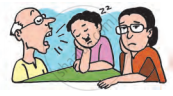 |
 |
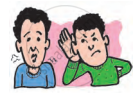 |
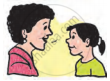 |
Discuss how you will measure the worth of a sports event.
Imagine that you are in a land of tiny people like Lilliput. Write about some of the interesting things you might see there, including animals, houses, plants, vehicles, etc. Find an interesting name for this land.
Form groups of 5-8 and list the following.
Bad habits
Find a word that has a similar meaning.
Whole
Identify the character or speaker.
He imprisoned the spirits in the bodies of large trees.
The weather is always too hot or cold; Summer and winter alike they scold. Nothing goes right with the folks you meet Down on that gloomy Complaining Street.
Pick out the rhyming words and identify the rhyme scheme of the above lines.
Read the story again and write how these character reacted in these situation:
You are an absolute treasure…………. Dr.Krishnan………………..
Zigzag………………………..
Write down the word that alliterate in the poetic line below
That spreads treasures on a tree.
Read these lines and answer the question given below.
The laughter and beauty of women long dead;
Explain the meaning of the above line.
Read the line and answer the question.
And all I ask is a windy day with the white clouds flying
Why does the poet ask for a windy day?
Can courage be developed suddenly? Why?
He got _________ the disease.
According to the Indian army, Jaswant is still serving.
What does it sing?
Choose the correct option from the given homophones.
I saw a ______ on the flower.
Who is the guest?
Where does the scene take place?
The brown sparrow laid ________eggs.
Sparrow tied the elephant and the crocodile with a ______.
Find and write the clues.
Clue for lame ______.
How does a friend support us?
Fill in the blank with rhyming word.
tree- ______
Why did Jana chase the squirrel?
A Shepherd had a _______.
What should we vow for?
Write about the places where the poet wants us to run.
What did the library door say?
How did the animals know that the king was just a jackal?
The passage given below is on Kabbadi. Read the passage and complete the activities that follow.
Kabbadi (கபடி - in Tamil) is a contact team sport that originated in Tamil Nadu, India. It is the national sport of Bangladesh. It is also popular in South Asia and is the state game of the Indian states of Tamil Nadu, Kerala, Andhra Pradesh, Bihar, Haryana, Karnataka, Maharashtra, Punjab, and Telangana.

Kabbadi is played between two teams of seven players: the objective of the game is for a single player on offence referred to as a 'raider', to run in to the opposing teams half of a court, tag out as many of their defenders as possible, and return to their own half of the court–all without being tackled by the defenders. Points are scored for each player tagged by the raider, while the opposing team earns a point for stopping the raider. Players are taken out of the game if they are tagged or tackled, but can be 'revived' for each point scored by their team from a tag or tackle. The raider should hold his breath and utter the words like 'kabbadi kabbadi, hututu hututu, chadu kudu' etc. while the opponents try to catch him. If he stops uttering these words, he is considered out.
The game is known by its regional names in different parts of the subcontinent, such as Kabbadi or Chedugudu in Andhra Pradesh, Kabbadi in Kerala and Telangana, Hadudu in Bangladesh, Bhavatik in Maldives, Kauddi or Kabbadi in the Punjab Region, Hu-Tu-Tu in Western India and Hu-Do-Do in Eastern India and Chadakudu in South India. The highest governing body of Kabbadi is the International Kabbadi Federation.
Given below is the visual presentation of the first paragraph.
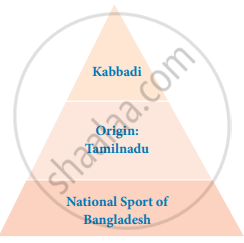
i) Represent the other paragraphs in a visual form of your choice(flow chart, mind-map, pie-chart, etc.).
ii) Choose the correct option.
1. A contact sport usually involves a ______contact between players.
- violent
- gentle
- physical
2. Kabbadi is a game played between ______.
- seven teams of two players
- two teams of seven players
- four teams of seven players
3. A single ______.
- player on offence is referred to as a raider
- offence is referred to as a raider
- raider is an offence by the player
iii) Answer the following.
- How does a raider score points for his team?
- When does a raider concede a point to the opponent team?
- Can a player be revived when he/she is out of the game? Explain your answer.
- Kabbadi is called by different names in different parts of India. Do you know how Pallankuzhi is called in Karnataka, Andhra Pradesh and Kerala?
On the basis of your understanding of the given passage, make notes in any appropriate format.
The Sherpas were nomadic people who first migrated from Tibet approximately 600 years ago, through the Nangpa La pass and settled in the Solukhumbu District, Nepal. These nomadic people then gradually moved westward along salt trade routes. During 14th century, Sherpa ancestors migrated from Kham. The group of people from the Kham region, east of Tibet, was called “Shyar Khamba”. The inhabitants of Shyar Khamba, were called Sherpa. Sherpa migrants travelled through Ü and Tsang, before crossing the Himalayas. According to Sherpa oral history, four groups migrated out of Solukhumbu at different times, giving rise to the four fundamental Sherpa clans: Minyagpa, Thimmi, Sertawa and Chawa. These four groups have since split into the more than 20 different clans that exist today
Sherpas had little contact with the world beyond the mountains and they spoke their own language. AngDawa, a 76-year-old former mountaineer recalled “My first expedition was to Makalu [the world’s fifth highest mountain] with Sir Edmund Hillary’’. We were not allowed to go to the top. We wore leather boots that got really heavy when wet, and we only got a little salary, but we danced the Sherpa dance, and we were able to buy firewood and make campfires, and we spent a lot of the time dancing and singing and drinking. Today Sherpas get good pay and good equipment, but they don’t have good entertainment. My one regret is that I never got to the top of Everest. I got to the South Summit, but I never got a chance to go for the top.
The transformation began when the Sherpa Tenzing Norgay and the New Zealander Edmund Hillary scaled Everest in 1953. Edmund Hillary took efforts to build schools and health clinics to raise the living standards of the Sherpas. Thus life in Khumbu improved due to the efforts taken by Edmund Hillary and hence he was known as ‘Sherpa King’.
Sherpas working on the Everest generally tend to perish one by one, casualties of crevasse falls, avalanches, and altitude sickness. Some have simply disappeared on the mountain, never to be seen again. Apart from the bad seasons in 1922, 1970 and 2014 they do not die en masse. Sherpas carry the heaviest loads and pay the highest prices on the world’s tallest mountain. In some ways, Sherpas have benefited from the commercialization of the Everest more than any group, earning income from thousands of climbers and trekkers drawn to the mountain. While interest in climbing Everest grew gradually over the decades after the first ascent, it wasn’t until the 1990s that the economic motives of commercial guiding on Everest began. This leads to eclipse the amateur impetus of traditional mountaineering. Climbers looked after each other for the love of adventure and “the brotherhood of the rope” now are tending to mountain businesses. Sherpas have taken up jobs as guides to look after clients for a salary. Commercial guiding agencies promised any reasonably fit person a shot at Everest.
