Advertisements
Advertisements
प्रश्न
Briefly explain the following statement from the text.
“You need some interaction to cause a transition.”
Advertisements
उत्तर
The statement is made by Rajendra in the text The Adventure by Jayant Vishnu Narlikar. Rajendra offered a scientific explanation in the light of catastrophic theory to rationalise the fantastic experience undergone by Prof. Gaitonde regarding the course of India's history after the Battle of Panipat. As per the History text books, the Marathas lost the Battle of Panipat after which India gradually fell to the foreign forces. Contrary to this fact, Prof. Gaitonde witnessed that the Marathas emerged victorious in the Battle of Panipat and extended influence all over the country. These two versions of history seemed perplexing to Prof. Gaitonde. Rajendra's explanation convinced Prof. Gaitonde but he was unable to understand how his consciousness level changed so that he could experience a catastrophic event in history. In this context, Rajendra tried to explain that when Prof. Gaitonde was hit by a truck he was at that time thinking about the Battle of Panipat. The neurons in his brain acted as trigger to change his consciouness level leading to his experience of another version of the course of history after the Battle of Panipat.
APPEARS IN
संबंधित प्रश्न
B1. What does the poet want us to do in the following situation?
(a) While struggling ………..
(b) While making money ………
(c) While dreaming ………………
(d) While losing …………..
It's doing your job the best you can,
And being just to your fellow man;
It's making money-but holding friends,
And being true to your aims and ends.
It's figuring how and learning why,
And looking forward and thinking high;
And dreaming a little and doing much,
It's keeping always in closest touch.
With what is finest in word and deed,
It's being through, yet making speed;
It's daring blithely the field of chance,
While making labour a brave romance.
It’s going onward despite defeat
And fighting staunchly, but keeping sweet;
It's struggling on with the will to win,
But taking loss with a cheerful grin.
B2. Achieving Success
Hints given by the poet to become successful are
(a) Doing your job the best
(b)
(c)
(d)
(e)
B3. Poetic Device
Select the appropriate rhyme scheme for the 3rd stanza.
(1) abab
(2) aabb
(3) aaba
Attempt the following in 150-200 words.
Write a character sketch of Bishop Brooks as he appears in Helen Keller's − The Story of My Life.
Answer any four of the following in 30−40 words each:
(a) What did garbage mean to the children of Seemapuri and to their parents?
(b) How did Rajkumar Shukla establish that he was resolute?
(c) 'Life is what it is all about;...' How is keeping quiet related to life?
(d) Mention any four things of beauty that add joy to our life.
(e) The manner of his (the Tiger King's) death is a matter of extraordinary interest. Comment.
(f) In what condition did Dr. Sadao find the American soldier at the seashore?
In ‘The Diary of a Young Girl’ how did the Franks and others celebrate two festivals, Hanukkah and St. Nicholas Day in the Annexe ?
Read the passage and complete the activities given below
B1 Complete the table :
A few facts about the Mehendi rituals during marriage ceremonies are given below :
Write them into appropriate columns :
(i) A simple family affair.
(ii) Song and dance performances accompanied by lavish food and entertainment.
(iii) Creative family members, apply Mehendi to the bride.
(iv) Beauticians are appointed to apply Mehendi to the bride.
Fill in the table as :
| Yesteryears | Present times |
| (i) | (i) |
| (ii) | (ii) |
Mehendi enjoys special attention during the wedding. In India, the day before the wedding is devoted exclusively to the elaborate ritual of applying Mehendi on the hands and feet of the bride. This practice is followed in Arab countries as well, except that it is held a few days prior to the wedding day. Songs are woven around the healing properties and lucky omens associated with mehndi are sung by the bride’s family and friends. An age-old belief handed down to generations lays great emphasis on the color of the bride’s Mehendi – a darker color suggests bountiful love and affection from the future in-laws and husband, and for this reason, brides take the pain to ensure that only the best quality henna is used for her wedding day.
The ritual of adorning the bride with henna is a sacred one and in some communities requires the initiation by the mother-in-law. A popular game during marriage function is the search for their names, by the bride and groom hidden within the elaborate pattern on the bride’s hands.
In certain parts of India, the bridegroom has his hands decorated with henna. The Mehendi function during marriages has evolved from simple family affairs of yesteryears to elaborate events of today. A lavish spread of food and entertainment in the form of song and dance performances have transformed it from a small function to a gala prelude. In earlier days, the task of applying Mehendi on the bride was the sole prerogative of creative family members. The demand for intricate and different style now, sees this job outsourced to beauticians skilled in this art. Beauty salons charge according to the style and complexity of pattern desired by the clients.
B2 What is the age-old belief related to the bride’s Mehendi color and its significance?
B3 Find the words :
Find the words from the passage :
| Noun | Verd | Adjectives |
| (i) attention | attend | _______________ |
| (ii) creation | _________________ | creative |
A lot of money is spent nowadays on marriage ceremonies. What is your opinion about it?
Talk to your partner about the following.
Describe the changing relationship between the author and his grandmother. Did their feelings for each other change?
Give reasons for the following statement.
The author was disappointed with Darchen.
Give reasons for the following statement.
The author thought that his positive thinking strategy worked well after all.
We 'draw up a deed'. Complete the following phrase with an appropriate word.
________one's will
What was the reason for the anxiety of Paul's mother as he grew older?
What do you infer from Darwin's comment on his indifference to literature as he advanced in years?
How does 'A Kondh Song' substantiate the tribal urge to gain domination over time by conversing with their dead ancestors?
Qua story’: what does the word mean? Find other expressions using the word qua.
The significance of reading an autobiography lies in drawing lessons from another life. What is the significance of Kumudini's account for us as readers?
Read the following statement and mark those that apply to you.
I have a small group of close friends and have no wish to interact with anyone else.
Think and answer in your own words.
How do parents react when they see children soil their clothes in dust and heat?
Find evidence from the lesson and write in your own words.
India has many amazing success stories.
Answer the given question in your own words.
Why was the Prince sad?
The poem is a Petrarchan Sonnet. The poem is divided into two parts -
- An Octave
The first part comprising eight lines. - A sestet
The second part comprising six lines.
Read the first four lines of the poem. The rhyme scheme is a b b a. Read the rhyme scheme for the next four lines. It is a b b a. Now read the first three lines of the sestet and note the rhyme scheme. It is c d c. The rhyme scheme of the last three lines is d c d. This is the common design of a Petrarchan Sonnet.
This is a Petrarchan Sonnet. Complete the given table by giving examples from the poem.
| Features | Examples / Lines |
| Objects used | |
| Praise/blames | |
| Metaphor | |
| Simile | |
| Personification | |
| Number of lines | |
| Rhyme scheme |
Where do we find all types of wild animals in urban areas?
Answer the following question in short.
Why did Pundit Shahane visit Vijaynagar?
Form pairs. Make a list of as many games as you can. (At least 25) Then classify the games using the following criteria:
- Indoor and outdoor games.
- Games played with and without any equipment.
- Games which have one-to-one matches and those in which teams play against each other (Single-player or team)
- Games played mostly by children and games played by adult players.
- Shape and size of the court or field.
Use the following figures to show your classification.
From the internet or other sources, find the other names by which Kabaddi is known in different parts of our country and the world.
What are the clothes compared to? Give two examples.
Explain the following statement with reference to the context.
You ought to be ashamed of yourself.
Write a short monologue using one of the following ideas. Write down the monologue and present it in the class.
Yonamine’s father worrying about getting her married.
Read the following words. Write the words that are combined to make these words.
- faraway
- nobleman
- whoever
- moneylender
- sometimes
Add ten more words to the list on your own. Each of the component words must be meaningful.
To whom is the poem addressed?
A parody is a playful, comic imitation of a writer’s style. A parody is like a verbal cartoon. Compare the original poem and its parody given on page 35 using the following points:
|
How doth the little busy bee |
How doth the little crocodile (parody) |
| Choice of a subject (an animal) | __________________ |
| __________________ | __________________ |
| Number of lines and stanzas | __________________ |
| __________________ | __________________ |
| Same or similar constructions | __________________ |
| __________________ | __________________ |
| Tone of the poem | __________________ |
| __________________ | __________________ |
List the names of body parts used in the passage.
Mention the various places that the brook flows past.
Look at the photographs on textbook pages 19-20 carefully and imagine the following:
- The colours, shape, size, actions, etc. of what you see in the picture.
- The sound/sounds you may hear at the scene of the photograph.
- How the different things, birds, animals, etc. in the picture feel to the touch.
- The smell / smells you may smell at the scene of the picture.
- The taste of what you see in the pictures.
In short, let your imagination include oil your five senses.
Now, write short descriptions of any 8-10 of your choice.
Remember to make use of your senses (one or more!) when you describe a photograph. You will find the following words and phrases useful. You may also use other words you know.
Title summarises the story. Each paragraph is a part of the story. Look at the following expressions and find out the paragraphs that best suit these expressions.
- Oh, No! But it happens!
- Don’t let out your travelling dates
- Anyway, people will be people
- Search begins
- Things are not that easy
- Hurry invites worry
Write the name of the toys against each picture.

Hamid’s heart sank because the price of the tongs was______for him.
What do you think is going to happen next?
Give an example for dazzling light.
Identify the speaker/character.
Don't worry, Madam, it's only a warning.
Turtles come ashore to lay eggs
When did the richest farmer get upset? Why?
How did Santhosh spend his time in the river?
Jaswant decided to stay in his post.
The robot did not obey his master.
What did you learn from this lesson?
Why did the old man disguise himself as a beggar?
Identify the character or the speaker.
“Do not feel sad dear.”
Recite the poem ‘Mother Nature’.
Write the rhyming word.
away
Divide the following word.
butter
______always stays to the last in our needs.
Number the actions of Pandi and Nandhini in order.
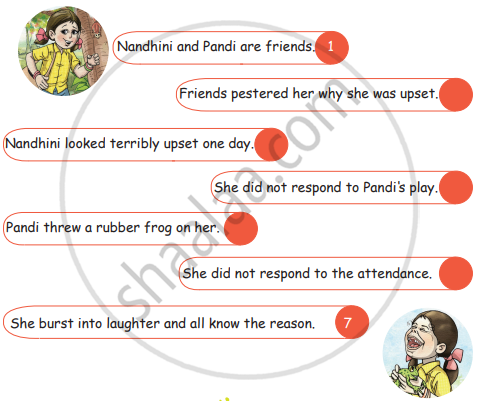
Fill in the blank with rhyming word.
tunnels- ______
Fill in the blank

Where did the tanker man take the water from the village?
Mugund loved wild animals.
Pencil asked him to draw ______.
Why did the headmaster give Megala a special prize?
Replace the bold word/words with a word from the quiver and re-write the sentence –
In no time she hit the object she aimed at.
What did the books in the library look like ?
Bertha was very good but very proud too.
