Advertisements
Advertisements
प्रश्न
What impression would you form of a state where the King was 'just and placid'?
Advertisements
उत्तर
A model answer has been provided for students' reference.
It is strongly recommended that students prepare the answer on their own.
A state where the king was Just and placid enjoyed peace, liberty and justice. The king was titular and symbolic. The citizens enjoyed freedom of all kinds. The real governance of the country was in the hands of the citizens. In the poem 'The Tale of a Melon City' the king had to be hanged as the citizens ultimately wanted someone to be hung. The king could not defend himself. Even though the wisest man gave the verdict that the arch was the real culprit but the citizens wanted someone to be hanged. Ultimately, the king was hanged. This shows that in such a state where the king was just and placid the citizens influenced the fate of a king.
APPEARS IN
संबंधित प्रश्न
Attempt a character sketch of Otto Frank, Anne's father.
Answer any four of the following questions in 30-40 words each:
(a) How could the peddler enter the forge without being noticed by the blacksmith?
(b) At Champaran what did the British landlords want from the sharecroppers?
(c) How does the poet show the futility of Aunt Jennifer's efforts?
(d) Stephen Spender in his poem, 'An elementary School Classroom in a Slum' paints a dismal picture of poverty. Comment.
(e) How did Evans have the last laugh at the Governor?
(f) How did the General plan to get rid of the American POW?
Complete the call-outs:
A.1)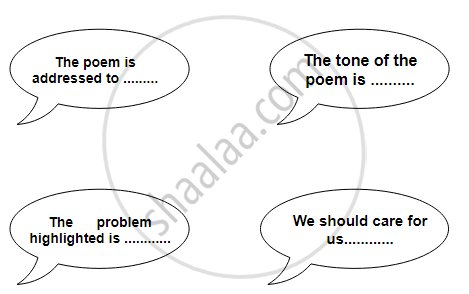
Our world is an institution
Of environmental pollution
We choose not to care
For our future generations
And I for one am guilty
For buying the hundreds of electronic gadgets
That attracts the industries to produce like maggots
environmental pollution is at the heart of our planet
The forests are dying
Wildlife is crying
Millions of fish are dying
Mother earth is sighing
Tell me is it right
That we sleep well at night
Replenishing ourselves
For tomorrow’s greedy fight
Overcrowded trains
Overloaded brains
Where is the light? What is our plight?
While the river break their banks
And greedy industries play their polluted pranks.
A.2) Find the examples that show that we do not care for our future generation
A.3) Match:
Match the lines in Column ‘A’ with the figures of speech in Column ‘B’:
| Column ‘A’ | Column ‘B’ | ||
| (i) | Our world is an institution | (a) | Personification |
| (ii) | Mother earth is sighing | (b) | Simile |
| (c) | Metaphor |
Read the following extract and do the given activities:
B.1) Fill in the Balloons with suitable ideas from the poem:
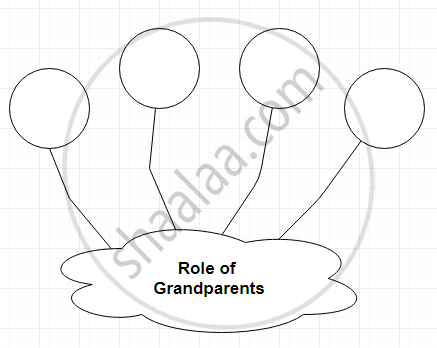 “Oh, the value of the elderly! How could anyone not know?
They hold so many keys, so many things they can show.
We all will read the other side this I firmly believe
And the elderly are closest oh what clues we could retrieve.
For their characters are closest to how we’ll be on high.
They are the ones most developed, you can see it if you try.
They’ve let go of the frivolous and kept things that are dear
The memories of so sweet, of loved ones that were near.
As a nation, we are missing our greatest true resource,
To get to know our elders and let them guide our course.”
B.2) Find Evidence:
Pick out the line from the extract which supports the given ideas:
(i) The elders have many things to share.
(ii) Everybody knows the value of elderly people.
(iii) The elderly people have vast experience.
(iv) The elderly people are a boon to the nation.
B.3) Write a pair from the extract that rhymes with the given word:
| Fear | ........................... | .......................... |
Notice these expression in the text. Infer their meaning from the context.
billowed
What was the importance of the watch to the author?
'On reading Shelley's A Defence of Poetry, the question insistently occurs why there is no similar A Defence of Science written of equal endowment.'
How does the poem capture the elusive nature of the peacock?
Why does Ruskin feel that reading the work of a good author is a painstaking task?
The text is an excerpt from Sesame and Lilies which consists of two essays, primarily, written for delivery as public lectures in 1864. Identify the features that fit the speech mode. Notice the sentence patterns.
There are intervals of silence in the interaction between the landlady and the prospective tenant. What are the reasons for this?
How does the poem emphasise the physical prowess of the Hawk?
Fill in the blank.
Baban’s father and some elders mentioned the name of __________.
‘Dull would he be of soul who could pass by.’
This line of the poem can be rewritten as:
'He would be of a dull soul.'
The figure of speech is known as ‘Inversion’.
Find out one more example of Inversion from the poem.
Read the lesson and name the following.
The Father of modern neurosurgery ______
You will come across many blogs written by famous personalities on different topics and issues. Read and make a list of at least ten blogs available on the internet. Read and summarise a blog and present it before the class.
| Sr.No. | The topic of the Blog | Name of the Blogger |
| 1. | Don’t teach kids how to read, teach them why. (https://www.teachthought.com/literacy stop-teaching-kids-how-to-read-reading-practice/) | Terry Heick |
| 2. | ||
| 3. | ||
| 4. | ||
| 5. |
Suggest what you would do in the following situation:
One particular friend of yours is always late for college, social functions, movies, etc. and delays everyone.
Choose any one of the objects we use daily and find out how it is made. Present the information in the form of a chart.
Read the given extract (Act III)
Match column A with column B.
| Sr.No. | A | B |
| 1. | Dr. Thomas Stockmann | Opportunist |
| 2. | Katherine | Vulnerable |
| 3. | Peter Stockmann | Honest and upright |
| 4. | Petra | Coward |
| 5. | Hovstad | timid but supportive |
| 6. | Billing | Cuinng and corrupt |
| 7. | Aslaksen | Courageous |
Explain the following statement with reference to the context.
And then, once the ring's broken, we'll get to work and show the public every day just how incompetent the Mayor is!
Form groups and hold debates on the following topic. Make bulleted lists of points in favour of the topic (pros) and those against it (cons). (3-6 points each).
Boys cannot cook or do any housework.
Bassanio borrowed money from Shylock in Antonio’s name.
Add ten more words to the list on your own. Each of the component words must be meaningful.
Rearrange the following in their proper order as in the poem. Write the serial number against each line:-
(a) The Ostad sang the Malkous Raga enchantingly.
(b) Akbar followed Tansen, dressed miserably.
(c) I request you to sing such a song that will I experience unmatched joy.
(d) Ostad was nowhere to be seen.
(e) O Divine Teacher, please gift us the joy of your song.
(f) One day, the singer sang Deepak Raga in the court.
(g) Akbar expressed his wish to meet the Teacher.
(h) He experienced heavenly delight.
(i) Tansen sings to please the earthly king but Ostad devotes his songs to God.
(j) She sang Raga Malhar, which had a cooling effect.
Make a list of your favourite fruits and vegetables and note down the time of the year when they are available in plenty.
Imagine that you are in a land of tiny people like Lilliput. Write about some of the interesting things you might see there, including animals, houses, plants, vehicles, etc. Find an interesting name for this land.
List the rhyming words in the (On the water) poem.
Find a word that has a similar meaning.
unfair
What different names is ‘Rangoli’ known by in different regions?
Identify the character or speaker.
I was Duke of Milan, and you were a princess.
Why do you think Mrs. Bodwell wanted to sell the house?
Few articles are missing in the given passage. Edit the passage given below by adding suitable articles where ever necessary.
My neighbourhood is very interesting place. My house is located in apartment building downtown near many stores and offices. There is small supermarket across street, where my family likes to go shopping. There is also post office and bank near our home. In our neighbourhood there is small, Green Park where my friends and I like to play on weekends and holidays. There is small pond near park and there are many ducks in park. We always have great time. In addition there is elementary school close to our home where my little brother studies in third grade. There are so many things to see and do in my neighbourhood that’s why I like it. It’s really great place.
Read the following line from the poem and answer the question given below.
Let us learn to walk with a smile and a song,
No matter if things do sometimes go wrong;
- What does the poet expect everyone to learn?
- What should we do when things go wrong sometimes?
Identify the speaker/character.
‘ The one that spits deadly poison straight into its opponent’s eyes.’
Read the story again and write how these character reacted in these situation:
You’re both quite mistaken.
Dr. Krishnan ........…………………….
Mrs. Krishnan……....…………………
What did Suresh ask Usha? Why?
Teach me to appreciate ______.
- nature
- destruction
- small creatures
What makes us happy and free, according to the poet?
How does Alice feel after all these changes?
Give a picturesque view through which the train travels.
Grandfather helped grandma out with the gardening because he______.
What made the trip a memorable one?
Gulliver was the captain of the ship.
What sight made the farmer thankful?
What should we do to save the Earth?
What were Anandhan and Yazhini watching in the television?
Which place was the last stand of the Indian army?
Rearrange the story in order.
- Jaswant stayed back in his post.
- He killed 300 chinese soldiers in the battle.
- He fired weapons from separate points.
- Sela and Nura helped him in the battle.
- Jaswant shot himself to death.
- Chinese soldiers caught the man who supplied food.
- He was awarded the Mahavir Chakra.
Vicky pleaded his father to buy a robot.
Connect and write the homophones in the box.
|
Sea |
 |
|
One |
 |
|
Flower |
 |


In early days, Amir left the tap opened.
Where do the moles save their food?
Every year the children visit the______.
The king gave______ seeds.
The grandmother had kept the plate in memory of her ______.
Read the passage carefully and answer the following question.
What did the farmer find in the field?
Write the word with same meaning.

chips- ______
The garden Alice saw was
What did the boy make with the branches of the tree?
Collect the outer coverings of fast food items. Discuss the following points in groups and then write your observations in your notebook.
- Ingredients
- Manufactured by
- Net weight
- Veg or Non-veg
- Recipe
- Nutrition facts
- MRP
- Mfg date
- Website
- Other instructions, if any
