Advertisements
Advertisements
प्रश्न
Narrate 'The Tale of Melon City' in your own words.
Advertisements
उत्तर
A model answer has been provided for students' reference.
It is strongly recommended that students prepare the answer on their own.
The Tale of Melon city is a narrative poem by Vikram Seth written in the couplet form. The poem is an account of an incident involving the monarch and citizens that took place in a city long ago. The tale is humorous with a very sharp focus on the thematic aspect. Structurally, the story has three parts-the first part mentions about a king's wish to build an arch. The second part relates his complaints regarding the faulty construction of the arch and the last part narrates how his decree ultimately falls on him leading to his hanging. The poem in a high tone of humour narrates the transition of power from the king to a melon which became a symbolic head.
In the beginning the poet narrates that there was a king in a city long ago. One day the king expressed his desire to construct an arch spanning the main thoroughfare to improve the onlookers morally and mentally. The king was just and peace loving. The construction work was soon undertaken by employing large number of labourers.
After the completion of the arch, the king went to inspect the newly constructed arch. The arch was very low. His crown struck against the arch and fell off. Feeling dishonoured, the king decided to hang the chief of builders. All arrangements were made for the hanging. The Chief of builders defended himself by shifting the responsibility to the labourers. Convinced by the argument, the king then ordered to hang all the labourers. The labourers shifted the responsibility to the size of the bricks. The king accordingly ordered the hanging of the masons. The masons in turn defended themselves and put all blame on the architect. The king ordered to hang the architect. The architect reminded the king that he (King) had made some amendments to the plan when it was shown to him. The architect indirectly put the blame on the king. The king was confused to hear the architect's argument. The king solicited the advice of the wisest man in his kingdom. Accordingly, the wisest man was found and brought to the court. He was so old that he could neither walk nor see. He gave the verdict that the arch was the real culprit. It was the arch that hit the crown violently and it fell off. So, the arch must be hanged. Accordingly, the arch was led to the scaffold. In the meantime, a councillor pointed out that it would be very shameful act to hang the arch that touched the king's crown.
The crowd which gathered there to witness the hanging of the culprit was getting restless. Sensing their mood, the king said that someone must be hanged since the nation wanted a hanging. The noose was set up. It was somewhat high. Each man was measured turn by turn. But there was only one man who was tall enough to fit in the noose, and it was the King. Interestingly, the king was hanged.
The poet then narrates the third part of the poem. In the concluding part the ministers heaved a sigh of relief that they were able to find someone, otherwise, the unruly crowd might have risen in revolt. After the death of the King, it was required to choose another king. As per the convention, the ministers sent out the herald to proclaim that the next to pass the City Gate would choose a king. An idiot happened to pass the City Gate. The guards asked him who was to be the King. The idiot answered that a melon should be chosen to be the next king. Actually that was his pet answer to all questions as he liked melons. The ministers crowned a melon and placed their Melon King reverently at the throne.
The poet narrates that the citizens were least bothered about their symbolic head. They enjoyed the principles of Laissez faire. They were very respectful to their new monarch as the new monarch did not interfere in their lives.
APPEARS IN
संबंधित प्रश्न
A1. (i) Two activities that mother was free to do:
(a)...........................................
(b)............................................
(ii)Two activities that children avoided doing because of television:
(a) .....................................
(b) ...................................
Oh yes, we know it keeps them still,
They don't climb out the window sill,
They never fight or kick or punch,
They leave you free to cook the lunch
And wash thedishes in the sink
But did you ever stop to think,
To wonder just exactly what
This does to your beloved tot?
It rots the sense in the head!
It kills imagination dead!
It clogs and clutters up the mind!
It makes a child so dull and blind
He can no longer understand
A fantasy, a fairyland!
His brain becomes as soft as cheese!
His power of thinking rust and freeze!
He cannot think - He only sees!
'All right!' you'll cry. 'All right!' you'll say,
'But if we take the set away,
What shall-we do to entertain
Our darling children? Please explain!'
We'll answer this by asking you,
'What used the darling ones to do?'
'How used they keep themselves contented
Before this monster was invented?'
Have you forgotten? Don't you know?
A2. According to the poem, why is excessive watching of TV harmful?
A3. His brain became as soft as cheese. The figure of speech is ..........because............
What were Watson's observations on the stick left behind by Dr. Mortimer? How far did Sherlock Holmes prove him wrong? (in about 125 words)
What do elephants do to prevent water from evaporating ?
A1 Web :
Complete the following web with the help of the passage :
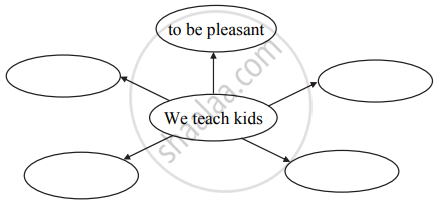
My dictionary tells me that personality is the “Personal or individual quality that makes one person be different and act differently from another.” Personality is, “the total physical, intellectual and emotional structure of an individual, including abilities, interests, and attitudes.”
There are many benefits to having a pleasant personality. There is only one opportunity to make a first impression, and all of us instinctively make decisions or judgments about an individual within the first few seconds of crossing paths. With that in mind, I believe when we teach our kids to smile, to be pleasant and cheerful, to be courteous and respectful of others, to pleasantly respond to requests or questions, we are helping them develop a personality that will open many doors for them. Once the doors are opened, the character will keep them open; but personality, not character, is on display in the first few seconds. Therefore, it’s important to develop a pleasant personality and use it for life.
A2 Personality :
Personality of an individual is recognized by :
(i) _______ (ii) _______
(iii) _______ (iv) _______
A3 Vocabulary :
Find out words for the following from the passage and write:
(i) polite =
(ii) relating to feelings =
(iii) to do anything naturally without thinking =
(iv) a chance to do something =
A4 Complete the following table :
| Noun | Adjective | Adverb |
| – | different | differently |
| Instinct | – | instinctively |
Select any word from the table and use it meaningfully in a sentence of your own.
A5 Personal Response :
Why do you thing, personality development is necessary?
Read the following passage and do the given activities:
A.1) True or False
State whether the following statements are true or false:
(i) The patient stirred and looked about in cheerful anticipation
(ii) The patient’s wife wanted to know the truth …………
The lady went away to the kitchen. She felt restless. She felt she must know the truth whatever it was. Why was the great man so evasive? The suspense was unbearable. Perhaps he could not speak so near the patient’s bed. She beckoned to him from the kitchen doorway.
The doctor rose and went over. She asked, “What about him now? How is he?” The doctor bit his lips and replied, looking at the floor, “Don’t get excited. Unless you must know about it, don’t ask now.” Her eyes opened wide in terror. She clasped her hands together and implored, “Tell me the truth.” The doctor replied, “I would rather not talk to you now.” He turned around and went back to his chair. terrible wailing shot through the still house; the patient stirred and looked about in bewilderment. The doctor got up again, went over to the kitchen door, drew it in securely and shut off the wail.
A.2) Give reasons for the following:
(i) Her eyes opened wide in terror.
(ii) The lady went away to the kitchen.
A.3) How, according to you, should the nature of the doctor be?
Notice the kind of English Tsetan uses while talking to the author. How do you think he picked it up?
There lies a great difference between text book medicine and the world of practising physician. Discuss.
We 'draw up a deed'. Complete the following phrase with an appropriate word.
________one's word
'The author's treatment of the subject matter makes the readers identify themselves with the experience.' Comment on the statement.
Identify some of the improbable images the author has used to effect greater humour.
How does Forster use the analogy of Scheherazade to establish his point ?
No trees except the one which grows and seethes in one's dreams'– why is the phrase 'grows and seethes' used?
Read the extract and state whether the following statement is true or false. Correct the false statement.
The aroma of the ‘desi’ rice would spread around the village.
Answer in your own words.
What did Revathi discover about her balsam plants?
A small thought, put in action, led to a great achievement. Pick out the lines from the beginning and end of the poem and explain their significance.
Read other poems by Leigh Hunt, especially 'Abou Ben Adhem'.
Compare the messages in that poem with those in 'The Plate of Gold'. What do you observe?
Say where . . . . . . .
______ do stars shine in the daytime?
Write 3 to 4 lines about the following in your own words.
First Neurosurgeon
List all the words specially used in the game of Kabaddi.
Form groups and discuss the following question:
Why are the clothes compared to living things?
List five questions from the play which can be answered with 'yes' or 'no'.
Choose a 'question' through your own observation. Try to follow the scientific method to find the answer to that question. Take the help of your teacher/parents to set up the experiment.
Use the following expressions in your own sentences:
- We all agree that
- It is he/she who
- Don’t you see
- None of us
Read the following sentence aloud. Write who said it and to whom.
“Would you lend me this, just this?”
Think and answer:
Why are the sights said to ‘fly’?
List the names of body parts used in the passage.
Find the meaning of the following words or phrases :
- ridges
- brimming
- eddying
- babble
- fallow
- trout
- netted
Rearrange the following in their proper order as in the poem. Write the serial number against each line:-
(a) The Ostad sang the Malkous Raga enchantingly.
(b) Akbar followed Tansen, dressed miserably.
(c) I request you to sing such a song that will I experience unmatched joy.
(d) Ostad was nowhere to be seen.
(e) O Divine Teacher, please gift us the joy of your song.
(f) One day, the singer sang Deepak Raga in the court.
(g) Akbar expressed his wish to meet the Teacher.
(h) He experienced heavenly delight.
(i) Tansen sings to please the earthly king but Ostad devotes his songs to God.
(j) She sang Raga Malhar, which had a cooling effect.
Imagine the following and write about it in your own words:
What the world looks like to a baby.
List 5 of the sounds that you like.
Find out when and where we get strawberries in Maharashtra.
Present any one of these announcements yourself, orally.
Note that we say 'its appetite', 'its manners' and not 'it’s appetite' or 'it’s manners’. It’s means 'It is' and its means 'belonging to it'.
What more difficulties would they have to face, if the roads are not cleared?
Ask your parents or other grown-ups to show you some used notes. Observe them carefully. Have they been used properly? Write your observations.
What are search engines?
Make a collection of Rangoli motifs and patterns.
Write about each motif or pattern in your own words -
it could just be a label or a description or some information or comment.
Complete the given tabular column with the suitable plural forms.
| chair | - | |
| box | - | |
| Eskimo | - | |
| lady | - | |
| radius | - | |
| formula | - | |
| child | - | |
| deer | - | |
| loaf | - | |
| hero | - |
Why did Dr. Ashok’s cousin call him?
When did the garden become a happy place for the author?
Grandmother had wanted the peepul tree cut down because______.
The villagers, built a _______ on his memory.
What did Anandhan want to become?
Where did Anitha go?
They would rest on the tree.
His father wanted him to do well in ______.
Some words sound the same but their spelling and meaning are different. Such words are called homophones. There are many homophones.
How did he lose his hand?
What was his master’s advice?
Why was the fish floating on top?
Answer using Yes or No and pick sentence from the story to support your answer.
Do cannibals eat people?
Choose the best answer.
Suddenly there was a______.
Fill in the blank
He is rich ______ he looks simple.
People ran off when the seawater receded.
Name the places that Tenzin’s family lived in.
What did the grandfather announce?
In real the plate was made of ______.
Why was his father unable to sleep?
Write the correct word.
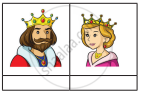
| rooster, king, hen, tiger, queen, tigress. |
Complete the dialogue.
| Anil: | Which is your favourite book? |
| Sunil: | ________________________ |
| Anil: | What type of book is it? |
| Sunil: | ________________________ |
