Advertisements
Advertisements
Question
Narrate 'The Tale of Melon City' in your own words.
Advertisements
Solution
A model answer has been provided for students' reference.
It is strongly recommended that students prepare the answer on their own.
The Tale of Melon city is a narrative poem by Vikram Seth written in the couplet form. The poem is an account of an incident involving the monarch and citizens that took place in a city long ago. The tale is humorous with a very sharp focus on the thematic aspect. Structurally, the story has three parts-the first part mentions about a king's wish to build an arch. The second part relates his complaints regarding the faulty construction of the arch and the last part narrates how his decree ultimately falls on him leading to his hanging. The poem in a high tone of humour narrates the transition of power from the king to a melon which became a symbolic head.
In the beginning the poet narrates that there was a king in a city long ago. One day the king expressed his desire to construct an arch spanning the main thoroughfare to improve the onlookers morally and mentally. The king was just and peace loving. The construction work was soon undertaken by employing large number of labourers.
After the completion of the arch, the king went to inspect the newly constructed arch. The arch was very low. His crown struck against the arch and fell off. Feeling dishonoured, the king decided to hang the chief of builders. All arrangements were made for the hanging. The Chief of builders defended himself by shifting the responsibility to the labourers. Convinced by the argument, the king then ordered to hang all the labourers. The labourers shifted the responsibility to the size of the bricks. The king accordingly ordered the hanging of the masons. The masons in turn defended themselves and put all blame on the architect. The king ordered to hang the architect. The architect reminded the king that he (King) had made some amendments to the plan when it was shown to him. The architect indirectly put the blame on the king. The king was confused to hear the architect's argument. The king solicited the advice of the wisest man in his kingdom. Accordingly, the wisest man was found and brought to the court. He was so old that he could neither walk nor see. He gave the verdict that the arch was the real culprit. It was the arch that hit the crown violently and it fell off. So, the arch must be hanged. Accordingly, the arch was led to the scaffold. In the meantime, a councillor pointed out that it would be very shameful act to hang the arch that touched the king's crown.
The crowd which gathered there to witness the hanging of the culprit was getting restless. Sensing their mood, the king said that someone must be hanged since the nation wanted a hanging. The noose was set up. It was somewhat high. Each man was measured turn by turn. But there was only one man who was tall enough to fit in the noose, and it was the King. Interestingly, the king was hanged.
The poet then narrates the third part of the poem. In the concluding part the ministers heaved a sigh of relief that they were able to find someone, otherwise, the unruly crowd might have risen in revolt. After the death of the King, it was required to choose another king. As per the convention, the ministers sent out the herald to proclaim that the next to pass the City Gate would choose a king. An idiot happened to pass the City Gate. The guards asked him who was to be the King. The idiot answered that a melon should be chosen to be the next king. Actually that was his pet answer to all questions as he liked melons. The ministers crowned a melon and placed their Melon King reverently at the throne.
The poet narrates that the citizens were least bothered about their symbolic head. They enjoyed the principles of Laissez faire. They were very respectful to their new monarch as the new monarch did not interfere in their lives.
APPEARS IN
RELATED QUESTIONS
There were many reasons for Helen Keller's embittered childhood. What were they and how were they overcome?
Read the passage given below :
(ii) he added a lot of grandeur to Mewar.
(iii) of his valour, sacrifice and patriotism.
(iv) both (ii) and (iii)
(b) Difficulties in the way of Mewar were :
(ii) ancient traditions of the kingdom.
(iii) its small area and small population.
(iv) the poverty of the subjects.
(ii) the flag of Mewar was hoisted high.
(iii) the people of Mewar showed gallantry.
(iv) most of the rulers heaved a sigh of relief.
(d) Mewar was lucky because :
(ii) most of its people were competent.
(iii) most of its rulers were competent.
(iv) only a few of its people were incompetent.
Answer the following questions briefly:
(h) How could art and literature flourish in Mewar?
(i) How did the rulers show that they cared for their subjects?
(j) What does the erection of Vijaya Stambha and Kirti Stambha in the same fort signify?
(k) Find words from the passage which mean the same as each of the following:
(ii) evidence (para 4)
The black kite may start a fire because
A1 Web :
Complete the following web with the help of the passage :
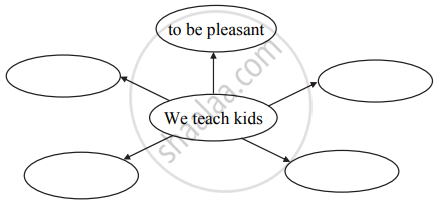
My dictionary tells me that personality is the “Personal or individual quality that makes one person be different and act differently from another.” Personality is, “the total physical, intellectual and emotional structure of an individual, including abilities, interests, and attitudes.”
There are many benefits to having a pleasant personality. There is only one opportunity to make a first impression, and all of us instinctively make decisions or judgments about an individual within the first few seconds of crossing paths. With that in mind, I believe when we teach our kids to smile, to be pleasant and cheerful, to be courteous and respectful of others, to pleasantly respond to requests or questions, we are helping them develop a personality that will open many doors for them. Once the doors are opened, the character will keep them open; but personality, not character, is on display in the first few seconds. Therefore, it’s important to develop a pleasant personality and use it for life.
A2 Personality :
Personality of an individual is recognized by :
(i) _______ (ii) _______
(iii) _______ (iv) _______
A3 Vocabulary :
Find out words for the following from the passage and write:
(i) polite =
(ii) relating to feelings =
(iii) to do anything naturally without thinking =
(iv) a chance to do something =
A4 Complete the following table :
| Noun | Adjective | Adverb |
| – | different | differently |
| Instinct | – | instinctively |
Select any word from the table and use it meaningfully in a sentence of your own.
A5 Personal Response :
Why do you thing, personality development is necessary?
Answer the following in 200-250 words :
What are Helen's opinions about examinations?
Mention the three phases of the author’s relationship with his grandmother before he left the country to study abroad.
Describe the changing relationship between the author and his grandmother. Did their feelings for each other change?
Do you think that the ruled always adopts the language of the ruler?
The story begins with a description of the setting. How does this serve as a fitting prelude to the events described in the story?
What is the emphasis placed by Ruskin on accuracy?
Comment on the use of the phrase ‘fresh-peeled voice’.
The quill is the central element of the poem – what does it symbolise?
How does Forster use the analogy of Scheherazade to establish his point ?
Fill in the blank.
Baban’s father and some elders mentioned the name of __________.
Answer in your own words.
Read and write down 5 points which prove that Tomba, (Lanthoi’s father) firmly believes in gender equality.
Make a list of words related to agriculture.
In our country engineering, teaching, and medical fields are much sought after. Other professions, occupations though they make a significant contribution to society, do not get their due.
| (a) | Farmer | highly unpredictable economic gains |
| (b) | Conservancy workers | ________________ |
| (c) | ________________ | ________________ |
| (d) | ________________ | ________________ |
| (e) | ________________ | ________________ |
You have heard the proverb ‘Plan your work, work your plan’. It means - ________________.
Suggest what you would do in the following situation:
One particular friend of yours is always late for college, social functions, movies, etc. and delays everyone.
Discuss and write 1-2 lines about the following,
Why Bushi told Yonamine not to travel at night.
Collect as many pictures as you can, or draw diagrams of all the sources you have listed above. Make a scrapbook using them.
Rewrite the poem in the form of a prose passage.
Write five words each -
with the suffix
- -less
- -ly
- -ness
From the play, find all the words that are related to the following:
knowledge and learning
Add other related words you know to the list.
Answer the following question and write in short, why the parody sounds funny.
What does the bee stand for?
What do you like better - the original poem or the parody? Why?
Rohan and Muk entered the garden at midnight ______.
What message does the poet wish to convey through this narrative poem, ‘Tansen’?
What plans did the wife make?
Describe the following with the help of the (The Twelve Months) story.
Summer
Write other meaningful words that begin/end with anywhere.
Describe Gulliver’s home in Lilliput.
Write any one of these stories, not as told by Gulliver, but by some other person.
Who were the narrator neighbours?
Why did Granny scold Hamid?
Write down the word that alliterate in the poetic line below
Festival of Flowers.
Do you think this was a good idea?
Read these lines and answer the questions given below.
Where the voice of the wind calls our wandering feet
Whose ‘Wandering feet’ is referred to here?
Fill in the table
| Problems Faced By Mr. Fogg And His Team | Solution |
| The train stopped in the middle of the forest. | |
| They couldn’t hire the elephant. | |
| They were in need of an elephant driver. |
Read the line and answer the question.
And quiet sleep and a sweet dream when the long trick’s over
What does the poet want to do after his voyage is over?
What is the ‘breath of life’?
Sea turtles are very small.
Why did the author leave town?
A tiny bird looked for a place to lay her eggs.
Name some of the activities that the village children were doing on their vacation.
Jaswant managed to kill _________ Chinese soldiers.
Where is the key?
What was the dish served to the old man?
Fortune knocks with its best who _______ for their guest.
How were her strokes?
Try your own.
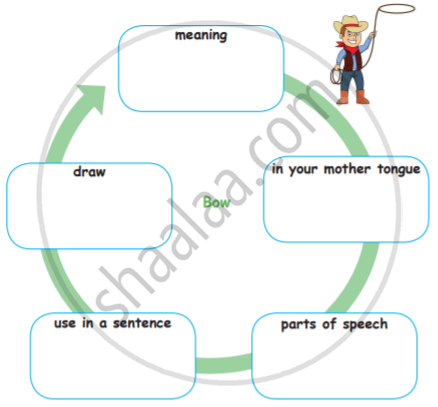
Write the rhyming word.
away
Who guessed the location of the real necklace?
Match the rhyming words.
| pale | knows |
| boat | gale |
| goes | goat |
All the animals called the sparrow ______.
Who is responsible for the society?
Before going to bed that night, Chris gave his new teacher a ______.
What did he call his puppet?
Say Aloud
| dash | bash | splash | cash | trash |
| steer | tear | clear | deer | dear |
| shower | power | tower | flower | mower |
| poked | croaked | soaked | stroked | joked |
| wept | kept | crept | leapt | slept |
Find words from the passage which are antonyms of the following.
- artificially (para 1)
- strength (para 2)
