Advertisements
Advertisements
Question
Think of one of your favourite stories. Fill in the following facts about the story.
- Name of the story:
- Type of story:
- Setting (time and place):
- Important characters:
- Theme/Plot:
- Conflict/Dilemma:
- Solution:
- End:
Advertisements
Solution
- Name of the story: Pride and Prejudice
- Type of story: Romantic/Social
- Setting (time and place): the early 1800s; in England
- Important characters: Elizabeth and Jane Bennet; Mrs. Bennet; Darcy.
- Theme/Plot: The emotional development of the main characters.
- Conflict/Dilemma: Darcy is rich and proud; Elizabeth is strongly prejudiced against him. Their status and lifestyles differ. However, they are attracted to each other.
- Solution: How they overcome their prejudices and come together forms the main story of the novel.
- End: Darcy and Elizabeth < overcome their prejudices and their true emotions come through. The end is a happy one with everything ending well.
RELATED QUESTIONS
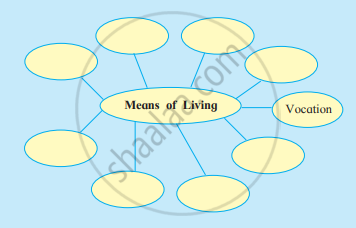
Pick out words that refer to ‘means of living’ and fill them in the Web.
(profession/recreation/occupation/job/ pastime/employment/hobby/career/entertainment/mission/trade/buisness/sports/retirement/placement)
Think and answer in your own words.
What could be the age group of the speaker in the poem?
Using a dictionary/internet note down the main difference between a remote-sensing satellite and a natural satellite.
Can you name different types of fabrics? Which is the most expensive fabric you know? Talk to your parents or to a textile shop assistant. Collect samples of as many types as you can and paste them into your scrapbook. Name each type.
Show the stages in the process in which Krakatoa collapsed and then Anak Krakatoa formed in the course of volcanic eruptions. Use the flowchart given below.
List the phrases which have the expression 'many a ______'.
Read the story and fill in the grid by ticking each character’s qualities.
Discuss in pairs to rate the characteristic and give marks from 1 to 10 depending on the grade of each quality.
Justify your views in one or two sentences.
| Characteristics | Jane Eyre | Mrs. Reed | Bessie | Helen Burns | Miss. Temple |
| arrogant | |||||
| bitter | |||||
| caring | |||||
| courageous | |||||
| cruel | |||||
| emotional | |||||
| friendly | |||||
| kind | |||||
| sensitive | |||||
| rich | |||||
| poor | |||||
| patient | |||||
| self-disciplined | |||||
| unjust |
The turtles use their flippers and make a hollow for their nests.
Narrate the story based on the story map
The king looked for a______.
