Advertisements
Advertisements
Question
What do you understand of Einstein’s nature from his conversations with his history teacher, his mathematics teacher and the head teacher?
Advertisements
Solution
A model answer has been provided for students' reference.
It is strongly recommended that students prepare the answer on their own.
Einstein’s behavior seemed to be extremely unruly. He didn't believe in the then prevailing system of education. His nature was a spontaneous one. He found memorising facts and dates quite useless. Ideas lured him more than facts because of which he had a heated argument on education with his history teacher. He was so restless and indifferent to the importance of attending school that he didn't mind not attending it at all. From his conversation with the Maths teacher, we come to know that he was a student who actually had some interest in mathematics, that being the only class in which he paid a lot of attention and never wasted his time. He wasn't open and outright in front of his Mathematics teacher. His behavior had turned mild before his teacher which showed his level of respect and obediance for elders. Later, when he confronts the headmaster, we find him defensive at the beginning and carefree at the end of the meeting.
RELATED QUESTIONS
Answer the following question in 120-150 words:
What kind of life did Silas lead at Lantern Yard?
Answer any four of the following questions in 30-40 words each :
(a) Why was Franz not scolded for reaching the school late that day?
(b) Sophie was dreaming of so many things in her life. What were they?
(c) Why are the youngsters described as springing? (My Mother at Sixty-six)
(d) In the hot season, how do man and beast get comfort? (A Thing of Beauty)
(e) How did the Maharaja deal with a high ranking British officer who wanted to shoot a tiger?
(f) Having got rid of his stink, what problem did Roger Skunk face?
Read the passage given below :
(ii) he added a lot of grandeur to Mewar.
(iii) of his valour, sacrifice and patriotism.
(iv) both (ii) and (iii)
(b) Difficulties in the way of Mewar were :
(ii) ancient traditions of the kingdom.
(iii) its small area and small population.
(iv) the poverty of the subjects.
(ii) the flag of Mewar was hoisted high.
(iii) the people of Mewar showed gallantry.
(iv) most of the rulers heaved a sigh of relief.
(d) Mewar was lucky because :
(ii) most of its people were competent.
(iii) most of its rulers were competent.
(iv) only a few of its people were incompetent.
Answer the following questions briefly:
(h) How could art and literature flourish in Mewar?
(i) How did the rulers show that they cared for their subjects?
(j) What does the erection of Vijaya Stambha and Kirti Stambha in the same fort signify?
(k) Find words from the passage which mean the same as each of the following:
(ii) evidence (para 4)
Read the following extract and then do all the activities that follow :
I rain into a stranger as he passed by
“Oh, excuse me please” was my reply.
He said, “please excuse me too; wasn't even watching for you.”
We were very polite, this stranger and I.
We went on out way and we said good-bye.
But at home a different story is told.
How we treat out loved ones, young and old.
Later that day, cooking the evening meal,
My daughter stood beside me very still.
When I turned, I nearly knoked her down.
“Move out of the way,” I said with a frown.
She walked away, her little heart broken.
I didn't realize how harshly I'd spoken.
While I lay awake in bed,
God's still small voice came to me and said,
“While Dealing with a stranger, common courtesy you use,
But children you love, you seem to abuse.”
A1. Order-
The incidents narrated in the extract are arranged in a jumbled manner here, Rearrange them in a proper order as they occur in the extract:
(i) The poet and the stranger went on their way saying good-bye.
(ii) Seeking excuse politely from the stranger, she went her way.
(iii) The poet ran into a stranger on the road.
(iv) The poet yelled at her daughter.
A2. Poetic device:
Make a list of rhyming pairs from the second stanza and note down the rhyme scheme of the same stanza.
A3. Personal Response:
Understanding and politeness are the essentials of out everyday life. Explain your views in brief.
A4. Creativity -
Frame two poetic lines on the following situation using a rhyming pattern with the help of clues given:
“While introducing great personalities, we praise them highly and talk about their qualities, but while speaking
about our friends we may not follow the same trend.”
While introducing great personalities, — a
------------------------------------ — a
But while speaking about our friends, — b
------------------------------------ — b
On the basis of your understanding of the above passage, make notes on it using headings and subheadings. Use recognizable abbreviations (wherever necessary – minimum four) and a format you consider suitable. Also supply an appropriate title to it.
Briefly explain the following statement from the text.
“The lack of determinism in quantum theory!”
Is drama a good medium for conveying a social message? Discuss.
Discuss in groups plays or films with a strong message of social reform that you have watched.
How does the insertion of dialogue in the story contribute to its interest?
What was the reason for young Paul's restlessness at the beginning of the story? How did it find expression?
Examine the communication channels in the story between Paul's mother and his uncle.
Identify some of the improbable images the author has used to effect greater humour.
What do you infer from Darwin's comment on his indifference to literature as he advanced in years?
The text is an excerpt from Sesame and Lilies which consists of two essays, primarily, written for delivery as public lectures in 1864. Identify the features that fit the speech mode. Notice the sentence patterns.
Read the story and complete the following.
When Revathi played her favourite raga, the plants began to move because, ____________.
Say why the speaker of the poem wishes to be a -
watchman
Write down any two Slogans on 'Gender Equality'.
Answer in your own words.
What are the provisions in the Declaration of the United Nations, to ensure the equality of men and women?
Pick out a word from the poem to complete the sentence meaningfully.
The Government made a ______ (announcement) about their new taxation policy.
Find at least five other Akbar and Birbal stories and share them with your friends. Make a list of the stories collected by the entire class. Put your list in alphabetical order.
Find at least two things from the poem that show the following:
The atmosphere is pleasant.
Fill in the gap, choosing a word from the bracket to make an appropriate comparison.
(tall / quiet / humble / merry / busy / slippery / fast / sly / slow / big)
as ______ as a snail
Enact the ad by playing the roles of Didi and her relatives. One more child acts as the salesman of ‘Hemagauri’ and presents the text given in white letters in pink bubbles.
Answer the following question in one sentence.
What would he do if he had the power to do it?
List the characters in the play and write one or two lines about each.
An activity:
Speak fast, think faster! Form groups of 4-6. Discuss each of the following topics. Then each person in the group should choose a topic and speak about it for one minute. Try to say as many sentences as you can in that time
What is not likely to happen or will never happen...
‘It won’t rain in the classroom... I won’t ever see a live dinosaur... The sun will never set in the east...’ etc.
Write a short note on the following:
The message in the vision.
Write any three of the silly remarks made by the characters other than Alice. Write why you think the remark is silly.
Find three lines, that contain images of nature in the autumn season.
During daytime
- _______________________
- _______________________
- _______________________
List the names of body parts used in the passage.
Choose the appropriate phrase to insert in the gap, to make the sentence meaningful. Use the appropriate form of the verb.
I ______ just as I was to receive my Report Card.
Make as many 5 to 8 letter words as you can within 5 minutes, from the name.
| TESHUMAI TEWINDROW | |||
| Five-letter words | Six-letter words | Seven-letter words | Eight-letter words |
Who said the following, to whom, and when?
"Ah no, to thee I sing: he sings to God.”
Describe the following in one or two lines.
The first little house of the bird.
Form groups. Discuss how one can be a 'good reader'. Use the points in the above passage in your discussion. Write down the points that show what makes a 'good reader'.
Find two examples of the following from the lesson.
A Statement
What methods did Anshuman's parents use to warn Anshuman about his bad habits?
What did Ahmad tell Kasim when he dug a channel and began to draw water?
Guess the meaning of the following word.
pleasing
Answer the question in a paragraph of about 100 – 150 word.
Narrate how Prospero made his enemies repent to restore his dukedom.
Read the incident again and answer the following question.
Why were the other passengers in the flight gazing at the writer?
Pick out the other examples for alliteration from the poem.
Read the data below and answer the following question.
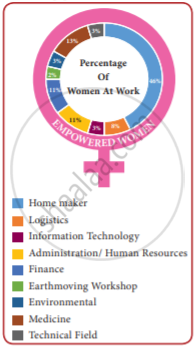
Choose the correct answer.
Percentage of women working in finance is the same as ______.
Hamid’s heart sank because the price of the tongs was______for him.
Which of these statements do you find in the speech?
- Inclusion is essential for us to do well in life.
- We should neglect others.
- Communicate politely with the less privileged.
- Teachers teach us to communicate well.
- Effective Communication is inessential to excel in life.
He exercised with Louise every day.
Read these lines and answer the questions given below.
With lutes in our hands ever-singing we roam,
All men are our kindred, the world is our home.
- Who does ‘we’ refer to? What do they have in their hands? What is its name?
- How are the men in the world related to the singers?
The terrorists asked Neerja to collect the passports of the passengers because ______.
The boar slept until the fading sun told him it was time to get up. What does the phrase until the fading sun mean?
Amuthan locked the door behind him.
Flag day is observed on the _________.
________ was a young talented doctor.
What kind of a boy was Vicky?
Choose what the elephant did.
Read the passage three times and colour a spacesuit for each time.
A spacesuit is like a spaceship built for one. A spacesuit lets us work and live in space. It protects us from the heat and the cold. It gives us air to breathe. The suit is made of many parts and has water to drink. It even has a built-in toilet, if you need to use it.

Guess how would the sparrow pull the elephant and the crocodile.
Find and write the clues.
Clue for lost teeth ______.
Moles dig ______ to catch earth worms.
How did he challenge everybody?
What did he make out of it?
