Advertisements
Advertisements
प्रश्न
What do you understand of Einstein’s nature from his conversations with his history teacher, his mathematics teacher and the head teacher?
Advertisements
उत्तर
A model answer has been provided for students' reference.
It is strongly recommended that students prepare the answer on their own.
Einstein’s behavior seemed to be extremely unruly. He didn't believe in the then prevailing system of education. His nature was a spontaneous one. He found memorising facts and dates quite useless. Ideas lured him more than facts because of which he had a heated argument on education with his history teacher. He was so restless and indifferent to the importance of attending school that he didn't mind not attending it at all. From his conversation with the Maths teacher, we come to know that he was a student who actually had some interest in mathematics, that being the only class in which he paid a lot of attention and never wasted his time. He wasn't open and outright in front of his Mathematics teacher. His behavior had turned mild before his teacher which showed his level of respect and obediance for elders. Later, when he confronts the headmaster, we find him defensive at the beginning and carefree at the end of the meeting.
संबंधित प्रश्न
Answer any four of the following questions in 30-40 words each :
(a) Why was Franz not scolded for reaching the school late that day?
(b) Sophie was dreaming of so many things in her life. What were they?
(c) Why are the youngsters described as springing? (My Mother at Sixty-six)
(d) In the hot season, how do man and beast get comfort? (A Thing of Beauty)
(e) How did the Maharaja deal with a high ranking British officer who wanted to shoot a tiger?
(f) Having got rid of his stink, what problem did Roger Skunk face?
Does the poem have a consistent rhyme scheme?
The three stanzas depict three different phases. What are they?
Briefly explain the following statement from the text.
“You need some interaction to cause a transition.”
What were the attempts made by the author to get his watch repaired?
'New Literature' is a misnomer for the wealth of the Indian Literary tradition. How does G. N. Devy explain this?
What were the concepts that Kumudini Lakhia represent through Duvidha, Atah Kim and panch Paras?
'Whose roots lay deeper than our lives' – what aspect of human behaviour does this line reflect?
Answer in your own words.
What did Revathi discover about her balsam plants?
Make a list of the preparations made for an assault on Tiger Hill.
Bofors guns _____________.
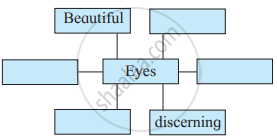
Complete the web with the help of adjectives used to describe eyes and nose in all respects. Two are done for you.

Expand the idea inherent in the following proverb :
Fools rush in where angels fear to tread - Alexander Pope.
Answer the following question in short.
What did the bundle in silken cloth contain?
Complete the following web diagram.

Suggest what you would do in the following situation:
One particular friend of yours is always late for college, social functions, movies, etc. and delays everyone.
Read the following conversation and complete the activities given below:
| Minnie: | Exams are over. I feel so relaxed! Let us plan something interesting. |
| Ritu: | How about a movie? |
| Paddy: | Great! Let’s go for “Aladdin”! |
| Minnie: | Oh, no! I have seen it. It has only a ‘one star’ rating. |
| Ritu: | How about that new release ummm... yes, “Harry Potter? |
| Della: | It is boring. I have read the review this morning. I don’t want to waste my time. |
| Paddy: | Wait, friends. I will check. Let’s decide later. |
(i) Choose the correct alternative from the following-
From one star given to the movie we conclude that-
- The movie is very short.
- The movie is not worth watching.
- The movie is serious.
- The movie is in black and white.
(ii) Discuss with your teacher how/why are ‘stars’ given to a movie.
(iii) The word ‘Review’ is different from summarizing and appeal writing. Choose the correct statements of the following.
- A film review is an expression of your personal views towards a particular film, documentary or movie.
- A film review gives you an opportunity to express opinions about the movie, including its characters, plot and background.
- A film review gives appealing sentences that make your reader curious or anxious about the film.
- A review means explanation of each and every event of the film.
Read the passage and answer the following question:
Who designed the PVC medal?
There were some reasons why Theseus was initially against but later gave consent for the marriage of Helena with Lysander. Explain.
Describe in your own words the incident when Hovstad's real intention to help Dr. Stockmann is exposed.
Discuss the following question after you have seen a presentation of the ‘ad’.
Think of the people you like. Do you like them because they have a fair (white) skin or because of some other qualities? List those qualities.
Visit a library:
Read Lewis Carroll’s book ‘Alice in Wonderland.’
Try to write interesting time tables for imaginary people or creatures.
What do the following events/actions tell us about the characters? Discuss.
Sir Ector kneeled before Arthur.
Answer the following question and write in short, why the parody sounds funny.
Why does the bee work hour after hour?
There are many popular lines like:-
- ‘Life is a game - play it well’.
- ‘Life is a journey - keep going ahead’.
Discuss and write down a few such metaphorical lines about ‘life’. You can make them up yourselves.
- ____________________________
- ____________________________
- ____________________________
- ____________________________
- ____________________________
Say whether you agree or disagree.
The bachelor had narrated an improper story to the children.
Describe Gulliver’s home in Lilliput.
Tell any one of the stories orally imagining you are Gulliver.
List the characters in the story and write a few lines about each of them.
Identify the character or speaker.
I will tie you neck and feet together.
In New York, Mr. Scotti left the plane because he thought he.
Rearrange the jumbled sentences and write them in the correct order.
- But Hamid bought a pair of tongs.
- Granny Ameena felt proud of her grandson.
- Hamid’s friends bought different toys of their choice.
- Hamid proudly compared his tongs with a brave tiger.
- Hamid had less money than his friends.
- Granny Ameena was worried as he had to go to the Eidgah alone.
Role play
Put students in pairs to role-play a conversation between:
- Alice and her sister.
- Alice and White Rabbit.
ashen – pale
His face was ashen.
Who is Raj?
Mithali’s mother tongue is Telugu.
Fill in the blanks to complete the summary.
Ever since their introduction, ______, and their unique rhythms have ______ poets. In this poem the poet shares his experience ______ with us. He presents natural scenes seen from ______ a railway carriage. The ______ is regular and steady but ______ from the window of the train is constantly changing. The poem’s rhythm and phrases bring ______ of a railway journey. The poet looks out of the window at the ______ images outside. Every line we see here is a quick account of something seen for ______. The line that best sums up is the final one: "Each a glimpse and gone forever!"
The girl was badly hurt.
Try your own.
How can we make our nation proud?
Why did the old man disguise himself as a beggar?
The hut was very ______.
Look at the picture and Choose the correct word.

Choose the correct option from the given homophones.
You should never ______ to your parents.
Choose what the elephant did.
What made him frightened?
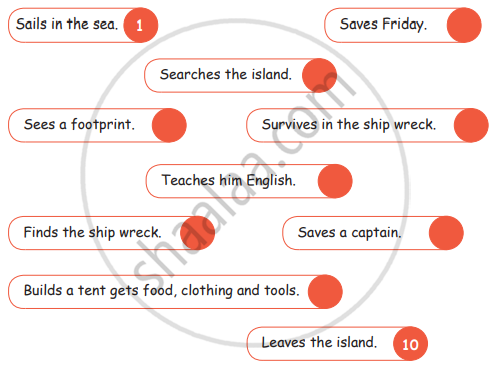
Arrange the actions of Robinson by numbering from 1 to 10.
List out the questions to which you seek answer using 'Why?'
______was with Robinson.
Guess how would the sparrow pull the elephant and the crocodile.
Rani thought of herself as a _______ engineer.
Write the rhyming word.
larder- ______.
Secondly the greedy merchant is ready to offer______.
Let us learn a few more word by joining the dots. Join the dots and fill the table below.
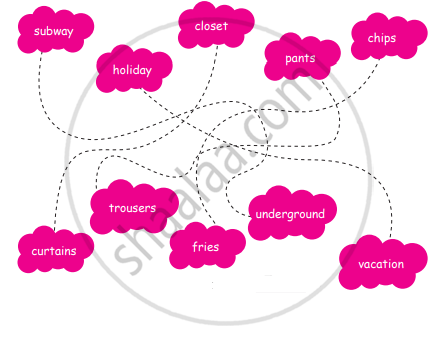
| subway | |
| holiday | |
| closet | |
| pants | |
| chips |
Mugund learnt the art from his ______.
Match the following rhyming words.
| 1. | earn | glow |
| 2. | fend | day |
| 3. | slow | learn |
| 4. | play | end |
Keep moving though your progress is ______.
Who wins the world at the end?
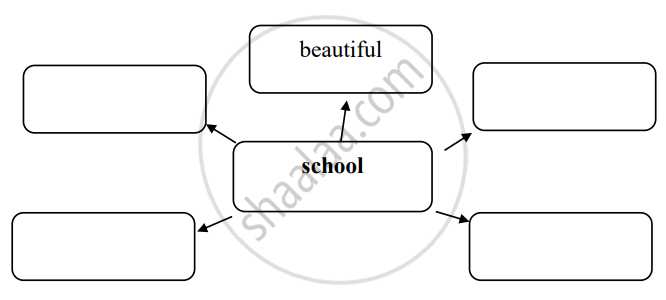
Write the related words as shown in the example:
Read the passage carefully and complete the activities:
A1. Complete the following sentences. [2]
- Female sparrows lay ______.
- Sparrows build their nest out of ______.
- The eggs are ______.
- In cities, sparrows build their nest in ______.
|
A sparrow is a small bird which is found throughout the world. There are many different species of sparrows. Sparrows are only about four to six inches in length. Many people appreciate their beautiful songs. Sparrows prefer to build their nests in low places-usually on the ground clumps of grass low trees and low bushes. In cities, they build their nests in building nooks or holes. They rarely build their nests in high places. They build their nests out of twigs grasses and plant fibers. Their nests are usually small and well-built structures. Female sparrows lay four to six eggs at a time. The eggs are white with reddish-brown spots. They hatch within eleven to fourteen days. Both the male and female parents care for the young. Insects are fed to the young after hatching. The large feet of the sparrows are used for scratching seeds. Adult sparrows mainly eat seeds. Sparrows can be found almost everywhere where there are humans. Many people throughout the world enjoy these delightful birds. The sparrows are some of the few birds that engage in dust bathing. Sparrows will first scratch a hole in the ground with their feet then lie in it and fling dirt or sand over their bodies with flicks of their wings. They will also bathe in water or in dry or melting snow. Water bathing is similar to dust bathing with the sparrow standing in shallow water and flicking water over its back with its wings also ducking its head under the water. Both activities are social with up to a hundred birds participating at once and are followed by preening and sometimes group singing. |
A2. How do sparrows take a bath? [2]
A3. Find out adjectives for the following nouns from the passage. [2]
- ______ Song
- ______ Water
- ______ Bird
- ______ species
A4. Do as directed. [2]
- A sparrow is a small bird which is found throughout the world.
(Underline the subordinate clause) - Female sparrows lay four to six eggs at a time.
(Frame a ‘wh’ type question to get the underlined part as an answer.)
A5. ‘We have to save the birds.’ Do you agree with this statement? Why? [2]
