Advertisements
Advertisements
प्रश्न
Tick the statement that is true.
The places mentioned in the story are all imaginary.
पर्याय
True
False
Advertisements
उत्तर
The places mentioned in the story are all imaginary. (False)
APPEARS IN
संबंधित प्रश्न
Read the passage given below and answer the questions that follow:
1. Air pollution is an issue which concerns us all alike. One can willingly choose or reject a food, a drink or a life comfort, but unfortunately there is little choice for the air we breathe. All, what is there in the air is inhaled by one and all living in those surroundings.
2. Air pollutant is defined as a substance which is present while normally it is not there or present in an amount exceeding the normal concentrations. It could either be gaseous or a particulate matter. The important and harmful polluting gases are carbon monoxide, carbon dioxide, ozone and oxides of sulphur and nitrogen. The common particulate pollutants are the dusts of various inorganic or organic origins. Although we often talk of the outdoor air pollutions caused by industrial and vehicular exhausts, the indoor pollution may prove to be as or a more important cause of health problems.
3. Recognition of air pollution is relatively recent. It is not uncommon to experience a feeling of 'suffocation' in a closed environment. It is often ascribed to the lack of oxygen. Fortunately, however, the composition of air is remarkably constant all over the world. There is about 79 per cent nitrogen and 21 per cent oxygen in the air − the other gases forming a very small fraction. It is true that carbon dioxide exhaled out of lungs may accumulate in a closed and over-crowded place. But such an increase is usually small and temporary unless the room is really air-tight. Exposure to poisonous gases such as carbon monoxide may occur in a closed room, heated by burning coal inside. This may also prove to be fatal.
4. What is more common in a poorly ventilated home is a vague constellation of symptoms described as the sick-building syndrome. It is characterized by a general feeling of malaise, head-ache, dizziness and irritation of mucous membranes. It may also be accompanied by nausea, itching, aches, pains and depression. Sick building syndrome is getting commoner in big cities with the small houses, which are generally over-furnished. Some of the important pollutants whose indoor concentrations exceed those of the outdoors include gases such as carbon monoxide, carbon dioxide, oxides of nitrogen and organic substances like spores, formaldehydes, hydrocarbon aerosols and allergens. The sources are attributed to a variety of construction materials, insulations, furnishings, adhesives, cosmetics, house dusts, fungi and other indoor products.
5. By-products of fuel combustion are important in houses with indoor kitchens. It is not only the brining of dried dung and fuelwood which is responsible, but also kerosene and liquid petroleum gas. Oxides of both nitrogen and sulphur are released from their combustion.
6. Smoking of tobacco in the closed environment is an important source of indoor pollution. It may not be high quantitatively, but significantly hazardous for health. It is because of the fact that there are over 3000 chemical constituents in tobacco smoke, which have been identified. These are harmful for human health.
7. Micro-organisms and allergens are of special significance in the causation and spread of diseases. Most of the infective illnesses may involve more persons of a family living in common indoor environment. These include viral and bacterial diseases like tuberculosis.
8. Besides infections, allergic and hypersensitivity disorders are spreading fast. Although asthma is the most common form of respiratory allergic disorders, pneumonias are not uncommon, but more persistent and serious. These are attributed to exposures to allergens from various fungi, molds, hay and other organic materials. Indoor air ventilation systems, coolers, air-conditioners, dampness, decay, pet animals, production or handling of the causative items are responsible for these hypersensitivity − diseases.
9. Obviously, the spectrum of pollution is very wide and our options are limited. Indoor pollution may be handled relatively easily by an individual. Moreover, the good work must start from one’s own house
(Extracted from the Tribune)
(a) (i) What is an air pollutant? (1)
(ii) In what forms are the air pollutants present? (2)
(iii) Why do we feel suffocated in a closed environment? (1)
(iv) What is sick building syndrome? How is it increasing? (2)
(v) How is indoor smoking very hazardous? (1)
(vi) How can one overcome the dangers of indoor air pollution? (2)
(b) Find the words from the above passage which mean the same as the following: (3)
(i) giddiness (para 4)
(ii) constant (para 8)
(iii) humidity (para 8)
Answer any four of the following in 30−40 words each:
(a) What did garbage mean to the children of Seemapuri and to their parents?
(b) How did Rajkumar Shukla establish that he was resolute?
(c) 'Life is what it is all about;...' How is keeping quiet related to life?
(d) Mention any four things of beauty that add joy to our life.
(e) The manner of his (the Tiger King's) death is a matter of extraordinary interest. Comment.
(f) In what condition did Dr. Sadao find the American soldier at the seashore?
Griffin failed not only as a son and a scientist, but also as a human being. Comment. (The Invisible Man)
|
The energy stored in coal and petroleum originally came to the earth from the sun. The bulk of the present-day supplies was laid down some 200 to 600 million years ago, when tropical conditions were widespread. Lush, swampy forests produced huge trees; warm coastal seas swarmed with microscopic forms of life. When these organisms died, much of their tissue was recycled as it is today — through scavenging and decay. But a significant amount of dead plant and animal material was covered with mud, which prevented complete decomposition. With the passage of time, layer upon layer of the fine sediment was deposited over the once-living material; the sheer weight turned the sediments to rock. Sandwiched between the layers, both coal and petroleum were produced and preserved under pressure. Coal was formed mostly of giant fern-like plants that have only small counterparts today. Coal may still be forming here and there on earth, but conditions are not right for the production of significant quantities. |
Number the points.
In which language do you think Gangadharpant and Khan Sahib talked to each other? Which language did Gangadharpant use to talk to the English receptionist?
'Have you come back?' said the woman.'I thought that no one had come back.'
Does this statement give some clue about the story? If yes, what is it?
Comment on the influence of English – the language and the way of life – on Indian life as reflected in the story. What is the narrator's attitude to English?
Astrologers' perceptions are based more on hearsay and conjecture than what they learn from the study of the stars. Comment with reference to the story.
Tick the item that is closest in meaning to the following phrase.
to be wound up
How does the poet juxtapose the human condition with the behaviour of the political class?
Read the extract 'Being Neighborly' and complete the following statement:
To Jo, the fine house seemed like ______.
Answer in your own words.
What are the provisions in the Declaration of the United Nations, to ensure the equality of men and women?
Answer the following question in short.
On what condition did Tenali Raman agree to take up the challenge?
Read the passage and answer the following question:
Who designed the PVC medal?
Give reasons :
Oberon and Titania fight for the custody of the Indian boy because - Oberon wants __________________.
List the various people and places mentioned in the passage. The places Milo visits and the people he meets have unusual names. Write the meanings of those names.
Try to write interesting time tables for imaginary people or creatures.
Using your imagination, write more sentences in the same pattern:
- But the more the lion had, the more he wanted.
- Whenever he took a walk, they followed him.
- To be king is good. But to be kind is better.
Read the passage and name the following.
He was killed by a poisoned arrow that entered his heel.
Gather more information about the following from your Science textbook, the internet, and other sources.
Gravitational force
Answer the following question and write in short, why the parody sounds funny.
What does the crocodile stand for?
Choose the appropriate phrase to insert in the gap, to make the sentence meaningful. Use the appropriate form of the verb.
Before we do the experiment in the Laboratory, let me ______ you all about it.
Mention the various places that the brook flows past.
Say whether you agree or disagree.
The bachelor had narrated an improper story to the children.
Find out when and where we get strawberries in Maharashtra.
An announcement can be made in every class, orally. Or, it can be put up on the school notice-board. Discuss and decide what method should be used for the announcement given here.
Oral aanouncement
Read the following incident carefully to answer the question that follow.
The tie that does not bind
“Oh, so you’re going abroad? Can you bring me back…..?” I’ve been asked to bring back a vaccine for a course. Once I searched the suburbs of Paris for two days for a special brand of ceramic paint. Having spent a lot of money for Cartier lighter refills, I had them confiscated at the airport just before boarding because the gas might be dangerous in the air.
Now, two months before a trip, I stop talking to people so they won’t suspect I’m about to travel. But someone always catches me.” I’ve heard you’re going to New York, and I want you to get something for me. It’s just a little thing you can find anywhere. I don’t know exactly how much it costs, but it shouldn’t be much. We’ll settle up when you get back”.
What Gilson asked me to buy was, in fact, a little thing: a tie. But not just any tie. He wanted a tie with a small embroidered G. Any colour would do, as long as it had his initials. Look, this is a special flight, I explained. We are only staying Saturday through Tuesday. On the day we arrived I didn’t have time to think about the tie, but strolling around on Sunday I did see ties bearing various letters in more than one shop window. They were cheap, just a dollar, but all the shops were closed.
On Monday, lunch lasted the whole afternoon. Then it was Tuesday morning, time to leave. It was only when I saw our airport bus waiting outside the hotel that I remembered the tie.
I told the group to go on. I would get a taxi to the airport. And so I went in search of a nearby shop where I had seen ties.
But I couldn’t find it. I walked further down the street-one, two, three blocks - all in vain. Back at the hotel, a bit anxious now, I took my suitcase, got a taxi and asked the driver to rush to the street where I had seen them.
The driver stopped at each shop we passed so I could look from the window. The stores had all sorts of ties, but not the kind I was looking for.
When I finally thought I had located the right shop, I decided to go in and check. The driver refused to wait. Parking was prohibited, he said. I promised to double the fare, jumped out and ran into the shop. Was I going to miss the plane just for a damned tie?
The salesman was unbearably slow. When I realized that the smallest change I had was a ten dollar note , I grabbed ten ties of different colours so I wouldn’t have to wait for change. I rushed out with the ties in a paper bag.
On the street I looked around. The taxi had vanished, taking my suitcase. What is more, I was going to miss the plane.
I ran to the corner, and hope flared up again: the taxi was waiting in the next street. Quick to the airport! As I settled down inside the taxi. I sighed with relief. Gilson was going to have enough initialized ties to last him a lifetime.
When I reached the airport, I paid the taxi driver the double fare and grabbed my suitcase. Panting, I boarded the plane under the reproachful gaze of the other passengers, all primly seated with their seat belts fastened. Ready to take off. Departure had been delayed because of me.
“At least I hope you found your tie”, said one who knew the story.
“I did”, I answered triumphantly.
After making myself comfortable, I reached for the paper bag to show the ties.
I had left it behind; in the taxi.
Fernando Sabino.
Read the incident again and answer the following question.
What was the writer always asked to do whenever he planned to go abroad?
Mention at least two expressions which shows that Mrs. Krishnan was not willing to have Zigzag at home?
Which gift did Anne value the most?
How did the children react when they met each other at the ruins?
What do you need to learn to live a good life in this world?
When are we in a state of trance?
Read the line and answer the question.
And quiet sleep and a sweet dream when the long trick’s over
What does the poet want to do after his voyage is over?
If you are a flight attendant how will you deal with the hijackers?
Sea turtles come to rest on land.
Geetha madam couldn’t stop the children running out of the train because they ______.
Read the lines and answer the questions given below.
Summer comes
in a blaze of heat with
sunny smiles
and dusty feet
- Does the poet welcome the summer? How do you know?
- Which line tells you that there is no rain in summer?
The boy and the girl were taken by the cavalry to explain their action.
They went out through the broken windows.
How did Santhosh know that the river was clean?
It ploughs soil before _________.
Find the rhyming word from the poem.
Language - ______.
Take out the correct rhyming pair from the poem and match with the given word.
| 1. | tall | |
| 2. | light | |
| 3. | might |
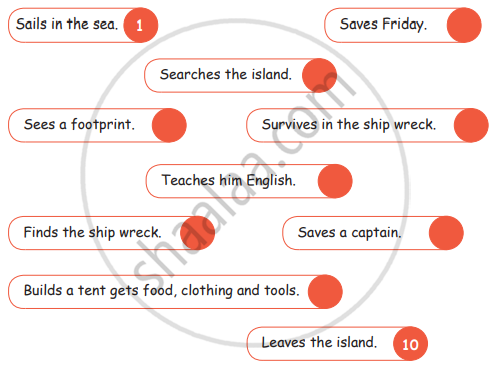
Arrange the actions of Robinson by numbering from 1 to 10.
Circle the animals which are in the voyage.

The message was to gather on ______.
Choose the correct answer.
Meena's village was hit by waves on a______.
The official and his wife liked______.
What were the people excited about?
______always stays to the last in our needs.
Who brought us to this world?
What do you save? Why it is needed?
Savings is done after fulfilling the______.
Ani valued honesty.
What did Ani's parents teach her?
Write the word with same meaning.

eraser- ______.
What was his dream ?
Before going to bed that night, Chris gave his new teacher a ______.
Why is it not advisable to play online games?
