Advertisements
Advertisements
प्रश्न
Tick the statement that is true.
Rajendra Desphande was a historical event.
पर्याय
True
False
Advertisements
उत्तर
Rajendra Deshpande was a historian. (True)
APPEARS IN
संबंधित प्रश्न
How did a story book, 'Little Lord Fauntleroy' open a window of knowledge to Helen and help to shape her career?
What causes the element of surprise when the child comes on the scene of 'adult reconciling'?
Find from the poem, positive qualities to fill up the web.
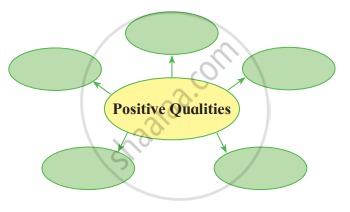
Find from the story one word for the following.
a very narrow passage between buildings ______
Answer in your own words.
What message does the poem convey to all of us?
Trees are revered because:
- They give us joy.
- _________________
- _________________
- _________________
- _________________
Say where . . . . . . .
______ does Beauty’s smile begin?
Answer the following question in short.
On what condition did Tenali Raman agree to take up the challenge?
Apart from the children, no other human beings are mentioned in the poem. However, many natural elements are shown to act like persons. Name them and also write what they do.
Complete the following web diagram.

From the internet or other sources, find the other names by which Kabaddi is known in different parts of our country and the world.
Read the passage and answer the following question:
What makes Indra’s vajra or weapon invincible?
What do fairy-tale witches do?
Do you know any poem or song about the moon in your own language? Sing it in the class.
Discuss and write 1-2 lines about the following,
Yonamine’s ideas about marriage.
Discuss and write 1-2 lines about the following,
Why Bushi told Yonamine not to travel at night.
Answer the following question in one sentence.
What should human beings do in order to make progress?
The wheel, which was probably invented more than 6000 years ago, is thought of as one of the greatest technological advances made by man. Why do you think the wheel is so important in human civilization?
Read about the novel ‘Robinson Crusoe’ by Daniel Defoe and ‘Gulliver’s Travels’ by Jonathan Swift.
Portia saved Antonio in the court of law.
Read the following sentence aloud. Write who said it and to whom.
“What! ... how ! ... That’s impossible! ”
Answer the following question and write in short, why the parody sounds funny.
What does the bee stand for?
Fill in the table.
| Period | Way of Addressing a Mother | Boy’s Costume | Lady’s Costume | Daily Chores | Games |
| The 1950s | silk saree | ||||
| 1910 | Kurta pajama and cap | ||||
| The 1800s | |||||
| The 1500s | |||||
| 1000 | |||||
| 100 AD | feed poultry tend sheep keep away birds plaster the yard | ||||
| 3000 BC | Chaupar |
Answer in your own words.
What task did Grandpa wish to avoid?
Observe the picture and the labels carefully. Then match the words and the meanings given in the following table.
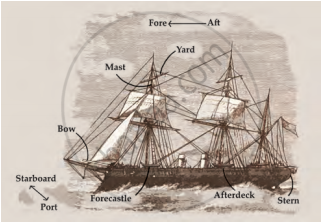
| Words | Meaning |
| 1. yard | (a) a floor, flat area built on a ship |
| 2. mast | (b) the forward part of the main body of a ship |
| 3. bow | (c) the forward part of a deck |
| 4. deck | (d) tall, upright pole on a ship |
| 5. forecastle | (e) a pole slung across a ship’s mast. A sail hangs from a yard. |
| 6. starboard | (f) the rearmost (back) part of a ship |
| 7. stern | (g) the part which is always at the front while the ship is sailing. |
| 8. afterdeck | (h) the right-hand side of a ship as one faces forward |
| 9. fore | (i) an open deck near the back |
Read the lines of the following poem. Guess and fill in suitable words to make the lines rhyme -
Golden Glow
Soon after dawn, rises the _________________.
It wakes and enlivens every _________________.
It scares away the long, dark _________________.
The shining stars go out of _________________.
From tree to tree birds flit and, _________________.
Searching for food, with a sharp _________________.
The buds that open now show their, _________________
As flowers, they dance with beauty and _________________.
The hill slope wears a grassy green,_________________
The curved sparkling river, it's gold _________________.
The cock then crows to give a loud, _________________
Come on! wake up, folks! One and _________________.
I, then wake up, ‘Good Morning’ to,_________________
Let’s all look forward to a golden _________________.
Complete the following diagram.

List the various ways of avoiding the errors mentioned in the passage.
What did Gopal Bhand want to tell the husband and wife?
List 5 of the sounds that you like.
Name the following.
Hosts of the 1936 Olympic Games.
Read the poem aloud using proper intonation.
List all the pairs of antonyms you find in the passage.
Do you think that the young seagull’s parents were harsh to him? Why?
Read the following line from the poem and answer the question that follow.
In the dim past, nor holding back in fear From what the future veils; but with a whole And happy heart, that pays its toll To Youth and Age, and travels on with cheer.
- What does the poet mean by the phrase ‘in the dim past’?
- Is the poet afraid of future?
- How can one travel on with cheer?
And whether their station be high or humble,…
Pick out the alliteration from the above line.
How were offerings carried during the ancient period?
Read the comic strip and answer the following question.
Which website do you often access? Why?
Imagine you are a marketing executive for a company in a specific industry (toothpaste, soup, hair care products, automobiles, etc) and are developing a product with a brand name that refers to a character from the story.
For example: You want to sell bandages that have little pictures of Don Quixote on them. Your company’s name is Kure-All and you decide to call them “Kure-All Quixote Bandages”.
The slogan might be: “Had a tough day with windmills? When you take a fall, use Kure-All.”
You can use exciting words, a catchy new slogan and a jingle among other things to promote sales of your item.
Give an example for dazzling light.
Read the incidents. Work in small groups to role play the situations in which they showed their presence of mind. Each group should perform the skit for the rest of the class. Share similar situations in the class.
When the author returned from England to Dehradun, he found Grandfather's dream had come true because the______.
Why did Santhosh forget to watch television or play video games?
How was the rich man's house?
Who will be the fortunate?
How were her strokes?
Number the pictures in the correct order of the story.

Why was the teacher annoyed?
Read the advertisement and answer the question given below.

What is the advertisement about?
Why did Kani run to the kitchen?
Where do the moles save their food?
What should we vow for?
Kamali gave her savings to______.
Read the passage three times on your own. Colour a Piggy bank each time you read.
Piggy bank is a coin box used by children. The real use of a piggy bank is to store coins. Piggy banks look like pigs. They come in many shapes and sizes. In Tamil, they are known as Hundial. It is a red, mud pot. We can drop the coins into the pot. Once the pot is full, we must break the pot and use the coins. Start saving with your hundial today!
Moles dig ______ to catch earth worms.
How long did the competition take to reach the final?
What is the main idea of the story?
Which creatures wake up in the morning before the child does?
The rabbit had
Write compound word using the pictures.
 |
+ |  |
| ____________ | ||
