Advertisements
Advertisements
प्रश्न
Tick the statement that is true.
Rajendra Desphande was a historical event.
विकल्प
True
False
Advertisements
उत्तर
Rajendra Deshpande was a historian. (True)
APPEARS IN
संबंधित प्रश्न
Answer the following question in 120-150 words :
Nancy Lammeter is a typical country girl. Comment.
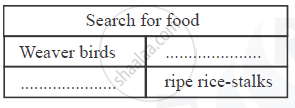
Complete the following table :
Read the following passage carefully and complete the activities given below :
A.1) Complete the web :
Write the words from the passage on the web. 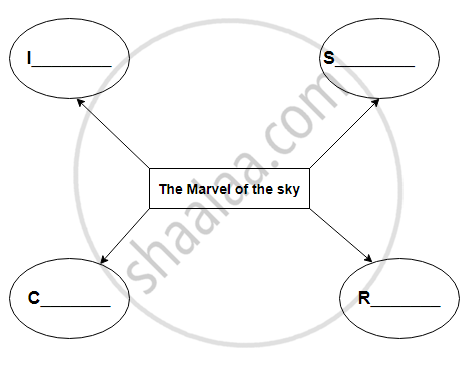
We saw small bits of grass peeping through the small cracks in concrete pavement. It left us thinking: however impossible things may look, there is always an opening…………
We saw a tree bare of all leaves in the cold winter months. We thought its chapter was over. But three months passed, spring set in and the tree was back to its green majesty once again, full of leaves, flowers, birds, and life. What if we too had the conviction that, however difficult things are right now, it will not remain so forever. Remember, this too shall pass.
We saw an army of ants lugging a fly which was at least ten times the ant’s size. The ants organized themselves around the fly, lifted it on frail feelers and carried it to quite a distance. Their teamwork and perseverance were impressive. What if we too are consistent, organized, focused ……… Spider webs are delicate, yet very strong. A rainbow colors the entire sky. Oysters take in a grain of sand they open up with a pearl. Innumerable stars shine across the infinite sky. Clouds take new shapes with every passing moment. The wind makes trees dance with unhindered passion. Water, without a hint of ego, changes its form according to the dictates of the sun and the wind. When we see a caterpillar turn into a butterfly, a flower turns into a fruit, we experience the alchemy of nature ………. We touch it and become gold ourselves.
A.2) Finding meanings :
Write what you mean by :
(i) _______ there is always an opening.
(ii) _______ its chapter was over.
(iii) _______ the tree was back to its green majesty.
(iv) _______ this too shall pass.
A.3) Matching :
Match the words in Column ‘A’ with their synonyms in Column ‘B’:
| Column 'A' | Column'B" | ||
| (i) | conviction | (a) | strong feeling |
| (ii) | alchemy | (b) | delicate |
| (iii) | frail | (c) | mysterious/magical power |
| (iv) | passion | (d) | strong belief |
A.4) Language study :
Rewrite the sentence using the correct question tag given in the brackets :
(i) Water changes its form. (does it?, do it?, do they?, doesn’t it)
(ii) However impossible things may look, there is always an opening. (Rewrite using ‘but’)
A.5) Personal Response :
Nature is the best teacher. Explain.
Read the following passage carefully and do the given activities:
A.1) True or False:
Write the statements and state whether they are true or false:
(i) Those who choose to live well must help others.
(ii) If neighbors grow inferior corn, cross-pollination will steadily improve the quality.
(iii) The farmer grew award-winning corn.
(iv) The reporter discovered that the farmer didn’t share his seed corn with his neighbors.
There once was a farmer who grew award-winning corn. Each year he entered his corn in the state fair where it won a blue ribbon. One year a newspaper reporter interviewed him and learned something interesting about how he grew it. The reporter discovered that the farmer shared his sweet corn with his neighbors. “How can you afford to share your best seed corn with your neighbors when they are entering corn in competition with yours each year?” the reporter asked.
“Why sir”, said the farmer, “didn’t you know? The wind picks up pollen from the ripening corn and swirls it from field to field. If my neighbors grow inferior corn, cross-pollination will steadily degrade the quality of my corn. If I am to grow good corn, I must help my neighbors grow good corn.” He is very much aware of the connectedness of life. His corn cannot improve unless his neighbor's corn also improves. So it is with our lives. Those who choose to live in peace must help their neighbors to live in peace. Those who choose to live well must help others to live well, for the value of a life is measured by the lives it touches.
The lesson for each of us is this: if we are to grow good corn, we must help our neighbors grow good corn.
A.2) Consequences:
Write the consequences:
(i) The farmer shares the corn.
(ii) The farmer doesn’t share the corn.
A.3) Antonyms:
Find out the words opposite in meaning from the passage:
(i) superior x _______
(ii) lost x _______
(iii) improve x _______
(iv) inconstantly x _______
A.4) Language study:
(i) We must help our neighbors. (Replace the modal auxiliary showing advice).
(ii) The wind picks up pollen from ripening corn and swirls it field to field. (Use “not only…….. but also” and rewrite)
A.5) Personal Response:
What do you learn from the story? Suggest a suitable title.
Answer the following in 200-250 words :
Describe the relationship between Anne and Margot?
Answer the following question in 200-250 words:
How did Kitty help Anne overcome her loneliness?
Mention the three phases of the author’s relationship with his grandmother before he left the country to study abroad.
Notice these expression in the text. Infer their meaning from the context.
ducking back
Notice these expression in the text. Infer their meaning from the context.
manoeuvres
There is mention of three communities in the story: the Marathas, the Mughals, the Anglo-Indians. Which language do you think they used within their communities and while speaking to the other groups?
Discuss the following in pairs
Empathy and understanding are going out of modern society. The individual experiences intense alienation from the society around him or her.
Examine the communication channels in the story between Paul and his mother.
While tribal communities may not seem to possess the scientific temper,there are many ideas from tribal conventions that could enrich modern societies.
Comment on the lines that make you visualise the colourful image of the peacock.
How does 'A Kondh Song' substantiate the tribal urge to gain domination over time by conversing with their dead ancestors?
Identify the lines that reveal the critical tone of the poet towards the felling of the tree.
“I can see clear bridges between my life experiences and my work in dance.” How does Kumudini Lakhia weave episodes from the two realms in her account?
Think, choose and fill up the labels with what a ‘sunrise’ symbolizes.
(jewellery/art/hope/birth/anger/new opportunities/good manners/inspiration/new achievements/happiness/misery/bright moments/new aims/money/new surprises)

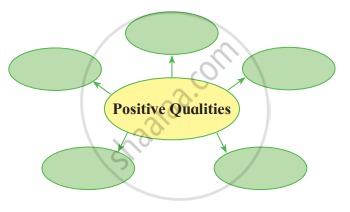
Find from the poem, positive qualities to fill up the web.
Make a list of the preparations made for an assault on Tiger Hill.
Throughout the last week of June 1999, 18 Grenadiers ____________.
Divide the story into parts. Make 4 groups in your class. Each group should take one of the 4 parts to convert the story into a play and enact your part.
|
Little things Little drops of water, Thus the little minutes, Little deeds of kindness, |
What important message does the above poem convey?
Which two sayings about God are conveyed through the poem 'The Plate of Gold'?
- God helps those, who help themselves.
- God loves those, who love their fellow beings.
- God loves those, who give away their wealth, to please Him.
- Service to mankind is service to God.
Kite - flying in Gujarat, is a competitive sport - cum - festival.
Refer to a good dictionary that carries phonetic transcriptions printed next to words. The word below is familiar to you. Copy the phonetic transcription from the dictionary and say it aloud as you write.
work ........
Write a sentence each about three of your friends. Each time you should say what your friend cannot do, and yet, pay a compliment to your friend.
How are fabrics used in our daily life? List all the things that are made up of fabrics in your home. (At least 25)
Can you name different types of fabrics? Which is the most expensive fabric you know? Talk to your parents or to a textile shop assistant. Collect samples of as many types as you can and paste them into your scrapbook. Name each type.
Draw a character sketch of Oberon as an enemy of his wife but a friend of the lovers.
The wheel, which was probably invented more than 6000 years ago, is thought of as one of the greatest technological advances made by man. Why do you think the wheel is so important in human civilization?
Hold a mock trial for the following offence. There should be a complainant, a defendant, and lawyers to argue the case on behalf of them. The whole class can vote to pass the judgment. On what occasions will you plead for justice? What punishment will you suggest? When will you plead for mercy?
A poor man stole some ornaments from a rich girl.
Read the following sentence aloud. Write who said it and to whom.
“You have nothing else?”
Think and answer:
Are the boys and girls happy that it is raining?
Sayali did not understand the mistake she had made.
Read the ode ‘To Autumn’ by the famous poet John Keats. ‘Season of mists and mellow fruitfulness...’
Colour, sound, and images from nature add to the beauty of a poem: 'Tartary' is a perfect example of the above. Pick outlines that contain –
- Colour
- Sound
- Images from nature
Rearrange the following in their proper order as in the poem. Write the serial number against each line:-
(a) The Ostad sang the Malkous Raga enchantingly.
(b) Akbar followed Tansen, dressed miserably.
(c) I request you to sing such a song that will I experience unmatched joy.
(d) Ostad was nowhere to be seen.
(e) O Divine Teacher, please gift us the joy of your song.
(f) One day, the singer sang Deepak Raga in the court.
(g) Akbar expressed his wish to meet the Teacher.
(h) He experienced heavenly delight.
(i) Tansen sings to please the earthly king but Ostad devotes his songs to God.
(j) She sang Raga Malhar, which had a cooling effect.
Name the following.
Scored the first goal in the match.
Write other meaningful words that begin/end with snowwhite.
What are the complaints of the animals?
How did Helen overcome her handicaps?
Where was the author when he heard the noise?
Why do you think Mrs. Bodwell wanted to sell the house?
Answer the following question in about 100-150 word.
Describe the funny incident that caused the confusion in the house.
Read the letter again and write a few lines on each of the following.
- things that the coach taught….
- transformation in the child……..
- things that amazed the writer……..
What did Suresh ask Usha? Why?
Identify the character/speaker.
I'll see you later at the Queen's croquet game.
Why can’t Alice get through the little door into the garden?
What did she sell to support her family?
Find out the idiom that relates to ‘whatever the circumstances’, from the first paragraph.
Choose the odd one out.
_______ is our culture.
What was his master’s advice?
Answer using Yes or No and pick sentence from the story to support your answer.
Was Robinson interested in sea adventures?
Answer using Yes or No and pick sentence from the story to support your answer.
Did Robinson kill Friday?
Why did Robinson name the tribe Friday?
What are things that we can save? Why should we save them?
Match the rhyming words.
| Say | grow |
| All | time |
| Go | day |
| Rhyme | fall |
Work or play, let us______.
Read the passage below:
| 1. | Our history makes it evident that the Indian Plastics Industry made a vigorous beginning in 1957 but it took more than 30 years for it to pervade Indian lifestyles. In 1979, "the market for plastics' was just being seeded by the state-owned Indian Petro-Chemicals and it was only in 1994 that plastic soft drink bottles became a visible source of annoyance. |
| 2. | In the same year, people in other cities were concerned about the state of public sanitation and also urged regulatory bodies to ban the production, distribution and use of plastic bags. However, the challenge was greater than it appeared at first. |
| 3. |
The massive generation of plastic waste in India is due to rapid urbanisation, spread of retail chains, plastic packaging from grocery to food and vegetable products, to consumer items and cosmetics. The projected high growth rates of GDP and continuing rapid urbanisation suggest that India's trajectory of plastic consumption and plastic waste is likely to increase.
|
| 4. | According to the United Nations Environment Programme (UNEP) report of 2018, India stands among few other countries like France, Mongolia and several African countries that have initiated total or partial nationallevel bans on plastics in their jurisdictions. On World Environment Day in 2018, India vowed to phase out single-use plastics by 2022, which gave a much needed impetus to bring this change |
| 5. | In this context, thereafter ten states (Andhra Pradesh, Chhattisgarh, Gujarat, Himachal Pradesh, Karnataka, Madhya Pradesh, Meghalaya, Odisha, Rajasthan and Tamil Nadu) are currently sending their collected waste to cement plants for co-processing, twelve other states/UTs are using plastic waste for polymer bitumen road construction and still four other states are using the plastic waste for waste-to-energy plants and oil production. A world of greater possibilities has now opened up to initiate appropriate and concrete actions to build up the necessary institutions and systems before oceans turn, irreversibly into a thin soup of plastic. |
| 6. | However there is no one single masterstroke to counter the challenges witnessed by the staggering plastic waste management in the country. The time is now to formulate robust and inclusive National Action Plans and while doing so, the country will establish greater transparency to combat the plastic jeopardy in a more sustainable and holistic way. |

Based on your understanding of the passage answer any six out of the seven questions given below:
- What does the writer mean by 'visible source of annoyance'?
- Why did people demand a ban on plastics?
- What created a demand for plastics in India?
- With reference to the graph write one conclusion that can be drawn about the production of plastics in 2019 (approximately).
- What does the upward trend of the graph indicate?
- What does the line, oceans turning 'irreversibly into a thin soup of plastic', suggest?
- What step must be taken to combat the challenges of plastic waste management? What will be its impact?
