English
Tamil Nadu Board of Secondary EducationSSLC (English Medium) Class 5

Try your own.

Advertisements
Advertisements

Question

Try your own.
Diagram
Advertisements

Solution

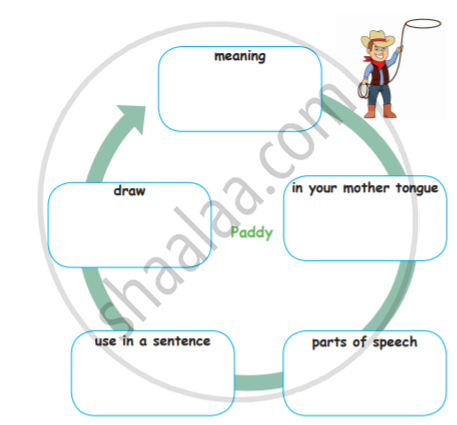
Paddy.

Meaning Rice in the husk is known as paddy.
In your mother tongue உங்கள் தாய்மொழியில்
parts of speech Nouch 
use in a sentence West Bengal is the largest producer of paddy in India.
draw 
shaalaa.com
Reading Skills
  Is there an error in this question or solution?
Chapter 2.3: The Farmer and his Daughters - Let us understand [Page 122]

APPEARS IN

Samacheer Kalvi English - Term 1 Class 5 TN Board
Chapter 2.3 The Farmer and his Daughters
Let us understand | Q D. | Page 122

RELATED QUESTIONS

B1. Complete the following statements:
(i) The poet is talking about............................. .
(ii) As a nation weare missing our .................................... .
(iii) Old people havekeys ........................... .
(iv) The elderly remember .......................... .

"Oh the value of the elderly! How could anyone not know? They hold so many keys, so many
things they can show.
We all will read the other side this I firmly believe.
And the elderly are closest oh what clues we could retrieve.
For their characters are closest to how we'll be on high.
They are the ones most developed, you can see it if you try.
They've let go of the frivolous and kept things that are dear.
The memories of so sweet, of loved ones that were near.
As a nation we are missing our greatest true resource,
To get to know our elders and let them guide our course."

B2 Express
State what the underlined words mean:
(i) Oh the value of the elderly! State the value ............. .
(ii) They are the ones most developed. 'They' stand for ............. .

B3: Match the words in Column A with their rhyming word in Column B:

Column A Column B
(i) Course (a) Show
(ii) Believe (b) resource
- (c) retrieve


Attempt the following in 150-200 words.

What was the incident of the Frost King? How did it affect Helen?


Read the text below and summarise it.

Green Sahara

The Great Desert Where Hippos Once Wallowed

The Sahara sets a standard for dry land. It’s the world’s largest desert. Relative humidity can drop into the low single digits. There are places where it rains only about once a century. There are people who reach the end of their lives without ever seeing water come from the sky.

Yet beneath the Sahara are vast aquifers of fresh water, enough liquid to fill a small sea. It is fossil water, a treasure laid down in prehistoric times, some of it possibly a million years old. Just 6,000 years ago, the Sahara was a much different place.

It was green. Prehistoric rock art in the Sahara shows something surprising: hippopotamuses, which need year-round water.

“We don’t have much evidence of a tropical paradise out there, but we had something perfectly liveable,” says Jennifer Smith, a geologist at Washington University in St Louis.

The green Sahara was the product of the migration of the paleo-monsoon. In the same way that ice ages come and go, so too do monsoons migrate north and south. The dynamics of earth’s motion are responsible. The tilt of the earth’s axis varies in a regular cycle — sometimes the planet is more tilted towards the sun, sometimes less so. The axis also wobbles like a spinning top. The date of the earth’s perihelion — its closest approach to the sun — varies in cycle as well.

At times when the Northern Hemisphere tilts sharply towards the sun and the planet makes its closest approach, the increased blast of sunlight during the north’s summer months can cause the African monsoon (which currently occurs between the Equator and roughly 17°N latitude) to shift to the north as it did 10,000 years ago, inundating North Africa.

Around 5,000 years ago the monsoon shifted dramatically southward again. The prehistoric inhabitants of the Sahara discovered that their relatively green surroundings were undergoing something worse than a drought (and perhaps they migrated towards the Nile Valley, where Egyptian culture began to flourish at around the same time).

“We’re learning, and only in recent years, that some climate changes in the past have been as rapid as anything underway today,” says Robert Giegengack, a University of Pennsylvania geologist.

As the land dried out and vegetation decreased, the soil lost its ability to hold water when it did rain. Fewer clouds formed from evaporation. When it rained, the water washed away and evaporated quickly. There was a kind of runaway drying effect. By 4,000 years ago the Sahara had become what it is today.

No one knows how human-driven climate change may alter the Sahara in the future. It’s something scientists can ponder while sipping bottled fossil water pumped from underground.

“It’s the best water in Egypt,” Giegengack said — clean, refreshing mineral water. If you want to drink something good, try the ancient buried treasure of the Sahara.

JOEL ACHENBACK
Staff Writer, Washington Post

Pick out dialogue of Tenali Raman that proves that he had the following quality.

 Wit and wisdom


Bassanio borrowed money from Shylock in Antonio’s name.


Make a time table of your daily routine

  1. On a school day
  2. On a holiday, and
  3. During examinations.

Start at the time you normally get up and list your activities
hourly: 7 am to 8 am, and so on.


Name the following.

Not comfortable with the wet ground.


Find out how the following game is played.

Badminton


List and say whether the following statement agrees with the passage or not.

You should always speak softly but clearly.


A sea turtle camouflages its nest by tossing sand on it to ______.


Share
Notifications

Englishहिंदीमराठी


      Forgot password?
Use app×