Advertisements
Advertisements
प्रश्न
Discuss the following statement in groups of two pairs, each pair in a group taking opposite points of view.
Why do you think Professor Gaitonde decided never to preside over meetings again?
Advertisements
उत्तर
Professor Gaitonde was experiencing a different version of the Battle of Panipat. According to this version, the Marathas emerged victorious in the Battle and started extending influence over the entire country. His mind was actually witnessing a different version of the historical reality. Interestingly, he was also witnessing an event that was not conforming to the conventions. The event was a lecture session on the outcomes of the Battle of Panipat. In this lecture session, Prof. Gaitonde observed that the chair of the President was vacant. This again was contrary to the conventions. Prof. Gaitonde rushed to occupy the chair and started explaining the need of a President in a lecture session like this. The public got angry at this point and started throwing objects on him. He had a harrowing experience. This led him to decide not to preside over meetings again.
APPEARS IN
संबंधित प्रश्न
Read the passage given below and answer the questions that follow:
The term dietary fibres refers collectively to indigestible carbohydrates present in plant foods. The importance of these dietary fibres came into the picture when it was observed that the people having diet rich in these fibres, had low incidence of coronary heart disease, irritable bowel syndrome, dental caries and gall stones.
The foodstuffs rich in these dietary fibres are cereals and grains, legumes, fruits with seeds, citrus fruits, carrots, cabbage, green leafy vegetables, apples, melons, peaches, pears etc.
These dietary fibres are not digested by the enzymes of the stomach and the small intestine whereas most of other carbohydrates like starch and sugar are digested and absorbed. The dietary fibres have the property of holding water and because of it, these get swollen and behave like a sponge as these pass through the gastrointestinal tract. The fibres add bulk to the diet and increase transit time in the gut. Some of these fibres may undergo fermentation in the colon.
In recent years, it has been considered essential to have some amount of fibres in the diet. Their beneficial effects lie in preventing coronary heart disease, and decreasing cholesterol level. The fibres like gums and pectin are reported to decrease postprandial (after meals) glucose level in blood. These types of dietary fibres are recommended for the management of certain types of diabetes. Recent studies have shown that the fenugreek (Methi) seeds, which contain 40 per cent gum, are effective in decreasing blood glucose and cholesterol levels as compared to other gum containing vegetables.
Some dietary fibres increase transit time and decrease the time of release of ingested food in colon. The diet having less fibres is associated with colon cancer and the dietary fibres may play a role in decreasing the risk of it.
The dietary fibres hold water so that stools are soft, bulky and readily eliminated. Therefore high fibre intake prevents or relieves constipation.
The fibres increase motility of the small intestine and the colon and by decreasing the transit time there is less time for exposure of the mucosa to harmful toxic substances. Therefore, there is a less desire to eat and the energy intake can be maintained within the range of requirement. This phenomenon helps in keeping a check on obesity. Another reason in helping to decrease obesity is that the high-fibre diets have somewhat lower coefficients of digestibility.
The dietary fibres may have some adverse effects on nutrition by binding some trace metals like calcium, magnesium, phosphorus, zinc and others and therefore preventing their proper absorption. This may pose a possibility of nutritional deficiency especially when diets contain marginal levels of mineral elements. This may become important constraints on increasing dietary fibres. It is suggested that an intake of 40 grams dietary fibres per day is desirable.
(Extracted from ‘The Tribune’)
(a) On the basis of your reading of the above passage make notes on it in points only, using recognizable abbreviations wherever necessary. Also suggest a suitable title. (5)
(b) Write a summary of the above in about 80 words. (3)
Answer any four of the following questions in 30-40 words each:
(a) How could the peddler enter the forge without being noticed by the blacksmith?
(b) At Champaran what did the British landlords want from the sharecroppers?
(c) How does the poet show the futility of Aunt Jennifer's efforts?
(d) Stephen Spender in his poem, 'An elementary School Classroom in a Slum' paints a dismal picture of poverty. Comment.
(e) How did Evans have the last laugh at the Governor?
(f) How did the General plan to get rid of the American POW?
Guess the meaning of the following word:
Drokba
In which language are these word found?
The story begins with a description of the setting. How does this serve as a fitting prelude to the events described in the story?
Nouveau riche and bourgeoise are French words. Collect from newspapers, magazines, and other sources some more French words or expressions that are commonly used in English.
What was the reason for young Paul's restlessness at the beginning of the story? How did it find expression?
Examine the communication channels in the story between Basset and Paul's uncle.
‘The Tale of Melon City’ has been narrated in a verse form. This is a unique style which lends extra charm to an ancient tale. Find similar examples in your language. Share them in the class.
'The author's treatment of the subject matter makes the readers identify themselves with the experience.' Comment on the statement.
The significance of reading an autobiography lies in drawing lessons from another life. What is the significance of Kumudini's account for us as readers?
Read the story and complete the following.
At first, Revathi’s plants did not look normal and healthy because, ____________.
The word 'report' means -
(a) Give a spoken or written account of something.
(b) Cover an event or subject as a journalist or reporter.
Make a list of archaic words from the poem and give their modern equivalents.
Sue and Johnsy were very close friends.
For preparing questions based on the poem, an overall understanding of the poem is a must. Discuss with your partner and prepare a set of five questions.
For example:
- What is the name of the bridge?
- ________________________________
- ________________________________
- ________________________________
- ________________________________
- ________________________________
Discuss with your partner the different ideas connoted by the word 'season'.
- _______________________
- _______________________
- _______________________
Say the following word aloud and put the stress mark on the stressed syllable.
crea-tures
Read the description of the Kabaddi match and do the following:
Write, in your own words, what happened in the second half.
Read the given words and share with your friend what comes to your mind.

Discuss in groups and think about it.
List a few occasions on which you had become angry. What do you do when you are angry?
Discuss in groups and think about it.
Mention three occasions on which you have made someone else angry. What made that person angry? Can you avoid such things in the future?
Choose the odd one out :
Bottom, Moth, Mustardseed, Cobweb.
Discuss the following question after you have seen a presentation of the ‘ad’.
Why does Didi say ‘No party for me!’?
Find four words ending with ‘-ous’ from the story.
Can you add three more words ending with ‘-ous’ to this list?
Read the following sentence aloud. Write who said it and to whom.
“What! ... how ! ... That’s impossible! ”
Gather information about your favourite great historical personality. You may use the internet. You may also gather photographs, pictures, etc. Prepare a collage using the pictures, inspirational quotes, and a brief description of the person’s importance. Hold an exhibition of your collages in the classroom.
Find one example of the following given below from the poem: Simile.
Answer in your own words.
Why does a mother tell Neel about his Grandpa?
From the poem, find the old word used for each of the following :
- towards
- here
- does
Who said the following, to whom, and when?
“He dwells within a cave of Himalaya.”
Listen carefully and guess how the sentence would end.
When the students saw the question paper, they were ______.
Listen carefully and write all the words correctly.
You are right. Write it down in the right-hand corner.
Does Marouckla get any of the things she brings?
Show the major events in the story of Pheidippides on a ‘time-line’.
Why did Mrs. Jhunjhunwalla buy the painting?
Based on your reading, rearrange the following sentences in the correct sequence.
- Since all her methods failed, finally she gave him a pain-killer.
- He told his aunt that Peter had no aunt, so he gave him the medicine.
- The pain-killer triggered adverse reactions on Peter.
- It jumped out of the open window.
- Tom was dull and depressed.
- This incident upset Aunt Polly and she questioned him.
- But, Tom gave that painkiller to the cat Peter.
- So, Aunt Polly tried different types of remedies on him.
What did the coach teach the child?
Read the sentences and number them in correct order.
|
1. He wished to have Gopal with him. |
|
|
2. Salim felt that it should come from within. |
|
| 3. He thought he wouldn’t be able to finish it. | |
| 4. The old man worked tirelessly on the sculpture. | |
| 5. He realized that Gopal must learn to carve the finer details. | |
| 6. He had a strong wish to finish it in time. | |
| 7. Over days, he felt very weak. |
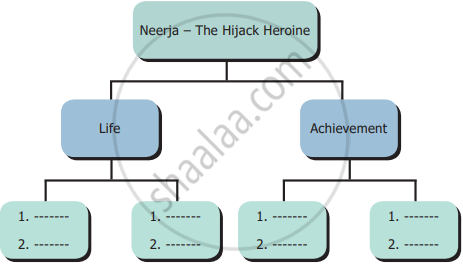
Read the “Story of Self Sacrifice and Bravery” once again and complete the flow chart.
The turtles use their flippers and make a hollow for their nests.
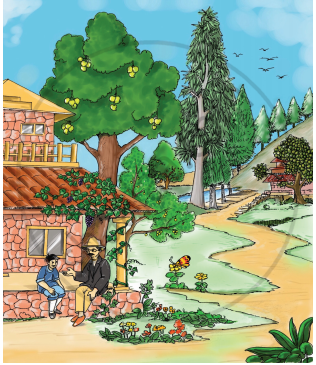
Listen to your teacher read the first part of the story. Many things described in the story can be seen in the picture. Find and name them.
Complete the sentence given below with word/phrase.
The hole became ______ and ______.
How should we treat everyone?
The robot that sat on her shoulder was a______.
The bird-catcher had a pigeon in his _______.
Identify the character or the speaker.
“Do not feel sad dear.”
Identify the character or the speaker.
“I will camp here for the night.”
Recite the poem ‘Mother Nature’.
How did he win the match?
Fill in the blank
He has bat ______ ball.
Why did Meena call the official 'Appa'? Do you think we need to be a family to care for others?
The kingdom was situated in the foothills of______.
Why did the greedy merchant get angry?
Mugund made______using the dry woods.
The child won’t ______ anything, if he closes his ears.
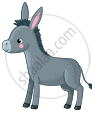
Match the animals with their sounds.
 |
bray |
 |
croak |
 |
bark |
 |
hum |
 |
neigh |
 |
mew |
Choose the right word.
Tansen was a famous ______.
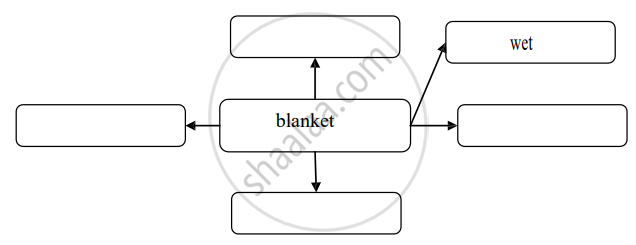
Write the related words as shown in the example.
Read the given sentence and underline the 'no' word.
Nobody is at home.
Write compound word using the pictures.
 |
+ |  |
| ____________ | ||
